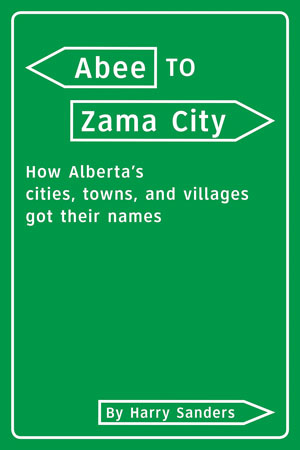
by Harry Sanders
SUMMERTHOUGHT PUBLISHING
2024/$24.95/288 pp.
I still remember fondly the intense negotiations that led to my ceding naming rights for subsequent children so that my eldest son would be James Alexander. It’s thrilling enough to give a name that will last one generation, so how much more thrilling must it be to name a new settlement that might, as so many early Albertans hoped, be the continent’s next Winnipeg, Pittsburgh or Chicago?
In the alphabetically titled (and organized) Abee to Zama City, historian extraordinaire Harry Sanders takes a look at how Alberta places got their names. This is far from the first book to cover the history of place names in Alberta—it isn’t even the first Sanders book of its kind—but as he points out, research on the subject has benefited greatly from the internet. You can now easily find out, for example, that stories about an Alberta hamlet being named after a place in Scotland must not be true if it turns out there is no such place. Sanders has a great reputation as a tireless diver into archives. His being able to supplement that research with more sources than ever before means that Abee to Zama City is likely to be the authoritative book on Alberta municipal toponymy for years to come.
But you probably want to hear some stories, right? Sanders has stories. Such as how Manning, near Grande Prairie, was named after Ernest Manning only because the name Aurora was already taken by a suburb of Toronto (the Post Office nixing suggested names is a persistent theme in the book). Or how Hussar, east of Calgary, was founded by German and Austrian military veterans, many actual hussars, just before the First World War (yes, the timing was not great, but the name stuck).
Along with the history of the naming of places, Sanders gives us a glimpse into the rising and falling fortunes of settlements in Alberta—time and again we see post offices giving rise to hamlets, which turn into villages and maybe even towns, before bad crop years, dwindling coal stocks or being bypassed by a railway line plummet yet another burgeoning prairie metropolis back to the lowly status of hamlet.
The book benefits greatly from its editorial apparatus—an index, an appendix categorizing all the place names in the book by type (descriptive, named after people, named after other places, etc.), and short informative articles on various topics (including the definitions of hamlet, village, town and city in Alberta). It will be a rare reader who, as I did, reads it cover to cover in a day, but regular dipping into this book will make you a source of amusement and enlightenment to your less historically minded friends and family—you might, as it were, make a name for yourself.
Alex Rettie is a long-time reviewer for Alberta Views.
_______________________________________