Nickle Galleries, University of Calgary,
curated by Michele Hardy and Christine Sowiak,
Oct 3–Dec 14, 2024
Nickle Galleries
“Solitude”
“Resilience”
Teresa Posyniak is a Calgary-based artist and activist who has been creating art for over 40 years, yet the full extent of her extraordinary practice was not understood until recently. It seems as if this 73-year-old artist was “discovered” in 2024. That June, her monumental painting “Grasslands Tapestry” was the showstopper among the hundreds of commissioned works in the new BMO Centre. A few months later the Nickle Galleries in Calgary presented Teresa Posyniak: Resilience, the most important exhibition of her long career. While not a retrospective, this exhibition was a curated selection of works demonstrating the major themes that have driven the artist’s work over four decades, primarily women’s issues and the environment.
What was striking to gallery visitors was the variety of styles, subjects and formats, ranging from a massive installation to paintings of great delicacy and intensity of feeling. Of note too was the number of media employed by the artist: steel, wood, concrete, handmade paper, felt and silk, as well as oil, acrylic, encaustic (hot wax) and cold wax. All of Posyniak’s works, in whatever material or format she uses, explore themes of vulnerability and resilience in her unique voice.
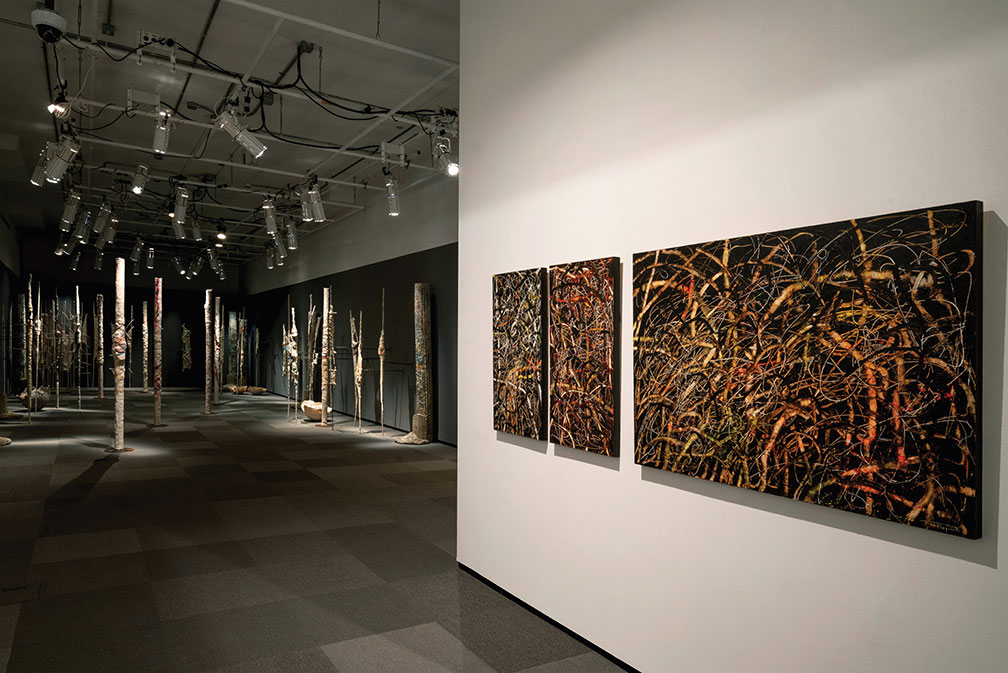
The exhibition was grounded by a dramatically lit installation entitled “Resilience,” set in a darkened gallery space evocative of ceremony and ritual. Its genesis can be traced to 1983, when Posyniak reacted viscerally to the sexual harassment she faced as a graduate student at the University of Calgary. Her response was to create a huge installation, effectively a metaphorical refuge she called “Sanctuary.” Over the years, elements harvested from “Sanctuary” were reused, remade and readapted in other works. One work of art begat another.
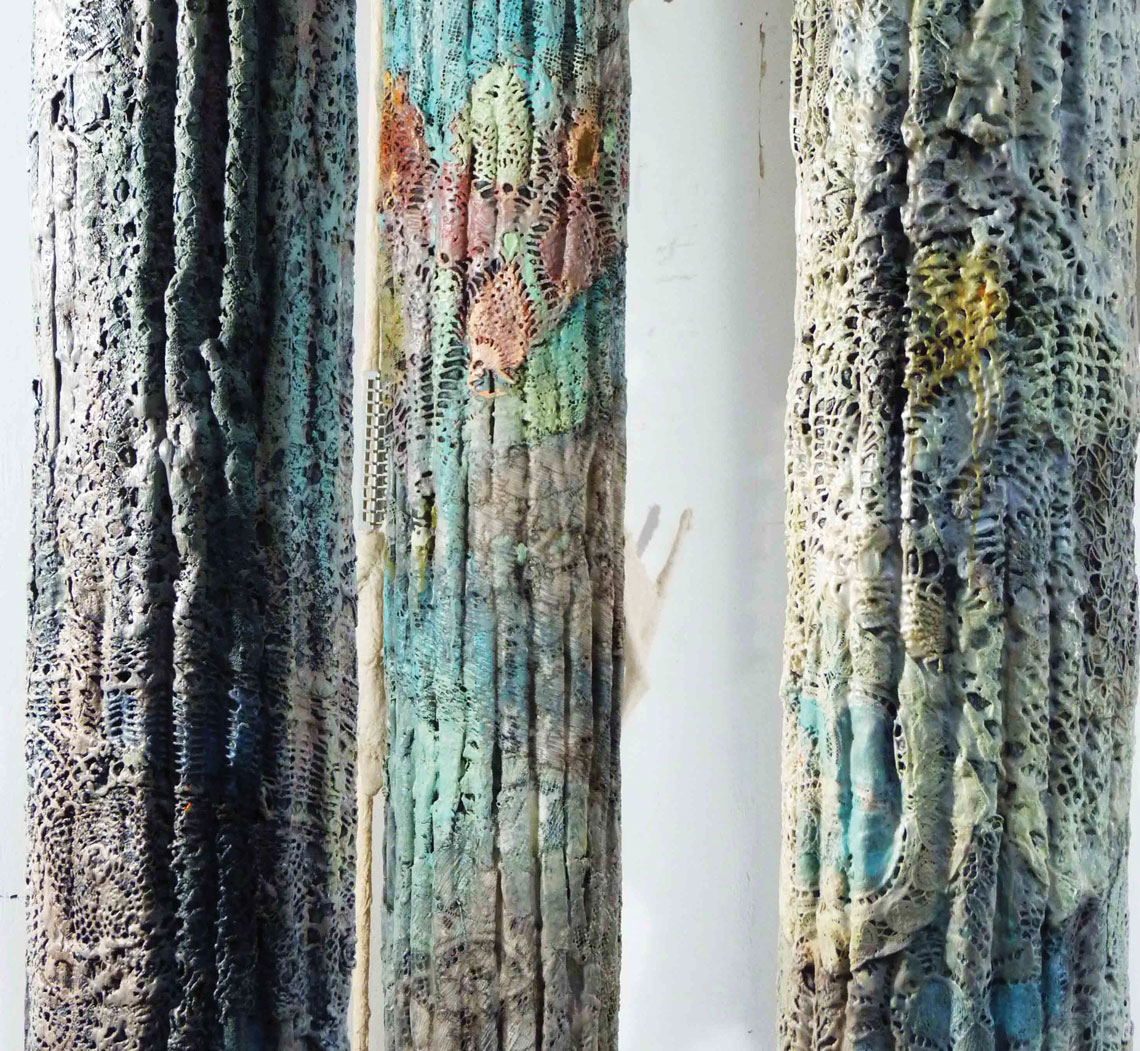
“Resilience” was the most recent iteration, comprised of fluted columns and strangely anthropomorphic vertical sculptures, like sentinels. In the gallery an altar-like frieze of splayed uprights silently beckoned. Although its parts are recycled from earlier works, every unique vertical bundle was a new entity. Several of the sculptures resonated with echoes of the artist’s heritage and childhood. Collaged doilies, crocheted fabrics and lace were sealed into their skins by coats of hot wax and painted with oil and cold wax. Layers of overlapping bindings both concealed and revealed, as apertures exposed open wounds while tightly bound surfaces restrained tension.
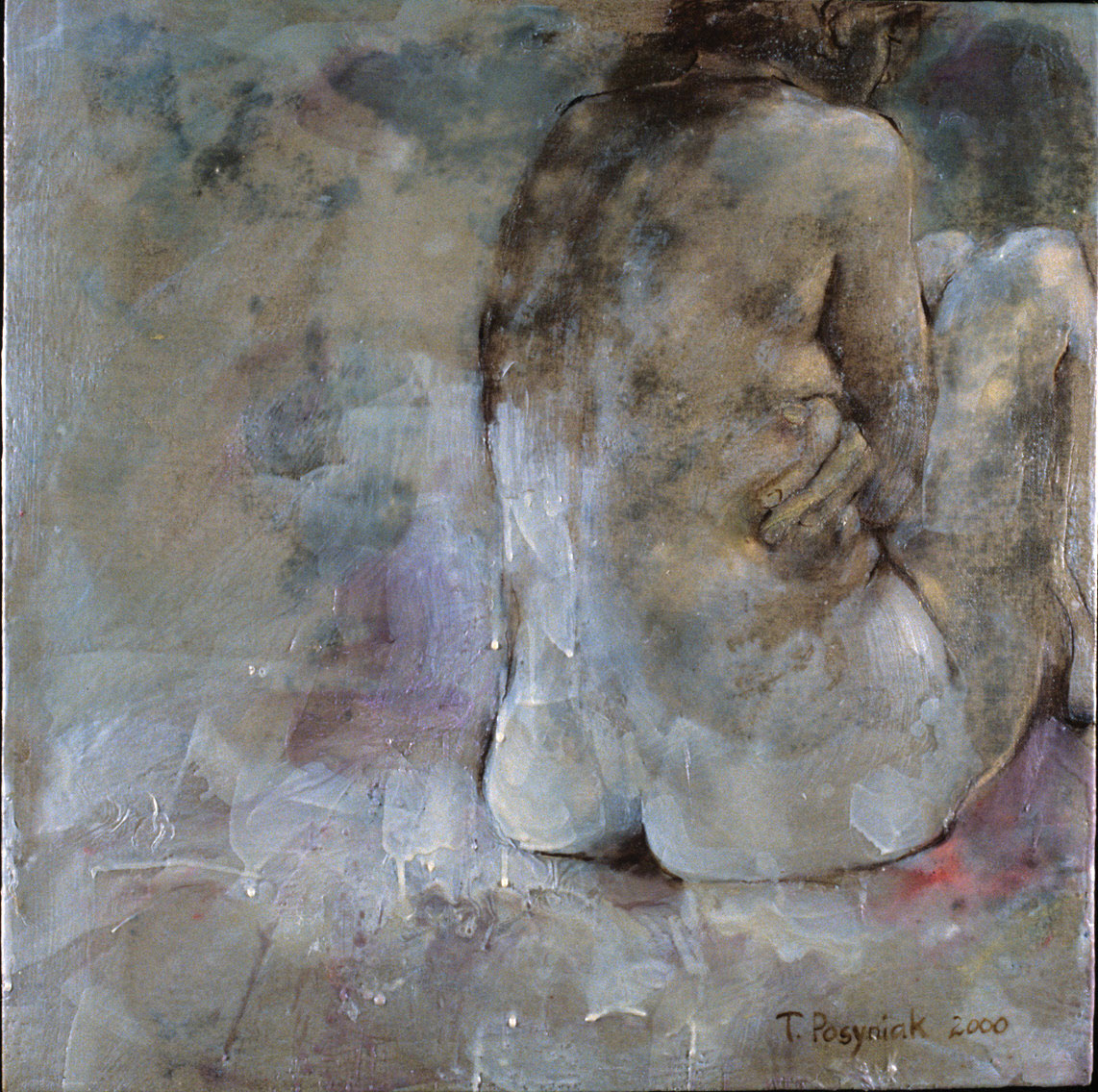
The artist’s focus on women and increasingly on motherhood continued as she transitioned to painting through the 1980s. Posyniak created haunting figurative works in which female nudes occupy indeterminate, unsettling spaces. In many works, an isolated woman reveals her pain and desperation through the bundle she clutches. When Posyniak became pregnant in 1986, she was overjoyed but also afraid. She expressed her feelings in powerful abstract paintings, such as the monumental triptych “Annunciation,” in which a sense of vitality and growth is conveyed through movement in sweeping lines, flowing shapes and high contrast. Here, the beginnings of life are intuited, expressed in fluid visual metaphors drawn in sinuous, overlapping and intertwined shapes.
In her art Posyniak strives to portray an interconnectedness between all life forms. Through a series undertaken over the past 15 years, represented in this exhibition by two stylistically different paintings, she explores the structure, shape and significance of microscopic plankton, which supply half of the world’s oxygen through photosynthesis and are under threat from climate change. In Posyniak’s hands, scientific fact is transmuted into a world of mystery and wonder. The exhibition included paintings that reflect not just the beauty of the patterns in nature but also its vulnerability. A case in point are her textured and coloured paintings that deal with the violence wrought by the mountain pine beetle on the ponderosa pine, an ecological disaster exacerbated by a warming planet.
____________________________________________