The longest conversation I ever had with the late Sharon Pollock was in 2005, during my last semester of a bachelor of fine arts at the University of Lethbridge. As part of an independent study, I was writing an essay about how to get started as a playwright, interviewing a handful of Canadian playwrights to get their advice. When Sharon agreed over email to speak with me, I was elated. I had by then read some of her many plays—Blood Relations, Saucy Jack and Doc—seen one performed, and admired her work very much. But I was also nervous. The person who gave me Sharon’s contact information had warned me she could be “prickly.” I didn’t know what “prickly” meant and didn’t know what to expect.
Fortunately, on the phone from Calgary, Sharon was anything but “prickly.” She was warm and friendly and full of laughter. And her guidance to me was solid. She said aspiring playwrights should try to get as much life experience in and out of theatre as they could, in part because that would inform their writing, but also because that’s simply a recipe for living an interesting life. As for playwriting, she was blunt: the profession is frequently challenging and enormously frustrating, even for her. “I don’t mean to be discouraging, but I really don’t have a lot of positive things to say,” she said. And then she laughed.
We spoke for close to an hour, much longer than I had intended. This from one of Canada’s most widely produced playwrights, a two-time winner of the Governor General’s Literary Award and a three-time winner of the Gwen Pharis Ringwood Drama Award. Back then I didn’t think someone of her stature would have much time for a young, inexperienced person like me. But as I learned later, when it came to young writers and artists, Sharon could be generous with her time, mentoring and supporting them however she could. That mentorship was a part of her devotion to theatre as a whole. In a comprehensive biography, Sherrill Grace writes that Sharon had experience doing just about any job you could think of in a theatre, from acting to being the artistic director to running the box office. When I asked Sharon why she was a playwright, she said it’s because theatre lives and breathes in the same space as the audience.
Her road to a life in theatre was a rocky one. Mary Sharon Chalmers was born in 1936 in Fredericton, New Brunswick. Her father was a hard-working and respected physician, while her mother was a former nurse who left the profession to raise a family. Life at home was far from idyllic. Her father’s absence and persistent infidelity caused deep marital strain, and her mother’s unhappiness as a housewife led her to alcoholism and increasingly erratic behaviour, and she ultimately died by suicide. It all left Sharon with profound emotional scars.
While attending the University of New Brunswick, Sharon met Ross Pollock. The two married quickly and moved to Toronto, where she became a housewife and mother. But Ross was physically and emotionally abusive, to the point that Sharon’s misery led to a moment of desperation when she unsuccessfully tried to poison him.
Amid her demanding life as a mother, Sharon began attending plays and eventually joined an amateur theatre group. Ross disapproved. After a particularly violent incident, she fled back to Fredericton with their five children. She got involved with another theatre group and soon began a relationship with a fellow actor, Michael Ball. When he was offered a position in the drama department at the University of Calgary, Sharon moved west with him. In Calgary she toured with the Prairie Players through small-town British Columbia and Alberta, earning accolades including best actress at the Dominion Drama Festival.
Her road to theatre was rocky…. She tried to poison her disapproving husband.
While pregnant with her sixth child, Sharon wrote her first play for the stage. A Compulsory Option won the 1971 Alberta Playwriting Competition and was produced the following year. Her next work, Walsh, about the relationship between a North-West Mounted Police officer and the Sioux chief Sitting Bull, premiered at Theatre Calgary in 1973 and was subsequently produced at the Stratford Festival. Walsh brought Sharon wide public attention and more productions, and by the time she was 38, she had begun a promising career as a playwright. She started to write plays in part out of frustration with not seeing Canadian stories on the stage. “I wanted other actors to stand up and say my words,” she said, “to speak directly through an experience I shared with those other Albertans and Canadians.”
Walsh was an important development in Sharon’s career. It demonstrates her storytelling gifts—a reviewer in the Ottawa Citizen said Walsh had “that indefinable magic that is the essence of the art” of theatre—and reveals her strong inclination to write about historical injustices.
But I didn’t read Walsh until just after I had finished my degree, and by then it would only affirm my deep admiration for her as a playwright. It was Blood Relations that first exposed me to Sharon’s work, when the University of Lethbridge drama department produced the play for its mainstage season in 2003. The two plays had different impacts on me in my early twenties, but when I reread the two scripts at 41, I noticed both are about individuals caught in oppressive social and political systems. In the case of Walsh, we get a glimpse into the Canadian bureaucracy that was seemingly designed to inflict hardship on Indigenous people, with NWMP colonel James Walsh being a captive and reluctant agent of this bureaucracy, and into the Sioux people, led by Sitting Bull, being forced to return to the United States from which they had fled. “Honour, truth… the lot… they’re just words,” says Walsh in the play. “I gave my life to them, and they don’t exist.”
On the other hand, Blood Relations examines how the repressive roles imposed on women cause the protagonist to lash out in a horrifying way. The play is about Lizzie Borden and the circumstances leading up to the 1892 axe murders of her father and stepmother, of which she was accused and acquitted. Though the story may seem far removed from Sharon’s experience, she felt a personal connection to Lizzie’s case. “Prior to working in the theatre,” she wrote, in the afterword to the Methuen edition of the play, “I was married for some years to a violent man. I spent a great deal of time devising, quite literally, murderous schemes to rid me of him…. I would have killed to maintain my sense of self…. And so it is with Lizzie.” In Blood Relations, Sharon was less concerned about whether Borden committed the murders and more interested in why she might have done it.
I saw the play well over a decade before the #MeToo movement and, at 20, my comprehension of feminist issues was juvenile. Yet even someone as oblivious as I was could see that Blood Relations was about how accepted social conventions restrain women. Lizzie is trapped in a strict Victorian family that suppresses her personal ambitions and independence. She’s pressured to spend time with a suitor she despises. She watches helplessly as her father signs title to the family farm she loves over to the stepmother she hates. She’s refused the opportunity to get a job to attain her own independence, and her father refuses her the money to live on her own. Her stepmother tells her she has no rights. Later, when Lizzie protests too much, her father butchers her beloved pet birds.
But the play doesn’t just catalogue the ways women have historically faced limited prospects for freedom and were punished for seeking autonomy. When I saw the play, what stood out to me was its moral ambiguity. Lizzie’s violence can be seen as an act of defiance against subjugation, making her character and her actions morally complex. The crime was heinous, no question. But at the same time, it was clear to me that Lizzie’s legal options were limited, that she had been backed into a corner, and under that extreme duress she became desperate and reckless, lashing out at the people who had pushed her too far. Sharon didn’t offer a safe separation between guilt or innocence, instead confronting her audience with serious ethical questions about violence as a reaction against oppression.
I had never seen a play like Blood Relations. At that time in my life, I was only studying drama in university as a stopgap toward going to film school, with no plans to finish my degree or take up theatre as an artistic practice. The production of Blood Relations didn’t single-handedly change that, but it did open my eyes to how the stage could tell a deeply layered story as rich as anything I’d seen on film.
In Blood Relations Sharon was more interested in why Lizzie might have done it.
It wasn’t just the thematic elements of the play that struck me, but also the way in which Sharon told the story. The action that unfolded before me wasn’t a linear, by-the-facts murder mystery, but a twisting and turning play-within-a-play that introduced me to a new level of theatricality. In the play, as the stage lights come up in the theatre, an Actress character is standing centre stage in an upper class Victorian room, reciting Hermione’s lines from Act 3, Scene 2 of The Winter’s Tale:
Since what I am to say must be but that
Which contradicts my accusation, and
The testimony on my part no other
But what comes from myself, it shall scarce boot me
To say “Not Guilty.”…
Lizzie Borden then enters and, after a brief exchange with the Actress, the two of them decide to have some fun by acting out the events leading up to the infamous crime. I watched the Actress don Lizzie’s costume to play Lizzie Borden, while Lizzie herself put on a costume fit for an observer servant. From there, the action seemed to go back in time as characters from the past entered the stage to re-enact what happened.
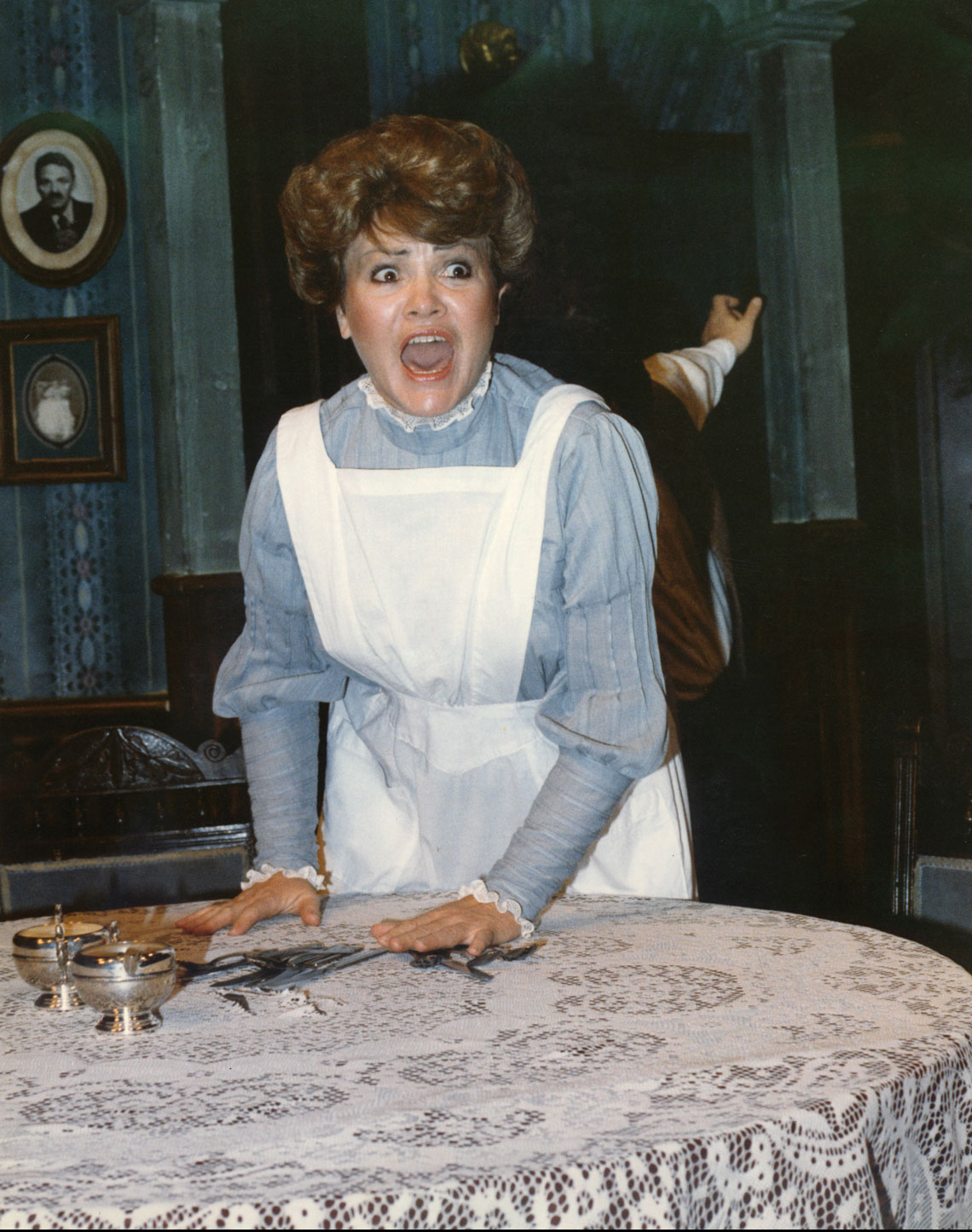
Pollock performing in Blood Relations at Theatre Calgary in 1981. Her play is based on the true story of an unsolved double-murder in 1892
This play-within-a-play device jolted me out of my passive observance. What was this extra layer of psychological and temporal complexity being thrown at me? Of these two women, who was the real Lizzie Borden? Why include this role-playing at all? Why not simply tell the story in a simple, straightforward fashion? But of course, I embodied the answer to this latter question: I leaned forward in my seat and paid close attention, piecing the action together in my own way, while the audience around me was likely doing the same. What might have been a chronological, facts-of-the-crime murder mystery became something more engaging and thought-provoking, pulling the audience into more-active scrutiny of the unfolding drama. The play-within-a-play device pushes Blood Relations deeper into the realm of theatricality and imagination, lending itself well to different readings and varying interpretations, raising questions about identity, memory and truth, and ultimately making the whole experience more subtle and artful.
Two moments from the play remain as vivid to me now as they did then. The first occurs late in the play, when Andrew Borden lies napping on the couch, and the Actress, playing Lizzie, hums a soothing tune as she approaches him, carrying a hatchet. Standing over him, she raises the axe, and just before she swings it down, the lights in the theatre go out. In the darkness the voices of monstrous children sing the now infamous skipping rope rhyme:
Lizzie Borden took an axe
And gave her mother forty whacks
And when she saw what she had done
She gave her father forty-one
The second memorable moment happens at the play’s end. After a confrontation with her sister, Emma, during which Lizzie grips the hatchet, the question of whether Lizzie committed the crime comes up.
Emma: You didn’t… did you?
Miss Lizzie: Poor Emma.
The Actress: Lizzie. [She takes the hatchet from Miss Lizzie.]Lizzie, you did.
Miss Lizzie: I didn’t. [She smiles.] You did. [The Actress looks to the hatchet, then to the audience.]
[Blackout.]

From left to right: Sharon Pollock’s play Walsh, about Sitting Bull’s exile in Canada after the massacre at Little Bighorn, Talonbooks, 1973; Blood Relations, NeWest Press, 1981; Doc, Broadview, 1985; Saucy Jack, about Jack the Ripper, published in 1994 by Blizzard.
Sharon revealed a different kind of theatricality with her 1984 play Doc. This was one of the few plays I read as an undergraduate that really lit a fire under me to write for the stage. Ironically, when I first read it, I was oblivious to how autobiographical the play is to Sharon. Doc draws heavily on her family history growing up in Fredericton, with characters who are extensions of her overworked physician father, her despairing and alcoholic mother and the playwright herself.
In an interview with Canadian Journalist, Sharon said every play she writes “begins as an attempt to understand the world around me. I make up a story in which I can control the elements and the motivation of the characters. I create a little world which I know has meaning and makes sense. When I’m finished doing that, I’m better able to cope with what began as something incomprehensible to me.” So it seems she wrote Doc to clarify her thoughts and feelings surrounding her family’s troubled history, believing theatre can process, explore and make sense of complex personal relationships.
When I first read the script, it showed me that an intense family conflict can also be highly theatrical. Rather than presenting a linear, kitchen-sink drama, Doc is a memory play where the action shifts across time, with characters living and dead occupying the same space. The aged doctor and his estranged daughter Catherine reunite and try to make sense of their dark past, their conflicting memories playing out against one another. Temporal barriers are broken down, with characters from different time periods addressing one another, creating an elaborate and fluid interrogation of the past. In Doc, Catherine and Katie are the same person played by different actors at different stages of life, yet they speak to each other, each trying to come to grips with events in their own way. And all of it written with dialogue that avoids tedious melodrama and instead presents five humans with their own psychologically complex voices.
She wrote Doc to clarify her thoughts and feelings about her family’s troubled history.
In one scene, Ev, a worn-out doctor, stands isolated onstage while his wife, Bob, watches from the shadows.
Ev: We had the worst goddamn polio epidemic this province has seen, 11 years ago. We had an outbreak this year. You are lookin’ at the attending physician at the present Polio Clinic—it is a building that has been condemned by the Provincial Fire Marshal, it has been condemned by the Provincial Health Officer, it has been condemned by the Victoria Public Hospital, it’s infested with cockroaches, it’s overrun by rats, it’s the worst goddamn public building in this province! When is the government gonna stop building liquor stores and give the doctors of this province a chance to save a few fuckin’ lives!
Bob: Haven’t you got enough?
Ev: Enough what?
Bob: Enough! Enough everything!
Ev: You’re drunk.
As personal as Doc is to Sharon, this passage reflects how relevant it is to the rest of us. We are living in a time in Alberta when doctors and nurses are similarly burning out from overwork and the healthcare system is in crisis. Such is the power of Sharon’s craft, transforming the deeply personal into the universal, the private into the public.

Nicole Garies as Lizzy Borden in the University of Regina theatre department’s production of Blood Relations, November 2018. U of R Photography
Sharon continued working as a performer off and on throughout her career. In 2011 she was in rehearsals for Verb Theatre’s production of Marg Szkaluba (Pissy’s Wife), a one-woman show about a survivor of domestic violence. One day, the show’s director, my friend Jamie Dunsdon, emailed me to ask if I would come to the last week of rehearsals and be on book for Sharon, following along in the script and providing her with her line if she forgot.
I attended the rehearsals, watched Sharon work like a pro, and only had to cue her lines a few times. On opening night, I watched her onstage at the Ironwood in Inglewood, where she embodied blue-collar Marg Szkaluba’s fiery wit and defiance with passion and humour. After the show I was invited to join the creative team for drinks. There we were, a handful of eager artists in our mid-twenties having a beer with a 75-year-old woman who happened to be one of Canada’s most accomplished playwrights—youthful ambition and seasoned mastery converging over a shared passion for theatre.
That was Sharon for you. Despite her stature and achievements, she remained grounded and approachable, and shared her knowledge and experience in a way that nurtured the next generation of artists. Theatre was much more to her than a mere job or a pleasant pastime. It was central to her identity and sense of purpose. She devoted her life to it as a performer and as an administrator and, most importantly, as a playwright who gave voice to Canadian stories and sensibilities at a time when such things were almost entirely absent from our stages. Yes, she could be blunt, perhaps by some estimations even prickly, but she was always striving for excellence in craftsmanship, and she did so with great respect and generosity.
Since 2021 Sharon Pollock is no longer with us. For people who didn’t know her as a close friend or as family, all we have left are her plays and our memories of having seen them. For me, Sharon will always be the one who transformed how I conceive of theatre—this art form that lives and breathes with its audience. Every time I go to a play, I hope to be captivated the way Sharon’s plays captivated me, that there may be moments as brilliant as the ones I witnessed in Blood Relations, that the experience might light a fire under me the way Doc did. When the show is about to start, my anticipation goes up as the lights in the theatre go down.
Andrew Torry is a playwright in Calgary. His work has been shortlisted for the Gwen Pharis Ringwood Award for Drama.
____________________________________________