As they waded into the North Saskatchewan River, the researchers joked that they wished they were wearing concrete lifejackets. Applied chemist Jeremiah Bryksa and Northern Alberta Institute of Technology (NAIT) students were sampling the river flowing through Edmonton for microplastics. In 2020 it was one of the first times this had been done and there was no standardized method for collecting such samples from freshwater. They wanted to establish that method. And they expected to find what they were looking for.
Plastics are everywhere. Microplastics—tiny particles of plastic less than five millimetres long—have been found near the top of Mount Everest. A deep-sea submersible descended to the deepest point in the oceans, in the Mariana Trench, and found a plastic bag. Scientists found phthalates—chemicals used to increase the flexibility of some plastics—embedded in the skin of ants in remote parts of the Amazon rainforest. In Antarctica, an icy, unpopulated continent, 97 per cent of birds were found to have ingested microplastics—primarily common plastics such as polyethylene, polypropylene and polystyrene. Microplastics were similarly found in the blood of 77 per cent of people tested by scientists in the Netherlands. So, it would be no surprise to find such particles in the North Saskatchewan River.
But getting a clean sample wasn’t easy. To avoid polluting 1,500-litre samples of river water, the researchers designed and built a pump out of stainless steel, with no plastic at all. Then they worried about other things that contain and shed tiny bits of plastic, such as their clothes and lifejackets. “When we started sampling,” said Bryksa, “we would have to stand downriver [from the pump] because that lifejacket is contaminating the sample.” Studying plastic pollution would be easier, they joked, if their lifejackets were made of concrete.
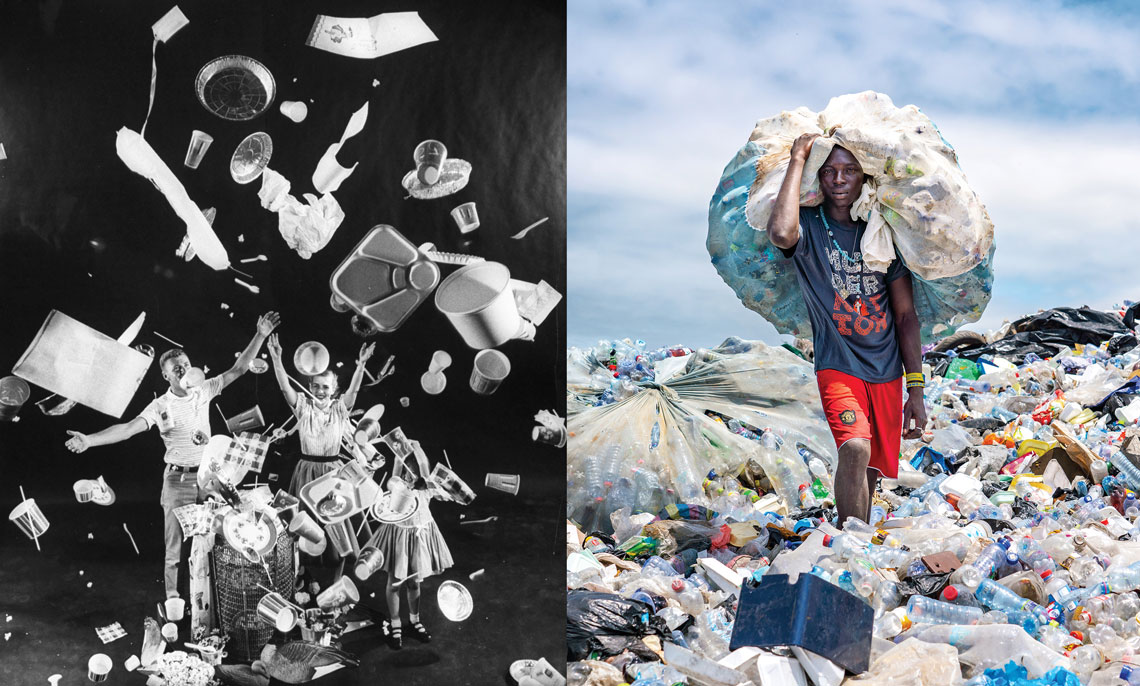
Left: In August 1955 a LIFE magazine article ran with the then-celebratory but now vaguely sinister title “Throwaway Living.”
Right: Kwabena Akese, Accra, Ghana, 2020. In Canada only 9–12 per cent of plastics are recycled. Most of the rest goes to landfills.
Unless you were born before 1907, when the first synthetic plastic was invented, everyone alive today has been born and raised in the age of plastic. Forget the generational divides—Boomers, Gen X, Millennials, Gen Z, Gen Alpha—we’re all part of the same era, an age marked by the increasing abundance of often useful and convenient plastic stuff and the growing amount of plastic waste found everywhere on earth.
The scale of plastic production today is mind-boggling. In 1950 all countries around the globe together produced 1.5 million tonnes of the stuff. In 2025, globally, over 500 million tonnes of new “virgin” plastics are now created every year. Much of it is disposable—50 per cent of virgin plastic is turned into single-use items meant to be thrown away—and little of it is recycled. In Canada, depending on who’s making the calculations, only 9 to 12 per cent of plastics are recycled. Of the rest, the vast majority of the over three million tonnes a year that’s tossed out goes to landfills. Some 4 per cent is burned in incinerators and 1 per cent of plastic in Canada is lost into the environment as litter.
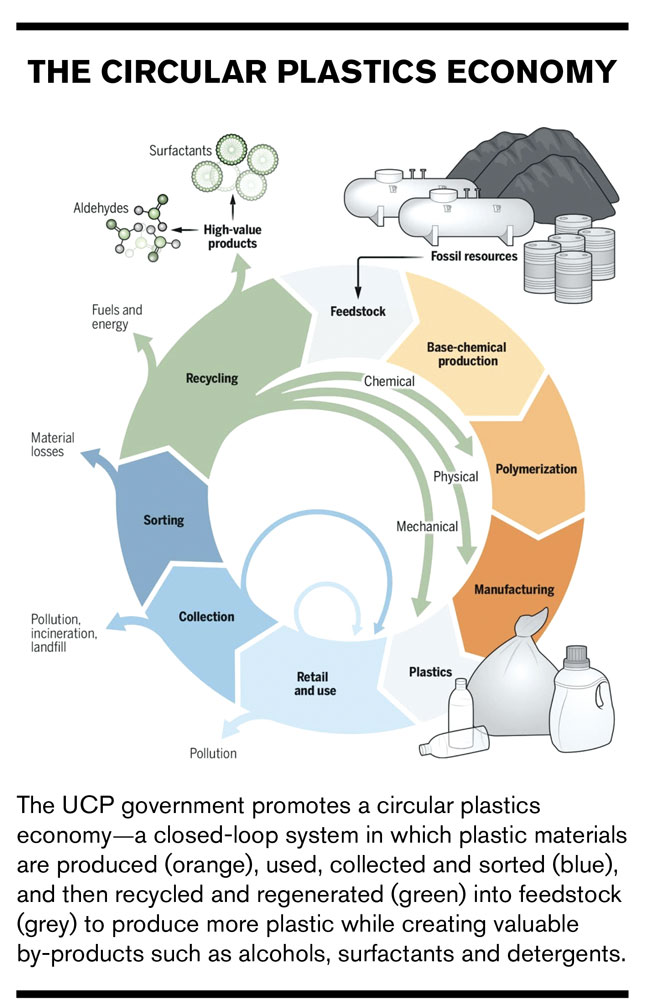
Figuring out how to keep the good things about plastic while limiting the downsides is one of the great conundrums of our time. In Alberta a variety of organizations think they have a solution to that problem. These groups range from the government of Alberta to recycling and chemical industry associations to NAIT polytechnic—where the sampling for microplastics study is part of a 10-year, $10-million program called Plastics Research in Action (PRIA). The NAIT program—funded by energy company Inter Pipeline—began in 2020, according to informational material, “with a single focus: finding ways for society to reuse and recycle plastic waste as valuable commodities. In short, PRIA is on a mission to build a sustainable circular economy.” The Alberta government has a similar goal in its “Natural Gas Vision and Strategy,” released in 2020, promoting a “plastics circular economy,” which they define as “when the full value of a plastic product is used across multiple lifecycles, not just used once and then discarded.”
Alberta’s plan is to reduce plastic waste while growing the plastics industry. “The future is bright, and it is circular,” said Leduc-Beaumont MLA Brandon Lunty (UCP) at the start of the third annual Alberta Circular Plastics Day at NAIT in March 2025. It sounds laudable. But you might ask: to what extent is a plastics circular economy for real?
Undeniably plastic has benefits. “This looks promising,” wrote Leo Baekeland, with prophetic understatement in his laboratory notebook after inventing the first synthetic plastic in 1907. His product—Bakelite—could be heated and moulded into various shapes such as radios, telephones, toys and other mass-produced goods. Its inventor made a fortune. But Bakelite had flaws. Made from chemical compounds teased from wood alcohol and coal tar, it was brittle and couldn’t absorb bright colours. New varieties of plastics were soon invented, and today 99 per cent of plastics are derived from oil and gas, including hydrocarbons such as ethane and propane.
The plan for our “circular economy” is to reduce plastic waste while growing the plastics industry.
In simple terms, “plastic”—from the Greek plastikos, meaning mouldable—is a synthetic polymer. A polymer is a chain of molecules—hence the “poly” (“many”) in long tongue-tripping names such as polyethylene and polypropylene. Plastics can be hard or flexible, depending on chemical structure and additives. But in its various forms, plastic is lightweight, durable and insoluble. It’s also relatively cheap to make in large volumes.
That’s handy for all kinds of products. Bottles, bags and clingwrap, for instance, are made from polyethylene. So too is the most common type of polyester. Coffee pods, straws and microwavable dishes are made from polypropylene. Cutlery and take-out cup lids can be made of polystyrene. Most vinyl siding on houses is polyvinyl chloride. The list of products that contain plastic today is almost endless. Bike helmets. Cell phones. Seatbelts, airbags and dashboards in automobiles. Medical equipment is now mostly made of plastic, not least because it’s hypoallergenic and it’s easier—think syringes—to ensure the sterility of a single-use product in a hospital.
Proponents of plastic can be extravagant in their praise. “In many instances, plastics are the solution to the climate change problem,” said Bob Masterson, president and CEO of Chemistry Industry Association Canada, to a committee of MPs in 2019. “That includes lightweight, high-strength plastic composites in the automotive sector, improved insulation in the building sector, enormous quantities of plastic resins that are vital to the production of renewable energy from wind turbines and solar panels, as well as the very important role of plastic packaging in reducing food waste.” The shelf life of zucchini, the MPs were told—with a helpful info sheet from the Flexible Packaging Association—is extended from one day to five days when stored in plastic packaging. Ground beef is extended from three days to 20. Grapes allegedly remain edible for 70 days instead of seven.
Plastics also benefit the economy. In 2020 Alberta’s petrochemical sector was valued at $12-billion. That’s but a portion of the $35-billion the sector generates in Canada as a whole and a tiny sliver of the US$712-billion global plastics market. Alberta has vast supplies of oil and gas—including ethane and propane—and global demand for plastics is growing. According to the International Energy Agency, “petrochemicals are set to account for more than a third of the growth in world oil demand to 2030, and nearly half the growth to 2050.” Given this economic projection, the provincial government wants to produce more plastic in Alberta. Goal number one in the “Natural Gas Vision and Strategy,” for instance, is “for Alberta to become a global top 10 producer of petrochemicals” and “to grow this sector by more than $30-billion by 2030.”
Government subsidies, under both the NDP and the UCP, have boosted the sector toward that goal. In 2019 the federal Liberal government gave $49-million to Inter Pipeline to both “invest in efforts to reduce plastic waste” and to build a polypropylene plant—the first in Canada—just northeast of Edmonton. In 2021 the province, through the Alberta Petrochemical Incentive Program (APIP), granted $408-million to Inter Pipeline to help build the Heartland Petrochemical Complex. Completed in 2023, that $4.3-billion plant now turns Alberta propane into 525,000 tonnes of pea-sized plastic pellets a year—mostly for export to the US.
Similarly, the APIP is granting about $1.8-billion to Dow Chemical’s Path2Zero project near Fort Saskatchewan. Construction began in 2024 on the plant, which will turn ethane into plastic polyethylene pellets for export, primarily to Asia. It’s the first such facility to be considered “net zero,” in part because it will burn hydrogen and bury CO2 nearby—reducing emissions lower than if it were built without those elements. The federal government is giving the “green plastic” project $400-million in investment tax credits. In late November 2023 premier Danielle Smith and then-federal finance minister Chrystia Freeland stood together in Alberta’s Industrial Heartland to announce that the $11.6-billion project had official approval to be built. “This project is the embodiment of the future of Canada,” said Freeland, “which is we have a growing economy, we have more great-paying jobs, and at the same time we’re reducing pollution.”
To date, the history of dealing with plastic waste has largely been a tale of failure. The latest flop was in December 2024 when about 175 UN countries held talks in South Korea to establish a legally binding global treaty to cut plastic pollution. It ended without an agreement.
It’s not as if the stakes were unknown. Plastic doesn’t dissolve. That’s great for storing water in bottles, for instance, but not ideal if you factor in that plastic bottles take somewhere between 400 and 1,000 years to fully break down. Some one million plastic bottles are bought every minute on earth. Add in other kinds of plastic, and it’s estimated that a truckload of insoluble plastic escapes into the environment every minute—much of it into the ocean, most famously in the “Great Pacific Garbage Patch,” which includes 1.8 trillion pieces of plastic floating in an ocean area twice the size of Texas. But plastic also breaks down locally into minuscule pieces. “It is widely agreed upon that smaller particles can enter the bloodstream and organs more easily than bigger particles,” says a 2022 article in the Journal of Hazardous Materials Letters.
The potential health risks are reason for caution. “Plastics are made out of the combination of thousands of chemicals,” said Patricia Villarrubia-Gómez, the lead author of a research article on plastic pollution released prior to the treaty talks in Korea. “Many of them, such as endocrine disruptors and forever chemicals, pose toxicity and harm to ecosystems and human health.” That alarm was echoed in an Environment and Climate Change Canada news release, also just before the talks: “The scale of this problem has reached a boiling point that requires urgent action,” said the feds, “with plastic pollution projected to grow by 2.5 times by 2040.”
In Canada the urgency around plastic waste had grown since January 1, 2018, when China stopped importing almost all used plastics for recycling. Previously Canada had exported most recyclable plastic—including what’s thrown in blue bins—to China and other Asian countries. The cost of dealing with all that waste hit fast. In 2019 the City of Calgary, for instance, spent $330,000 to store 2,000 tonnes of plastic clamshells, hoping to find a way to recycle them, then eventually dumped them—about 92 semi-trailer loads—into the landfill.
Alberta and the federal government soon fought over how to deal with plastic waste. Both sides, curiously, drew inspiration from the same document. That 2019 report by Deloitte, which the feds had commissioned, pointed out that in Canada we overwhelmingly produce, buy and use virgin plastics that are thrown away with little recycling. But plastic waste, said Deloitte, is “a lost opportunity.” If Canada recycled 90 per cent of plastics—moving from a “linear” to a “zero plastic waste” economy—the benefits could include thousands of new jobs and lower greenhouse gas emissions. It wouldn’t be easy—under the status quo only 25 per cent of discarded plastic is collected for recycling. Most plastic packaging, textiles, auto parts and electrical and electronic equipment end up as waste. But with better waste collection, bigger recycling plants, new incentives and innovation, the ambitious promise could be realized. Alberta and the feds agreed on the gist of all that. But on one point they sharply diverged.
In 2019 an all-party committee of MPs, convened after the Deloitte report, recommended “that the federal government commit to banning single-use plastic products—such as straws, bags, cutlery, cups, cigarette filters and polystyrene packaging.” The feds subsequently banned some of those single-use items such as plastic straws and plastic grocery bags. In response, a consortium of plastics companies, including Dow Chemical and Calgary’s Nova Chemicals, sued the feds. Alberta was an intervener in the case in support of the petrochemical companies. In 2023 the Federal Court of Canada ruled that the federal government’s labelling of some plastics as a “toxic substance” was jurisdictional overreach. The feds appealed, and the Single-Use Plastics Prohibition Regulations remain in force while the appeal is in court.
Constitutional matters aside, the fight comes down to one question: Should there be limits on plastic production? The UCP government says no. A ban on plastics would be a “serious threat” to the petrochemical industry, said then-premier Jason Kenney in 2022. Environment minister Rebecca Schulz added to that dissent in April 2024. “The federal government would be better served by taking a page out of Alberta’s plan, which diverts plastics from landfills and turns used plastics into new products,” she said. “This is the promise of Alberta’s plan to create a plastics circular economy, a modern miracle in which, through chemistry, we can have all of life’s conveniences and necessities while protecting our environment and reducing plastic waste.”
The third annual Alberta Circular Plastics Day—organized by the Alberta Plastics Recycling Association (APRA)—was held in March 2025 in the sprawling and light-filled Productivity and Innovation Centre at NAIT. Among the attendees—described by Tammy Schwass, the executive director of APRA, as “about 200 people from across the plastics value chain in the province”—were representatives from Dow, Nova and Inter Pipeline, reps from recycling companies, reps from companies selling new products made with recycled plastic, instructors from NAIT, and groups such as the Recycling Council of Alberta, which in 2024 officially switched their mandate from “supporting the recycling value chain” to “advancing the circular economy.”
“Our government sees plastics as an opportunity, not a problem,” said MLA Brandon Lunty, at the start of the conference. “We see this as a waste management issue, not a plastics issue.” He admitted he was “a circular plastics newbie” and sent greetings from minister Schulz, who was not able to attend. The UCP government, he read from prepared notes, “is working with the recycling industry, plastics manufacturers and Albertans to eliminate the plastics we don’t need, innovate to ensure the plastics we do need are either reusable, recyclable or compostable, and circulate the plastic items we use to keep them in the economy and out of the environment.”
Notably, he touted Alberta’s new Extended Producer Responsibility (EPR) regulations, which came into force on November 30, 2022, and were “fully implemented” on April 1, 2025. These are intended to shift the “burden of collecting, sorting, processing and recycling waste” away from municipalities and onto the producers of plastic packaging. A central body, Alberta Recycling Management Authority, will oversee the system, similarly to new EPR systems in Ontario and Quebec. The idea is that companies which produce plastic pollution will pay for or find ways to reduce that pollution.
Polyvinyl chloride releases harmful chemicals when melted. Polystyrene turns into a “weird powdery mix.”
“We know this transformation to a circular economy will take time,” said Lunty. How much time is unclear. But challenges were on display at the conference—not least that some plastics are very hard to recycle. Take, for example, a potato chip bag. “That chip bag might have 12 layers of foil and different kinds of plastic in it,” said Mark Sabourin at an exhibition booth for EFS-plastics, a company opening a new recycling plant in Lethbridge in July 2025. Each kind of plastic in those layers has a different melt temperature. That means if you heat the bag at just one temperature, the layers glom together into a piece of junk. “Recycling has to be like for like,” said Sabourin. Plastic products are stamped with numbers 1–7. EFS will specialize in recycling numbers 1, 2 and 5—basically polyethylene and polypropylene—turning those kinds of used plastics back into pellets to ship to producers that want such recycled material.
Even “like for like” recycling isn’t straightforward, however. Recycled plastic is not the same as virgin plastic. At the Nova Chemicals booth, bright-white virgin polyethylene pellets were displayed beside darker-coloured recycled pellets. Each time a plastic is “warmed up again to melt into a pellet,” said Robert Clare, the Nova rep, “you get more degradation.” He showed clear plastic bags made of virgin polyethylene beside bags made with “30 per cent recycled” plastic. The bags with recycled plastic had visible speckles. “It’s still fit for purpose,” he said. “You can fill it with liquid or solids and it would be hermetically sealed.” But for commercial purposes it’s not up to snuff. A used plastic can be turned back into a pellet up to 10 times, he claims, but each time it’s made into a new product it must be blended with virgin plastic to “boost the performance,” and chemical additives are needed to mask imperfections.
Other plastics pose more difficult challenges. Polyvinyl chloride releases harmful chemicals when it’s melted down. Polystyrene, said Sabourin, “turns into this weird powdery mixture that floats everywhere.” Most recyclers don’t want it.
Those problems are among the reasons why most plastics end up in the landfill. Finding ways to keep plastics out of the dump has been a primary focus of research initiatives at NAIT, along with funding for pilot projects and start-up companies from both government and the private sector. Dow Chemical, for instance, paved a parking lot at the new Path2Zero project with asphalt that included some 2.2 million plastic bags worth of used polyethylene. NAIT and Heartland Polymers (Inter Pipeline) collaborated to turn plastic polypropylene waste into a wax that they mixed into asphalt used to pave roads at four test sites, including on the Alexander First Nation. Alberta Innovates—which funds research projects “aligned with Government of Alberta priorities”—gave out numerous grants, including $250,000 to both PolyCo (a start-up that also partnered with NAIT), which makes luxury floor tiles from recyclable polypropylene, and to Resolve Plastics Recycling, which turns mixed plastics into cinder blocks that can be used to build everything from garden sheds to roadway crash barriers. Merlin Plastics, the biggest Alberta-based recycling company, got $2-million from Emissions Reduction Alberta (which doles out money from the government’s TIER fund) to research a “commercially viable” method for recycling used food-grade clamshells back into new food-grade clamshells. “The circular economy is in its infancy in the province,” said Schwass, praising all that’s been accomplished so far. “It’s only been about five years since we started talking about it here.”
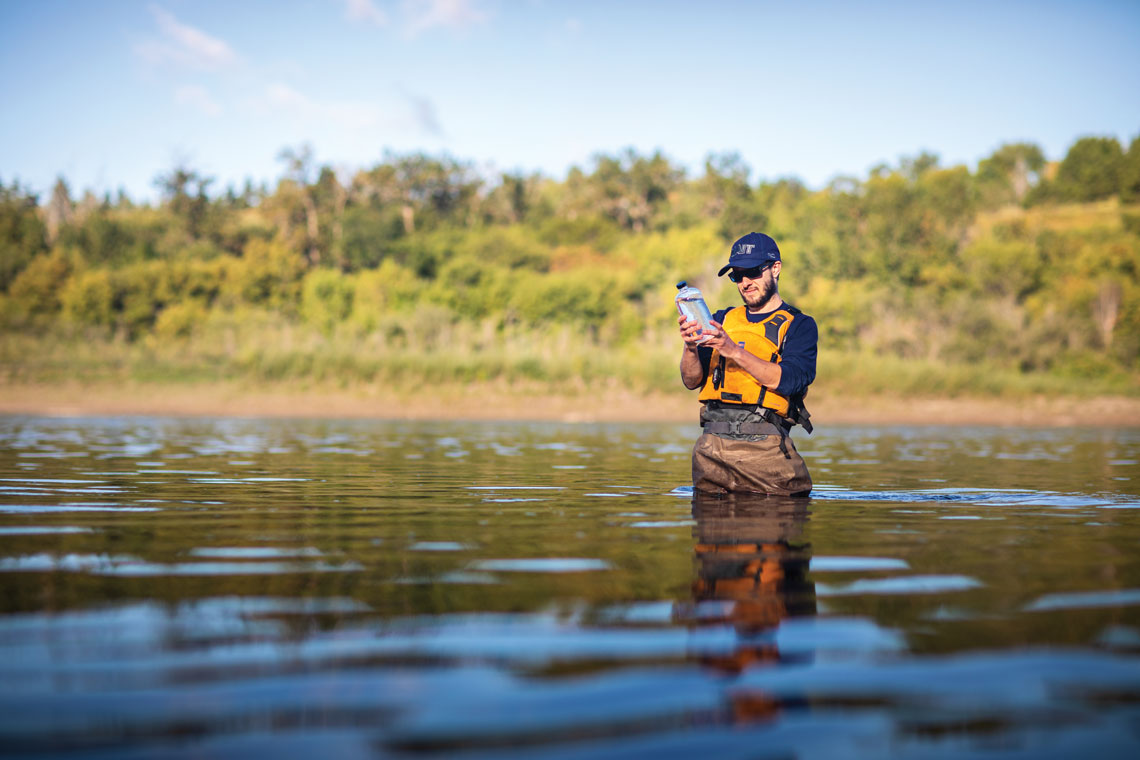
Jeremiah Bryksa looking for plastic in the North Saskatchewan River. He’d like to study microplastics in food packaging next.
By designing out waste and pollution, keeping products and materials in use, and regenerating natural systems,” says a quote from the UK-based Ellen MacArthur Foundation (which since 2010 has been acknowledged as the leading proponent of the circular economy concept), “we can reinvent everything.” It’s an ambitious idea. One that in Alberta still appears far off in the future.
Jennifer Koole, a conference attendee and the executive director of the Recycling Council of Alberta, told me in an interview that “there is a way to measure the circularity of an entity, whether that’s a country or a province. We haven’t measured it for Alberta,” she said, “but Canada’s circularity level is 6.1 per cent. That means a small percentage of materials [plastic or otherwise] are being recycled or recovered and there’s a lot of opportunity to do more.”
A few presenters who spoke at Alberta Circular Plastics Day—via Zoom—expressed hope that strict regulations could still be brought in to address plastic waste in the environment. Ryan Parmenter, from Environment and Climate Change Canada, told attendees that negotiators for a global treaty on plastic pollution will meet again in Switzerland in August 2025. This time, he said, “I think we’ll be able to move forward.” The stakes were highlighted by Roxana Sühring of Toronto Metropolitan University. “Plastics are complex chemical mixtures that are released into the environment throughout a product’s life cycle,” she said, explaining a study in which she traced microplastics back to their source products by analyzing chemical additives in various plastics. Microplastic regulation is needed, she said, but she wonders how it would be enforced.
Near the end of the day I talked with Jeremiah Bryksa. His microplastics sampling project was wrapping up in April 2025 and he was working on having the results of the study peer-reviewed and published in a journal. “We found plastics everywhere” in the North Saskatchewan River, he said. “They’re really low concentrations.” This surprised him. “I thought I would see way more plastic,” he said. “The river’s pretty clean.”
I asked how plastics are getting into our bodies, given that most people apparently have microplastics in their bloodstream. “The biggest exposure route is just through being indoors,” he said. “Most microplastics come from inhalation.”
At NAIT, he said, “our work is industry-driven, so I don’t get to choose what I work on.” But if he could choose, he said, “I would love to do more microplastic work. They come from plastic bottles. All food is packaged in plastic.” Studying microplastics in food packaging “would be a really interesting space to go to next.”
Tadzio Richards is a National Magazine Award winner and the associate editor at Alberta Views.
____________________________________________