The bus shelter across from the Hotel Macdonald used to have heaters,” says Ian Mulder, an architect with the City of Edmonton. But homeless people were sleeping in the warmth, so the city removed the heaters. Mulder says this was flawed thinking: “The actual problem was there wasn’t another place [for them] that had heat and shelter.” The city’s narrow focus on deterring “undesirable users” created a space that was less hospitable for everyone.
Similarly, in downtown Edmonton you’ll find metal blockers on ledges and railings to deter skateboarding. This satisfies some people, but “it restricts youth, and it restricts eyes on the street,” says Lourdes Juan, an urban planner with experience across Alberta. “Skateboarding gets a bad rap, but it’s a valid form of transportation and recreation and there’s a culture around it.” People want to use public spaces in many ways, she says. “We need to encourage this.”
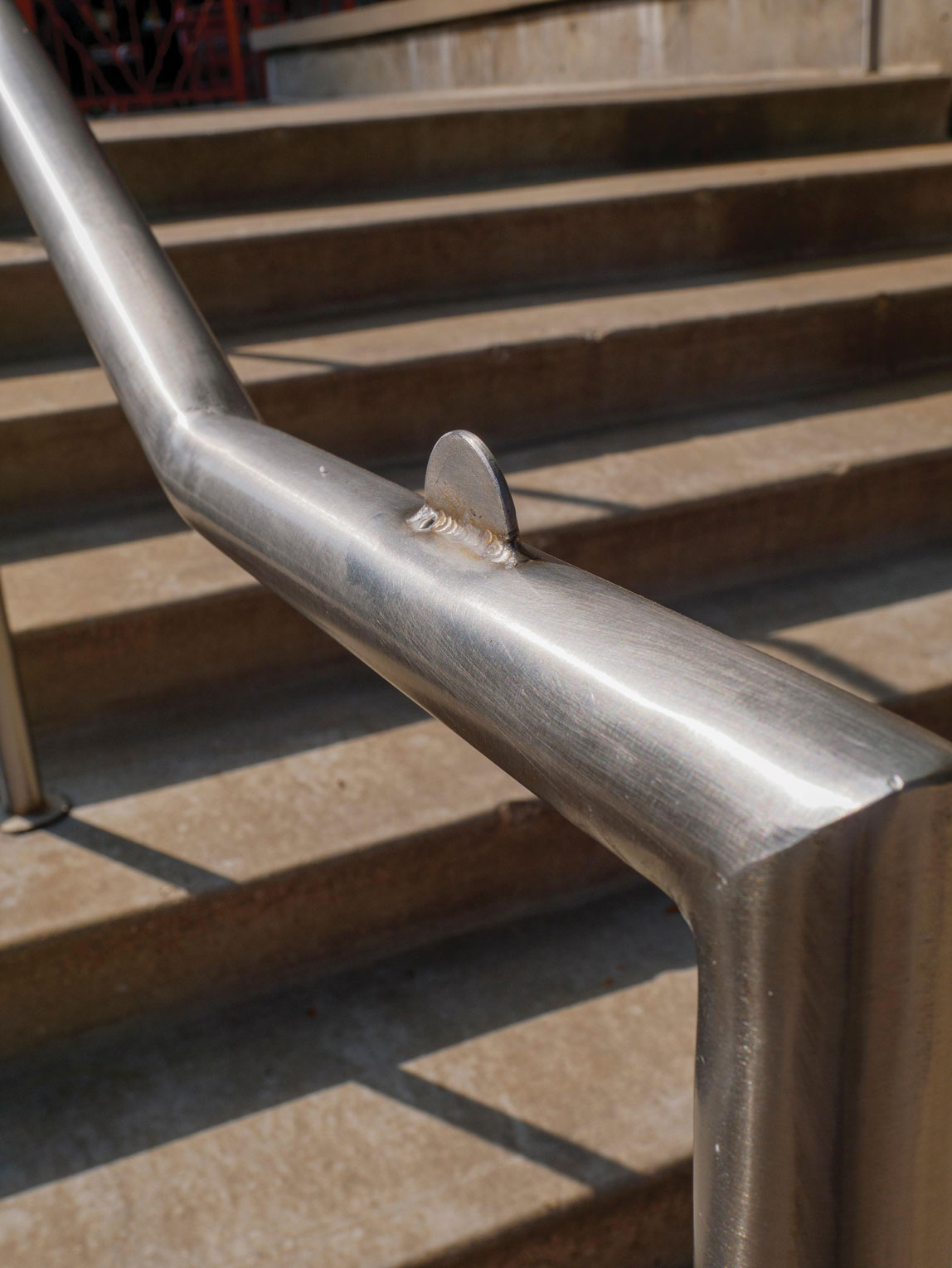
A railing with an anti-skateboard stopper
Should we accommodate the messy reality of human activity or enforce a sanitized ideal? An unheated bus shelter and metal “skate stoppers” cut to the heart of how we design public spaces. They represent just two visible manifestations of a broader philosophy: crime prevention through environmental design (CPTED), sometimes referred to as “hostile architecture.”
Churchill Square—Edmonton’s main civic gathering space—is an example. The square, when not hosting an event, can feel sparse, concrete and unwelcoming. Its benches have armrest separators strategically placed to prevent people from lying down. Ledges and walls are fitted with those same skate stoppers. These design elements discourage use, sending a clear message about which activities are acceptable in our shared spaces.
Across downtown, sloped surfaces are fitted with inconspicuous metal pieces designed to prevent lounging. The playground at Holy Child School in wîhkwêntôwin (formerly Oliver) has an open design that eliminates “hiding places.” Tunnel slides or covered structures were excluded in favour of visibility, ignoring children’s natural love of hiding places for imaginative play.
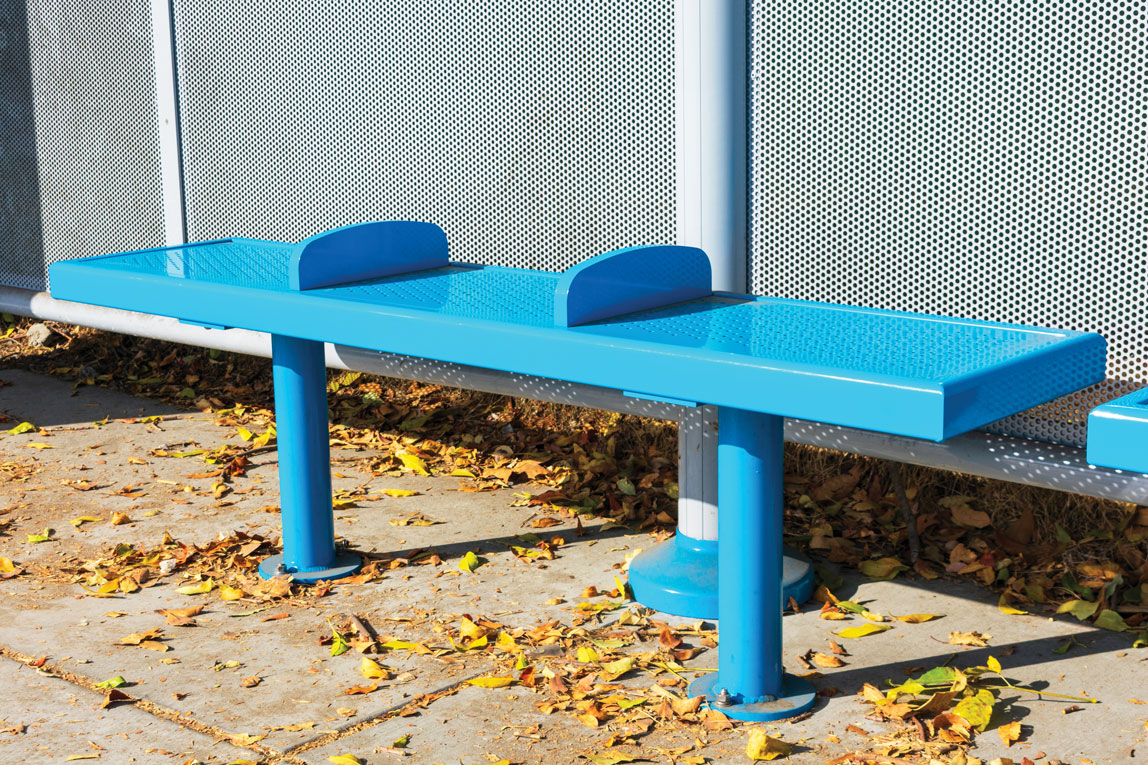
Bench armrests to stop people from lying down
We build public libraries to freely share knowledge. Public transit enables universal mobility. Public parks provide people with respite from heat and noise. Our streets serve as stages for civic life. Yet CPTED principles are proliferating in Edmonton. This raises questions about who shapes our public realm and whose interests they serve. When we design primarily against perceived threats, what do we lose in terms of human connection, inclusion, spontaneity and joy?
Edmonton is one of the few Canadian cities to formally include CPTED in its development approval process. “Edmonton was a trailblazer,” says Robert Lipka, an urban planner with the City who previously worked for the City of Toronto. He says Edmonton had a CPTED document in the 1990s, even as it often went unused. But today development permits in specific zoning areas require a CPTED review.
“First-generation CPTED started in the 1970s,” says Mulder. “Cities were dealing with a lot of social unrest:, with deficits in the built environment leading to graffiti and vandalism. They looked at physical components such as lighting and enclosed spaces.” This approach, heavily influenced by policing perspectives, emphasized deterrents and surveillance as solutions.
“The first generation was more ‘target-hardening,’ ” says constable Shannon Harrigan of Edmonton Police Service (EPS), referring to barriers, fences and cameras designed to impede criminal activity. Cities installed bright lights, played loud muzak and removed tree branches near the ground to improve visibility.
“Second-generation CPTED came about in the 1990s and 2000s,” says Mulder. “It looked at social determinants of crime where people were feeling free to behave badly. Why was that? What could we do about it?” The reframing moved beyond physical interventions to consider underlying social factors contributing to crime and perceptions of safety.
To make public spaces both safer and more usable involves reconciling different professional perspectives. “Every architect is an amateur sociologist trying to understand people,” Mulder says. “The police also have their view and lens based on their experience.” They spend a lot of time in public spaces themselves. Their framework, says Mulder, seems to criminalize certain behaviours rather than explore the tension between different users’ needs. It reinforces “a binary of some people’s needs as ‘good’ and others’ as ‘bad,’ ” he says, creating a dichotomy that fails to capture the complexity of public-space usage.
When we design primarily against threats, we lose public access to the commons.
The EPS’s Harrigan conducts CPTED training and performs security assessments for community leagues and not-for-profits. She says her approach is evolving beyond traditional policing perspectives to incorporate insights from urban planners, social workers and community advocates. She says workshops and collaborative assessments with community leagues have deepened her understanding of how security measures impact different people: “Every course I take from another organization shows me what they’re doing right, what works, what doesn’t.” She says more-nuanced CPTED assessments now consider not just crime prevention but how security measures might negatively impact members of the public.
During a CPTED training session with the Delton Community League, Harrigan said group homes, public transit and low-income housing “may lead to crime.” A community member offered a counterpoint: “Just because you’re poor doesn’t mean you’re bad, and everyone needs somewhere to be.”
Mulder says the broader context is important: “Our culture privileges the private realm; ownership, privacy, private, mine.” He offers a contrast: “If you go to Mexico… at night people are out, stores are open. Social elements in the public realm dissuade public disorder.” Cultural attitudes about public space shape perceptions of safety and appropriate use.
Some projects get the balance right. Chelsea Whitty, a planner with Dialog, worked on the new Calgary Central Library. That project was designed to balance security with extraordinary public access. The design process included librarians, security consultants and community representatives. Whitty says cross-disciplinary dialogue is very important. “Everyone sees it through their own lens. But we can all have an open, frank discussion about your priorities and my priorities and how we can actually work together.” The library is today beloved by Calgarians and was a featured tourist destination in the New York Times, dubbed a “gleaming jewel box” with a “stunning oval of snowflake-shaped windows and arching wood.” The collaborative approach incorporated security measures without compromising the library’s welcoming atmosphere.
However, there’s still a disparity between perceived danger and actual risk. “There’s a really interesting conversation around perception of safety and comfort versus actual lack of safety,” Whitty says. One person feels uncomfortable when an apparently homeless person is “sitting on the stairs in the sun because it’s warm—but isn’t actually doing anything wrong.” This discomfort with mere presence rather than bad behaviour shows how safety concerns can function as a proxy for a generalized discomfort with difference.
Some elements of hostile architecture, such as skate stoppers and bench armrests, are noticeable. But other, subtler elements also impact our experience of public space. Edmonton’s redesigned Stadium LRT station, for example, represents what Lipka considers “one of the best examples of CPTED applied to public design in Edmonton.” Its security-focused features create a complex trade-off for users. The station’s extensive use of glass, lack of traditional seating, hard angular surfaces and openness create excellent sightlines—a core principle intended to deter criminal activity through visibility.
“The design makes people feel exposed, which potentially prevents issues like drug use, graffiti and harassment,” says Lipka. “But these same features make it uncomfortably cold during our harsh winters.” The station’s minimalist aesthetic, devoid of plants, decorative elements or visual warmth, prioritizes surveillance over comfort. The redesign brought positive changes: replacing confusing underground ramps with visible, accessible entrances and adding a security office and public bathrooms. But Stadium Station embodies the tension at the heart of CPTED application. It’s a space simultaneously more accessible and more inhospitable, safer by some measures yet less welcoming by others.
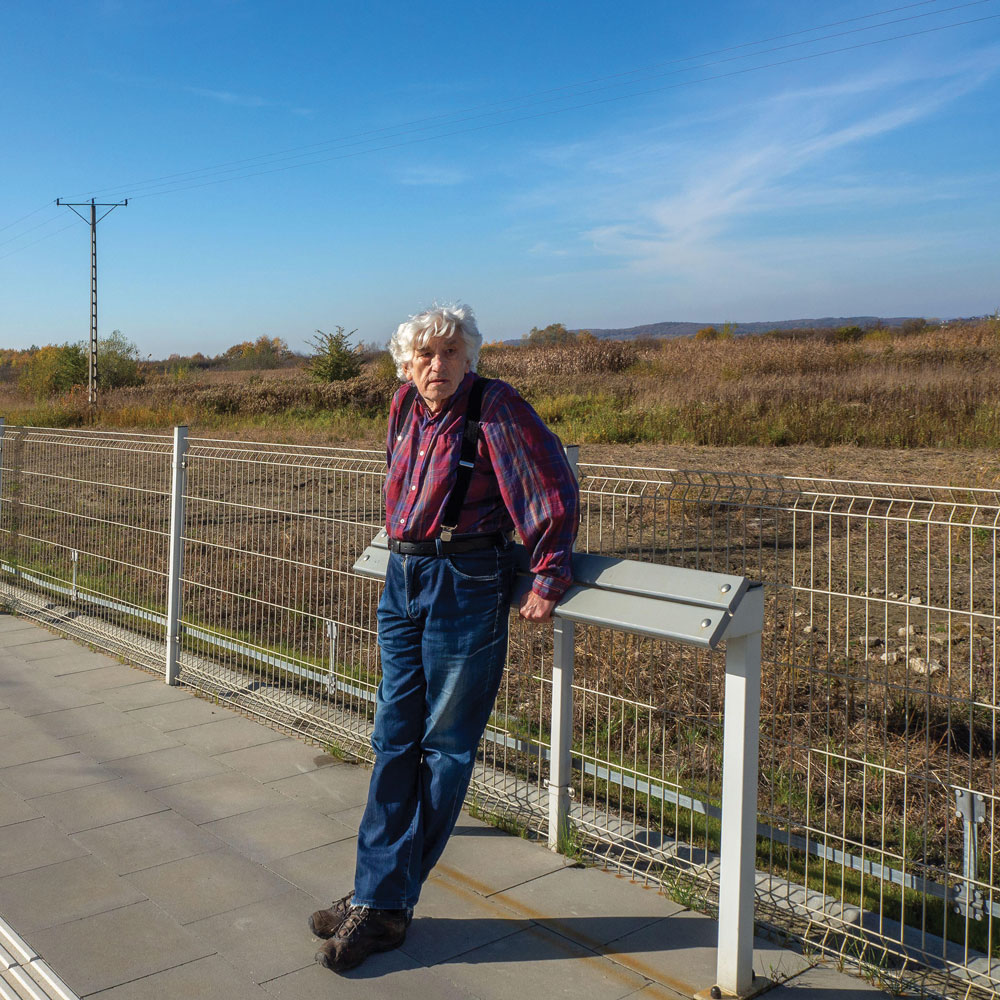
A “leaning bench” that prevents sitting or loitering
Downtown Edmonton is changing. “I worked here before COVID,” says City of Edmonton planner Robert Lipka. More recently, “I came downtown and thought—What happened?” Violent incidents in downtown rose from 13,224 in 2019 to 16,652 in 2024. According to EPS chief Dale McFee, “Perceptions of safety are tied as much to the disorder [people] see as the actual crime they experience.” Difficult times create a feedback loop: as economic pressures exacerbate homelessness and mental health challenges, and as downtowns see fewer office workers and shoppers, disorder becomes more visible, prompting more security measures, which further deter visitors.
The cycle is difficult to break. Removing a bench might stop someone from sleeping there overnight, but it can also deter the elderly, the disabled or people who just need a rest from walking through a neighbourhood. Public space is diminished for everyone.
Lourdes Juan says “hostile” design ultimately undermines its own goals: “The design is so punitive. Don’t go there. You’re not allowed to go there.” About Chinatown, she says: “They’ve removed all the benches and trees, and now you just have no one around.” The absence of public amenities doesn’t solve problems, she argues; it merely displaces problems and people.
We want public spaces that are both secure and welcoming. As Harrigan says, “We want trees. We want nature. But just do it the right way.” Mulder says “beauty still matters,” even in security-conscious design.
“I’m optimistic,” says Lipka. “I see a lot of opportunity for change.” The pandemic intensified social disorder, but it also amplified our collective need for shared spaces. By moving beyond reactive approaches, by considering more perspectives and by addressing underlying social needs, we can create public spaces that enhance everyone’s safety while nurturing the connections that make cities worth living in. Our pursuit of security needn’t come at the expense of our shared humanity.
Lauren Kalinowski is a freelance writer who lives and works in Edmonton. She is also a contributor to Edify magazine.
____________________________________________