As the former chief of staff to former Edmonton mayor Laurence Decore, who fearlessly fought greater powers on behalf of the citizens of his city, I am watching Alberta premier Danielle Smith and her predominantly rural caucus shamelessly erode the powers of municipal governments in favour of enhancing their own. I keep expecting the province’s municipal leaders to scream bloody murder—to organize massive public outcries against each incremental assault—but instead the reaction I most often see is disappointingly tepid, far too cautious. I believe our civic leaders are fearful of Smith’s retribution.

Laurence Decore
The mayors of today seem to have little idea how powerful they can be when they’re fighting for what is right for their citizens… when they are both courageous and, importantly, creative in marshalling the support of their citizens against an oppressive “superior” power. Alberta’s big-city mayors,after all, are elected by citizens who live and vote in as many as 46 provincial constituencies and 20 federal ridings. Premiers and prime ministers are all too aware of the potential electoral danger posed by a mayor who can rile up so many people over issues that closely touch their lives.
Unfortunately, courage and creativity in fighting ill-willed governments are not in great evidence these days. Too many people in all walks of life are bowing to political (and economic) power that has become so pervasive in our province that almost no one believes it can be fought. Too many politicians seek office for power, rather than to serve. They know how to be elected, but not why.
Much can be achieved by a mayor who brings courage, creativity and a sincere focus on public service to the office. Laurence Decore, Edmonton’s mayor from 1983 to 1988, exemplified those values more than any Alberta politician since Peter Lougheed.
Decore’s father, John Sr., a chief judge of the federal district court and a former Vegreville Member of Parliament, instilled in his son a strong social responsibility to work to improve the lives of everyday people regardless of their sex, ethnicity or socio-economic status. Laurence was taught that the purpose of politics is service, not power.
On the day of his swearing-in ceremony—held for previous mayors behind closed doors in the presence of family and “upscale” political supporters and donors—Laurence Decore at the last minute ordered that chairs, tables, linen, cutlery, tea and munchies be set out on the plaza in front of City Hall, and that buses be sent to senior citizens homes to bring people to a “swearing-in tea party.”
One of Decore’s first moves was to fire the previous mayor’s chauffeur and order the “limo” be sold. He drove his own modest Ford throughout his years in office.
Once, during a heated public debate over the publicly owned Edmonton Telephones’ request for a $1 monthly increase to residential phone bills, one of Decore’s advisers sent him a note asking why he was making such a big deal out of a small increase. The mayor replied it would take a dollar from the already meagre food budgets of the poor. He convinced the phone company to apply more often for much smaller increases.
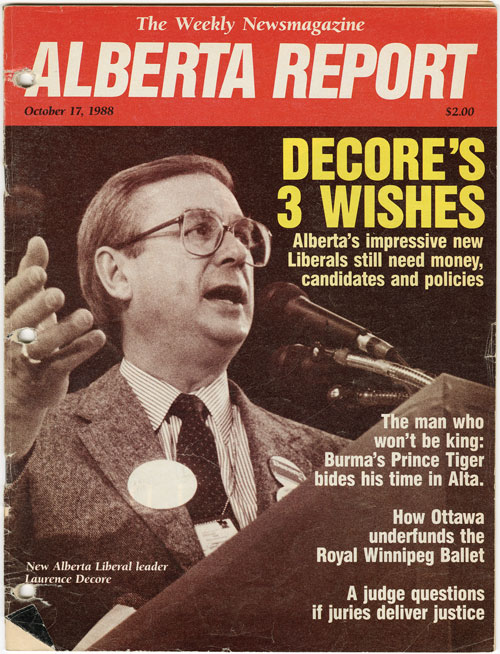
Alberta Report mid-1990s. In 1993 Laurence Decore’s Alberta Liberal Party got within a few thousand votes (in the tightest 10 constituencies) of forming government.
Early in Decore’s tenure the city administration was topped by a powerful Commission Board of senior unelected bureaucrats. While the mayor was a token elected member, the chief commissioner chaired its meetings. The mayor was in effect subservient to change-resistant bureaucrats and their boss.
On day one of his mayoralty, Decore ordered that the locks be changed on the private stairway between the chief commissioner’s office and the mayor’s office. He chuckled at the shouted fury of the chief commissioner when the man discovered he would henceforth have to use a public stairway and glass-walled waiting room until the mayor admitted him.
He also evicted the once-powerful members of the Commission Board from their parking stalls under City Hall, giving these to elected council members. He ended the practice of firefighters ferrying the commissioners’ cars offsite to be washed. Council members were made top priority for invitations to public events; commissioners, who’d been first before, now came last.
Within a few months, Decore convinced council to disband the Commission Board, replacing it with an executive committee of elected councillors and, to his great dismay at now being the lone bureaucrat, the chief commissioner. Councillors were rotated yearly to ensure each council member an equal chance at Executive Committee participation during their three-year term.
With elected people back in control at city hall, the appropriate balance of power was finally restored.
Decore saw to it that the Citizen Action Centre—which answered citizen questions and helped people who had issues with the bureaucracy—was given authority to act on the mayor’s behalf in resolving a host of issues previously subject to time-consuming involvement by the mayor and councillors and any number of bureaucrats. Citizens were amazed at the refreshing speed with which their needs were now looked after.
Each Friday noon, Decore hosted a high school student council and their police resource officer for a pizza lunch in the mayor’s office lounge. He didn’t have a political agenda to impart; he simply listened.
Also, each week he and top representatives from the Citizen Action Centre and Edmonton Transit System visited a different seniors home to bring residents news of current happenings at City Hall, to answer their questions and hear their complaints and suggestions.
When he had time for a lunch on his own, he often would go to cafeterias or modest restaurants and sit in the middle of the room. Before he’d finished his meal, people of all ages would have approached him with everything from a handshake to a complaint about potholes.
As part of the city’s debt reduction strategy, many councillors wanted to privatize services such as waste removal and building cleaning. Decore passionately argued that city employees had higher standards because profit wasn’t their underlying motive. He convinced council to adopt a 50:50 split between the public and private sectors to keep the latter in check vis à vis standards and costs.
He maintained a healthy respect for unions. He may not have always agreed with their demands, but no union leader left Decore’s office thinking they didn’t get a fair hearing. When the City’s budget needed assertive trimming, he knew city employees would need facts if they were going to believe the city wasn’t just artificially setting the stage for wage cuts. He implemented a “cascade system” wherein each layer of management was thoroughly briefed about budget details, then assigned to impart those details to the next level down in the hierarchy. In turn, those people did the same with the next level, until finally every employee knew the facts.
Using this system the City won an international Government Finance Officers Association award for the humanity with which it had accomplished downsizing with a minimum of grief to employees.
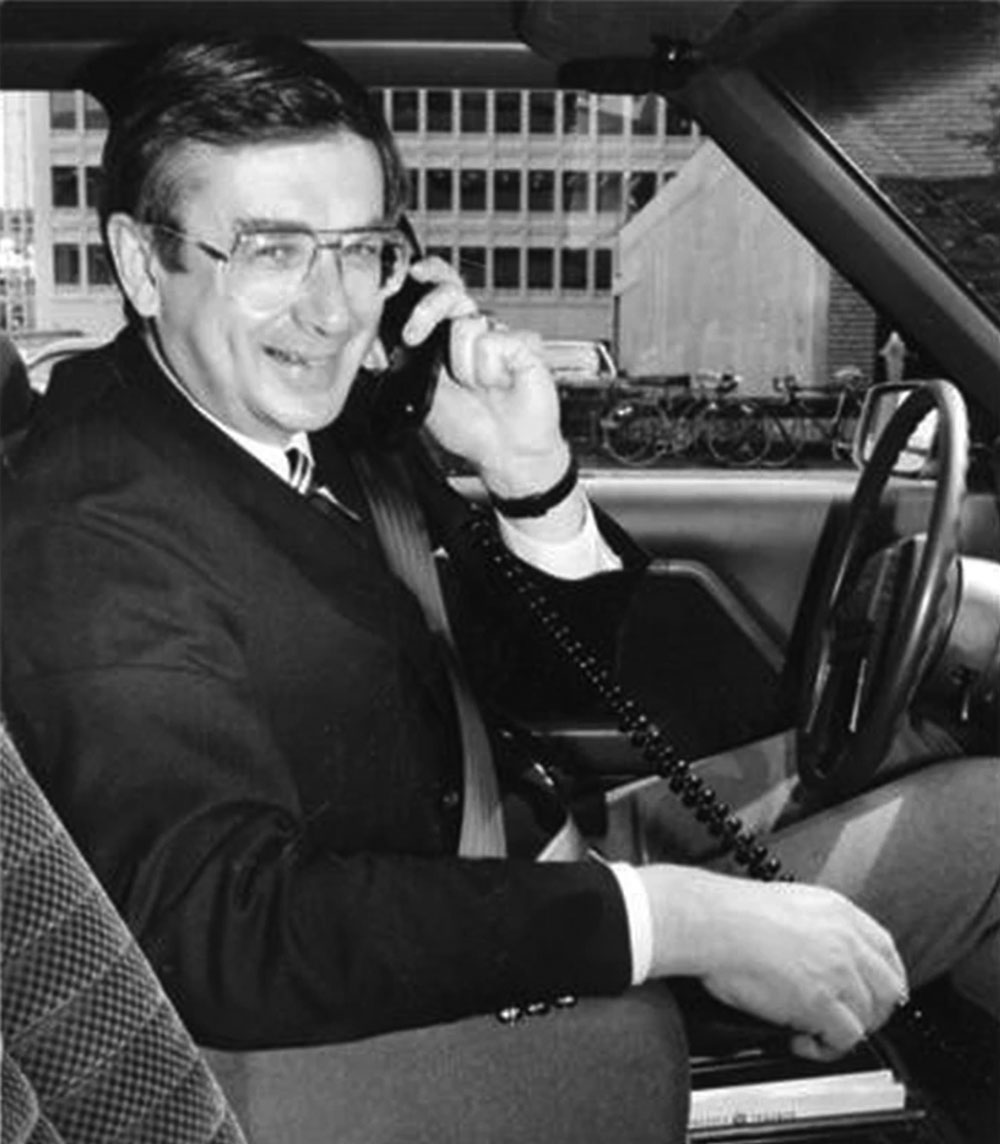
Laurence Decore with a mobile phone in 1986, when mobile cellular telephone service became available in Edmonton.
When so-called “senior” governments did things that harmed Edmontonians by depriving the city of revenue or by withdrawing critical services that supported people, Decore was fearless in taking on those governments and in marshalling the active support of the city’s citizens in his battles.
In his time, his city’s ownership of Edmonton Telephones was unique in North America. But EdTel was prevented by premier Peter Lougheed’s provincial government from receiving a fair share of the revenue generated by long-distance phone calls made by the company’s own customers. Decore asked Lougheed to “make it right” many times but was constantly rebuffed. He decided finally to place public pressure on Lougheed, with a strategy that humbled the province and its publicly owned Alberta Government Telephones (AGT).
In complete secrecy, a dozen telecom consultants were brought to the city and housed in a downtown hotel. For several weeks they developed a technical strategy whereby EdTel denied AGT the information it required to know what telephone number was originating a long-distance call. This rendered AGT unable to bill EdTel customers for long-distance calls. As a temporary fix, AGT operators throughout Alberta were forced to intercept outgoing EdTel calls and ask what number the caller was calling from. This worked for awhile, until a councillor working on the strategy slipped it to the media that there was no reason callers had to give AGT the right number.
Decore had a giant LED counting display placed on the City Hall information desk. It showed the amount of revenue that EdTel was being denied, right to the minute. He placed newspaper ads with mail-in forms people could use to demand that the premier give EdTel its fair share of long-distance revenue. Tens of thousands of those forms were completed, returned and dumped on the floor at news conferences.
Finally, after a long period of non-response, Lougheed—who had never before known a political defeat—agreed to appoint retired Supreme Court justice Tevie Miller to conduct an inquiry into Edmonton’s claim on its long-distance revenue. Miller eventually sided with the City, and EdTel was suddenly worth tens of millions of dollars more than it was before. The EdTel Endowment Fund, created from profits from the eventual sale of the public company, paid $45-million in dividends to the City of Edmonton in 2023. It ended that year with a market value just shy of $1-billion.
The province’s municipal leaders should be screaming bloody murder.
On another occasion, minister of social services Shirley McLellan announced the government’s intention to withdraw provincial funding for pre- and after-school daycare programs. Knowing how many thousands of families—especially single-parent ones—would be devastated by the withdrawal, Decore met with the minister within days. He calmly informed her that as mayor he had more than 700 buses under his control, each of which could seat 50 moms and kids who were about to be denied these important programs. He asked her to imagine the political effect of 100 or more of those buses—each delivering 50 parents and kids to the front steps of the Legislature—for a giant protest.
The minister reversed her position the next day.
One more great example of Decore’s courage in standing against “greater” powers occurred when Conservative finance minister Michael Wilson was developing rules for the coming imposition of the GST. At a Big City Mayors conference, it was made known that the minister was considering imposing GST on city departments that are provided services by other city departments—for example, when the law department secures rights of way for LRT line extensions.
At the next Big City Mayors meeting, fortuitously held in Ottawa, Decore circulated a dummy copy of a powerfully worded brochure sized to fit inside every city’s monthly utility bill envelope. The brochure bluntly explained the federal government’s intent—and its ultimate inflationary effect on property taxes—and gave all the information necessary for people across the country to phone their complaints to Wilson and prime minister Brian Mulroney’s offices.
Once the mayors approved the strategy, Decore convinced Vancouver mayor Michael Harcourt to walk with him across the street to Wilson’s office and demand to be seen. Wilson could hardly ignore the mayors of two of Canada’s largest cities. He saw them, heard the strategy, read the dummy brochure, recognized the magnitude of their potential political threat… and nothing was ever again heard about imposing the GST on internal civic services.
Decore knew how to use political power. That’s what politicians do when they know why they seek office.
Years before becoming mayor, Decore, as chairman of the Canadian Multicultural Council, organized a lobby effort on behalf of organizations who wanted prime minister Pierre Trudeau to include “multicultural” in the description of Canada in section 27 of the Charter of Rights and Freedoms. Trudeau bitterly resisted, but in the end, the strength of Decore’s national lobby forced Trudeau to acquiesce. The Charter now includes this wording: This Charter shall be interpreted in a manner consistent with the preservation and enhancement of the multicultural heritage of Canadians. That sentence enabled the flow of federal funding to support multicultural organizations.
After that, Trudeau harboured quite a dislike for the mayor of Edmonton. Decore simply didn’t care.
When, a few years later, new prime minister Jean Chrétien was forming his cabinet, Decore called him to promote Anne McLellan—an Edmonton MP well known locally but without national profile—as minister of natural resources, the ministry responsible for oil and other industries. He told Chrétien that McLellan was brilliant, a quick study and respected by the oilpatch. Chrétien, however, was determined to appoint a different MP, one with no connection to Alberta or the oil industry. The prime minister attempted to mollify Decore by telling him it wasn’t necessary to match ministers’ provinces of origin to the nature of their department’s responsibilities. The increasingly tense conversation went back and forth until finally Decore, by now quite ticked off, replied to Chrétien’s argument with: “Damnit, Jean… I’ll believe that when you appoint a fisheries minister from Saskatchewan!”
McLellan was appointed natural resources minister a few days later. She eventually became deputy prime minister.
When Canadian National closed the iconic Macdonald Hotel in 1983, it had become an embarrassment to Edmonton: a missing front tooth, a psycho-logical “downer” that dragged on Decore’s intent to revitalize the downtown. Learning that CN’s CEO was soon to visit Edmonton, Decore invited him to a meeting in his office. The CEO, Decore had heard, was a superior type who was highly conscious of his immense power and often dismissive of lesser mortals. When the CEO appeared, Decore had secretarial staff seat him in the glass-walled waiting room. Decore let him cool his heels in full view of the media for 20 minutes past the agreed meeting time.
When they finally met, after the CEO had explained all the reasons why CN could not possibly reopen the Macdonald, Decore unfolded a large black flag carrying the CN logo in white. He told the CEO that if a reopening were not announced very soon, he would fly the flag permanently in front of City Hall. Further, he threatened to organize a Pied Piper-style march from the City Hall flag-raising to the hotel, led by legendary jazz trombonist Big Miller. Decore threatened to nail up a proclamation at the Macdonald demanding that CN reopen the hotel as a display of its respect for a city whose broader region was responsible for more than half of CN’s national freight revenue.
At the same time, Decore told the CEO he would be equally difficult if CN continued refusing to entertain the relocation of its huge downtown switching yards, a move which would finally free the land to enable developments such as Grant MacEwan University. CN quickly announced the reopening of a significantly upgraded Macdonald Hotel, and within a year it was in negotiation with a councillor over the relocation of its downtown switching yards.
A few years later, as leader of the Alberta Liberal Official Opposition, Decore took his party to within a few thousand votes (in the tightest 10 constituencies) of winning the 1993 provincial election.
The man knew how to use political power. That’s what politicians do when they know why they seek office.
Alex Macdonald was chief of staff to former Edmonton mayor Laurence Decore (1983–1988) and an adviser when Decore became leader of the province’s Official Opposition.
____________________________________________