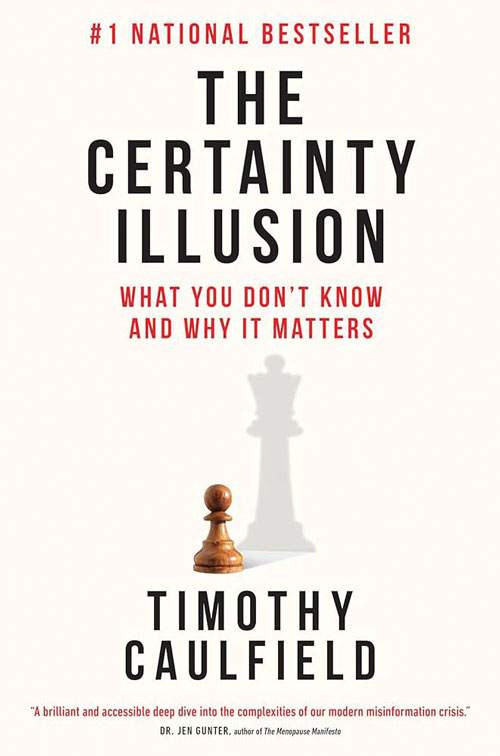
by Timothy Caulfield
ALLEN LANE
2025/$34.95/312 pp.
Reality is on shaky ground these days. As University of Alberta law professor Timothy Caulfield bluntly states in The Certainty Illusion: What You Don’t Know and Why It Matters, the information landscape has become “completely and truly f*cked” by a torrent of disinformation, misinformation and outright fantasy. Worse, the tools that are meant to protect us from manipulation are themselves being weaponized by bad actors and twisted by misaligned incentives.
To make this point, The Certainty Illusion outlines three potential sources of truth, showing why each is important to the choices we make, before explaining how they are being undermined. As trust in these sources breaks down, we find ourselves “adrift in a storm of information chaos,” according to Caulfield, “and we are tearing down the lighthouses.”
The “science illusion” comes first. Caulfield turns a critical eye on the predatory “academic” journals that take advantage of desperate-to-publish professors and cut corners to push political agendas. “Science-y” marketers also come under fire for their misuse of jargon (think “microbiome,” “nanotechnology” and especially “quantum”) to give a veneer of credibility to their sales pitches.
Next comes “the goodness illusion,” a sort of catch-all that starts with “health halos” (vague, aspirational terms such as “natural” and “healthy” that lack clear definitions) before moving on to topics as diverse as beauty products, hypermasculinity and ancient aliens. The connections here can be tenuous, showing the limits of Caulfield’s three-part structure, but the common thread is charlatans taking advantage of our desire to be good people by selling easy answers, scapegoats and snake oil.
Finally, for “the opinion illusion,” Caulfield moves away from expertise to the supposed wisdom of crowds, revealing the forces manipulating online reviews and skewing perceptions of public opinion. Between fake products, fake ratings and fake posts, you may never trust a five-star review again.
At its best, The Certainty Illusion promotes a healthy sense of skepticism, emphasizing the need to break free of biases and bubbles to have any hope of holding on to objectivity. Occasionally, though, you might wish Caulfield would take his own advice to heart in choosing his targets. The book’s criticisms are overwhelmingly aimed at one side of the political spectrum, and while a few self-deprecating jabs show he’s aware he’s “unfairly picking on the conservative right,” they read as attempts to disarm critics instead of addressing the imbalance. The solution isn’t to pretend all sides are equally right on all issues. But Caulfield’s sometimes snide tone risks alienating audiences who would otherwise benefit from the book’s message.
Considering how it is already reshaping the information landscape, it’s also surprising how small a role generative AI plays in Caulfield’s narrative. Likely this is an issue of timing—the state of AI changes so quickly that it makes sense to keep comments general—and he rightly notes that AI’s risks stem from the same trends and incentives that The Certainty Illusion is already outlining. But AI’s potential to supercharge those trends, untethered from human limitations, should probably merit more than a few asides.
Still, the problems Caulfield points to have been brewing for a lot longer than large language models have been around, which makes understanding the roots of our crisis even more important. Thirty years after Carl Sagan and Ann Druyan lit the original “candle in the dark” of our information landscape with The Demon-Haunted World, the need for scientific literacy and healthy skepticism is more urgent than ever. The Certainty Illusion is a solid introduction to the topic, and a valuable way of shoring up your intellectual immune system.
Peter Hemminger is a writer and editor in Calgary.
_______________________________________
Read More from Allen Lane