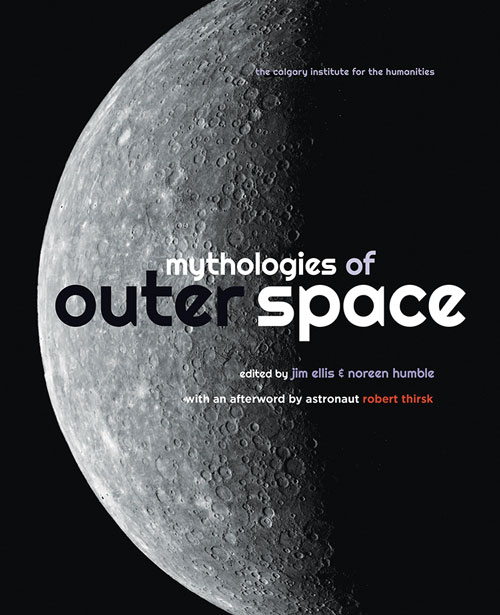
Edited by Jim Ellis and Noreen Humble
UNIVERSITY OF CALGARY PRESS
2025/$34.99/176 pp.
Mythologies of Outer Space, edited by Jim Ellis and Noreen Humble, is, as a physical object, a beautiful book, with colourful pages filled with gorgeous art, photography and diagrams. It would not be out of place on a coffee table. But it is so much more than a book for display. From outer space archaeologist Alice Gorman’s fascinating examination of changing perceptions of the moon as a living (or life-supporting) entity or a dead and sterile rock, to Mi’kmaw astronomer Hilding Neilson’s examination of the relationship between astronomy, space exploration and Indigenous rights, to an afterword written by Canadian astronaut Robert Thirsk, the book is a manifold engagement with space, in large part as it’s been imagined but also as it’s been experienced first-hand.
The book emerged, Ellis tells us in the introduction, from the 42nd annual community seminar of the Calgary Institute for the Humanities. Informally arranged into three sections, it opens with a focus on the moon. After Gorman’s chapter, Humble traces conceptions of the moon back to two ancient Greek texts written by Lucian in the second century C.E.: True Histories and Icaromenippus. She convincingly documents Lucian’s influence in work by figures as diverse as Johannes Kepler, Jules Verne and H.G. Wells. Following this, Keith Sidwell’s translation of Lucian’s peculiar and amusing “Voyage to the Moon” is worth the read just for the wildly imaginative narrative of lunar gender and procreation.
After the lunar section is a collection of scholarly chapters, thankfully written for a general audience, with widely accessible scholarship devoid of jargon and intrusive citation. Neilson’s thought-provoking chapter stands out here. He convincingly argues that “treaties do not have a height limit,” that light pollution is colonization, and that “any action by Canada, as a nation-state, in outer space must be conducted with and with the consent of Indigenous peoples living on these lands.” Another chapter sees digital humanities scholar Chris Pak sketching a history of narratives of terraforming as a way of understanding different time periods’ views of the future and planetary development. Resonant with Pak’s piece, Stefania Forlini delves into archival work with the U of C’s Bob Gibson Collection of Speculative Fiction. Gibson, whom Forlini identifies as a “lifelong collector of the everyday,” compiled more than 880 anthologies that “exemplify the carefully curated work of a collector with ‘scavenger sensibilities.’ ” This chapter is accompanied by compelling reproductions of rare periodical and book covers of speculative fiction.
The final section is a collection of artistic representations of outer space. Kyle Flemmer’s “Stellar Sequence” is essentially a high-quality poetry chapbook of a series of poems, each titled after a stellar body, the page colour corresponding to the colour of star poetically represented—“Red Dwarfs” appearing on a red page, “Blue Giants” on a blue page, etc. Elyse Longair engages in a conversation with collage artist Naomi Potter, accompanied by gorgeous reproductions of her work. And Nancy Tousley discusses “You Will Remember When You Need To,” David Hoffos’s mixed media installation piece that also includes some unsettling images from his work.
Mythologies of Outer Space is an aesthetically stunning text. It’s also unapologetically eclectic, so is difficult to summarize without doing it an injustice. Taken as a whole, it traces a history of vision and exploration and points to humanity’s future imaginative interactions with space, both inner and outer.
Jay Gamble teaches English at the University of Lethbridge and is the author of Book of Knots (Book*hug Press)
_______________________________________