I came of age in the heyday of globalization and easy travel. I didn’t feel the slightest fear about crossing a border—not when I visited Dubrovnik at the end of the Croatian War of Independence, not when I was dragged off a train by armed Slovakian border guards. But everything changed when I wanted to visit Canada, my homeland, in April 2025.
President Donald Trump was wreaking havoc on the centuries-old American traditions of the rule of law and the accommodation of the tired, poor, huddled masses “yearning to breathe free” from persecution in their native lands. His administration unleashed an army of masked ICE agents to round up and deport non-citizen residents, both legal and illegal, to prisons in countries run by dictators. Even green-card-holding permanent US residents like myself were suddenly being denied re-entry or detained and threatened with expulsion.
I’ve made Montana my home for 20 years, the longest I’ve lived anywhere since I left Calgary in 1993. I was drawn here by the chance to attend graduate school on a scholarship, then grew enraptured by the immensity of accessible wildlands, the progressive vibe of an American university town, and the beautiful and smart Swedish American mycologist I’d met. We married in 2011 and I happily set down roots for good.
Suddenly I’d be risking everything—first by trying to cross into Alberta, and then by trying to get back into my adopted US.
As a permanent resident I have most of the rights of a citizen. Because I can’t vote, I take seriously my other rights and responsibilities, namely the freedom to critique, challenge and condemn the government. In the spirit of Theodore Roosevelt, who said in 1918 that “it is even more important to tell the truth, pleasant or unpleasant, about [the president] than about anyone else,” I’ve protested the new regime and stood up for the victims of its extrajudicial decisions. A homemade “Free Mahmoud Khalil” poster is taped to my front window and a “MAGA is American Fascism” banner hangs on my house in Missoula.
I work for a small conservation organization to restore wildlife connectivity along a transportation corridor between Glacier National Park and the vast Bob Marshall Wilderness Complex, the only wound in the otherwise intact transborder Crown of the Continent ecosystem that stretches from Crowsnest Pass to Missoula’s doorstep. This work is both practical and symbolic to me, a way to knit a tiny bit of the world together at a time when it’s falling apart.
In late April, Banff was hosting a wildlife connectivity conference, Canada’s first, and I wanted to meet up with colleagues and old friends. But I feared the not insignificant chance that the capricious Trump administration would separate me from my lovely wife and my adult daughter, who lives in Arizona. It might prevent me from ever again seeing the 115-year-old home in Missoula I’d just renovated—painting it Falu red in honour of Sweden’s successful experiment with social democracy, a subtle rebuke to Trump’s lurch into autocracy.
Stuck on the American side watching the chaos unfurl, I began to have serious second thoughts. For the first time, I felt a tinge of the anxiety, insecurity and fear that millions of people around the world live with every day.
Premier Smith announced a new border security team—51 sheriffs with dogs and drones and the power to make warrantless arrests.
I’ve crossed the Alberta–Montana border more times than I can remember. It must be at least 100 times, maybe 150. It started when I was a young boy in the mid-1970s. My mother and father moved my brother and me from the blandness of Scarborough, Ontario, to a booming Calgary in 1971, the beginning of the glory days of Alberta’s enrichment and bedevilment by oil.
My father, when he wasn’t selling Sweda cash registers, became obsessed with slo-pitch. As a German refugee, his eastern Canadian childhood hadn’t included much fun. Life was simply work, school and church in the ghetto that was Cabbagetown. The move cross-country freed my father from the judgments of aging German relatives and sparked a new life in the thrall of southern Alberta slo-pitch.
Between the ages of 6 and 14 my brother and I spent more time at ballparks than in school, and every summer we’d travel to Great Falls, Montana, for the Can-Am Slo-Pitch Tournament. For my father and his middle-class, middle-aged teammates on the Calgary Jaycee men’s slo-pitch team, to cross the Medicine Line and defeat the Americans at their own game, on their own soil—this was their World Series. For my brother and me, it was a chance to chew grape Bubble Yum, which we smuggled back to Canada, and to stay in a hotel with a cloverleaf indoor pool, where we escaped the unrelenting Great Plains heat and played tag with the other slo-pitch orphans.
On one these trips, we got stuck at the border behind what would now be considered a vintage early-’70s Ford Econoline van painted tangerine. Four men with long hair and jeans—“hippies,” Dad called them—were standing on the tarmac laughing while the US border agents inspected their credentials. The hippies asked if I’d take a photo of them leaning against the van, as if they were going to be frisked; in mid-shutter, three border guards interrupted their fun.
“You think this is a joke?” one of the guards said, wresting the camera from my hand, while the others cuffed the hippies’ hands behind their backs and took them who knows where. “Do you think this is a joke?!”
But as the years and crossings passed, it seemed to me that traversing “the world’s longest undefended border” was, if not a joke, a mere technicality. As an adult looking much like those long-haired hippies, I’ve crossed the border in three vintages of Volkswagen vans (1968, 1974, 1991), and the only time I was ever checked for drugs was by the Canadians. The border agents wiped the blade of my pocketknife and the entire inside of the front window and then tested the dusty cloth for drugs. It was negative—and a warning to never smoke pot in my vehicle.
It wasn’t until September 11, 2001, that I realized how seriously the Americans take our common border. On that day, some colleagues and I, after a conference in Kalispell, were checking out of our hotel. There were many guests and too few staff, and I grew impatient, so I wandered back up to my room and turned on the TV. United Airlines Flight 175 had just turned the World Trade Center’s South Tower into a pillar of flame and billowing black smoke. I slumped on the bed and gaped. A replay of the first attack on the North Tower made it clear these were no accidents. The world had changed.
We drove three hours to the Sweetgrass border crossing, a place I knew well. But it was now occupied by Humvees and body-armoured soldiers, probably from Malmstrom Air Force Base outside Great Falls. And there was a Black Hawk.
It’s a peculiar fact that the American military names their combat helicopters after Native Americans, purportedly as a sign of respect for the peoples and cultures the American military tried to wipe off the face of the earth. Of the five helicopters named for Native Americans, only the Black Hawk is named for an individual: a highly respected Sauk war chief who for decades battled his American antagonists. He fought for the British in the long War of 1812, which saw the White House and the Capitol burned to the ground.
It’s reasonable to doubt that Black Hawk would have approved of his name being attached to a flying fortress of war and a menacing symbol of American military might, but one thing is certain: Black Hawks are impressive to behold. I’ll wager that few Canadian civilians have experienced the ferocious visage and the deep, earth-shaking sound of a heavily armed Black Hawk in action, and fewer still at an Alberta border crossing.
On this day the Black Hawk—machine guns visible in both side doors, its rotors thumping out the sound of doom—hung about 50 feet off the ground, precisely over the crosshair created by the last yards of Interstate 15 and the 49th parallel. It pronounced, unequivocally, how easily the longest undefended border in the world could be militarized.
The line was long, the going slow. We were tense and uncertain, and anxiety—ours and theirs—hung thick in the air. Usually it’s the Canadian border guards that size you up when you’re travelling north. Now, in 2001, the Americans wanted to know who was leaving their country. But on that particular day of infamy, a car full of aging white men, one of whom had renounced his US citizenship and moved to Canmore in protest of the Vietnam War, didn’t sufficiently alarm them.
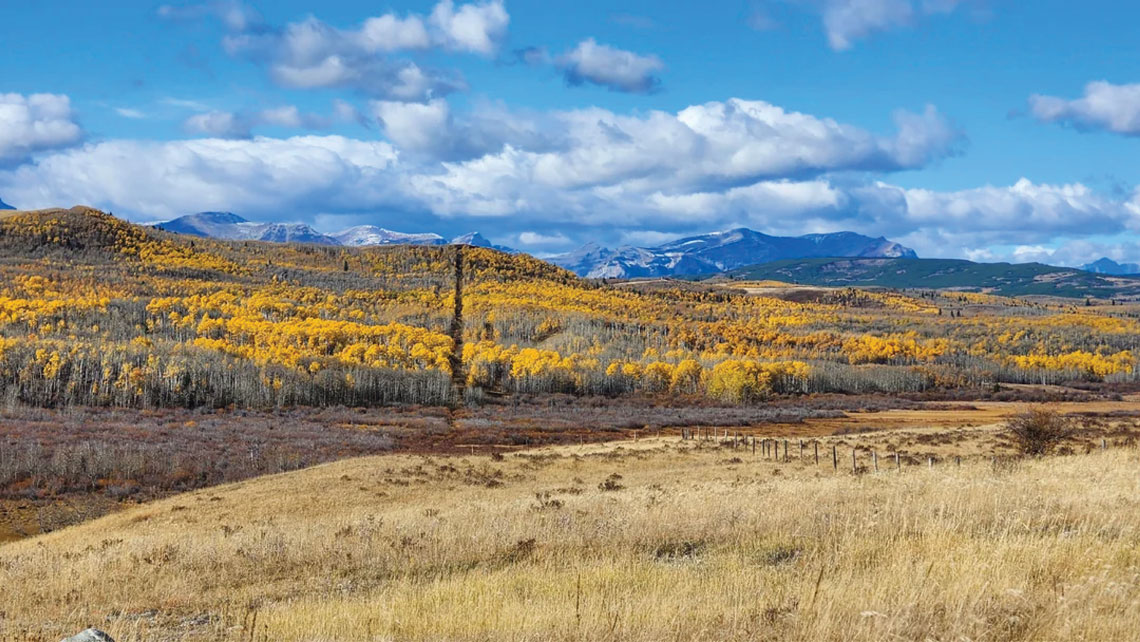
A six-metre-wide cutline comprises much of the Canada–US border, including between Alberta and Montana. The border has been undefended, but our provincial and federal governments are now spending big to “secure” it against trumped-up threats.
A week before the Banff conference was to start in spring 2025, I decided I would cross the border. I knew there was some risk of being denied re-entry into Montana. Trump’s raging hadn’t ended with illegal mass deportations. The US Border Patrol was harassing visitors and legal residents as they tried to enter the US; even unflattering opinions of the president on your smartphone could get you in trouble. But I wasn’t about to let some wannabe dictator in the White House determine whether I, a lawful, taxpaying citizen, could return to my country of birth to attend a conference among good people doing good works.
Besides, I couldn’t resist the opportunity to investigate premier Danielle Smith’s new interest in international border security. Traditionally, nation states secure their own borders against illegal incursions, but Trump was blackmailing the Canadian government with tariffs unless Canada “beefed up” its security to “protect” Americans against what he claimed was a scourge of fentanyl and illegal immigrants flowing across the border. Anyone with even a cursory understanding of America’s border problems knew Trump’s allegations were preposterous. Smith, however, jumped at the chance to impress a pathological liar who, we now know, was going to impose tariffs no matter what Canada did to solve a problem that didn’t exist.
Ever keen to encroach on federal jurisdiction and embarrass prime minister Justin Trudeau, premier Smith announced, on December 12, 2024, a $29-million “investment” in a brand new border security team. Fifty-one new provincial sheriffs would use dogs and drones and be given the power to make warrantless arrests to help make America safe again. Eventually Canada’s federal government acquiesced to the premier’s request to outfit the Alberta RCMP with one of Black Hawk’s eponymous war machines. All of this, supposedly, to appease Trump’s threat of tariffs by securing the Alberta–Montana border against an alleged wave of fentanyl and illegal immigrants.
“If we succeed and maintain proper border security,” Smith said in a live announcement, doing her best to imitate the head of state of a nation at war, “I expect we’ll have a very strong relationship with the United States, as we always have.”
I got a late start from Missoula on April 22, Earth Day, and when I approached the Carway crossing the late afternoon was already casting long shadows. It looked deserted. No cars or trucks. No border guards up and about on the US side. I crossed the line onto Canadian/Albertan soil and pulled up to the window. I pushed my sunglasses onto my forehead and handed my Canadian passport to a kindly female federal border agent.
“Where are you headed?”
“Banff National Park, for a conference.”
“How long will you be staying?”
“Five days.”
“Do you have any guns, alcohol, tobacco or marijuana?”
“No, ma’am.”
“Here you go. Have a nice day.”
I drove north into my homeland, the rugged rangelands of the Blackfeet Nation fading into green circles of irrigated cropland. Not a sheriff, dog, drone or helicopter in sight.
There are actually six crossings along the 298-km Alberta–Montana border. Most people use Carway–Piegan or Coutts–Sweetgrass, or, in summer, Chief Mountain in Waterton Lakes National Park. Few people live along either side of the border, where Coutts, with a mere 300 souls, is the biggest urban centre. On the US side, just east of Sweetgrass, a 10-mile stretch of Border Road connects to local roads in Alberta and Montana as if the border doesn’t exist at all.
Yet the area is now being described like a war zone. Trump said in his first Oval Office press conference in 2025 that Canada, like Mexico, was allowing a plague of fentanyl to cross the border, “killing Americans” and “destroying families.” He said Canada was allowing “mass numbers of people” across the border. As a consequence, he announced a plan for a crippling 25 per cent tariff on products from Canada and Mexico.
Trump’s words have little relationship to reality. Between 2022 and 2024, the US Customs and Border Patrol seized 61,900 pounds of fentanyl at the Mexican border, which is massive. At the entire Canadian border, a measly 59 pounds was found—less than 0.1 per cent of Mexico’s. The same pattern goes for unlawful border crossings. The number of illegal entries into the US from Canada has increased, from approximately 110,000 in 2022 to 200,000 in 2024, but this pales in comparison with the 2.3 million crossings per year from Mexico.
If US border agents were to search my computer, they could at best deny me entry. At worst they could detain me.
A 2022 report of the US’s Commission on Combating Synthetic Opioid Trafficking concluded that “Canada is not known to be a major source of fentanyl or other synthetic opioids or precursor chemicals to the US.” The US Drug Enforcement Agency, with its $2.6-billion budget and some 5,000 special agents, doesn’t even mention Canada in its 2024 National Drug Threat Assessment; Mexico, however, is mentioned 85 times. Likewise Canada isn’t cited in the US Customs and Border Protection’s May 2025 report America’s Frontline Against Fentanyl—but we do learn that the US spends $7.3-billion per year to “secure” the Mexico border, and has invested in “123 large-scale drive-through X-ray systems… to significantly increase vehicle and truck scanning rates across the southwest border.”
In spite of the facts, our own federal government at the time—with an election on the horizon and Pierre Poilievre claiming he’d follow Trump’s lead and send thousands of Canadian troops, agents and helicopters to “take back control of the border”—decided it had to do something. “Whether some of the allegations about what is going on at the border are accurate or not, or credible or not, I don’t have the luxury not to take it seriously,” Marc Miller, Canada’s immigration minister, grumbled in an interview.
A month after premier Smith had beaten them to the punch with her $29-million “investment,” the federal government announced its own $1.3-billion enhanced border security plan, which included 60 drones equipped with thermal cameras and two Black Hawk helicopters, one of them allocated to Alberta. It tightened requirements for the temporary visas that some visitors were using to arrive in Canada legally but then enter the US illegally. It introduced its Strong Borders Act to anoint a so-called “border czar,” presumably the first such czar in Canadian history.

Carway is Alberta’s second-busiest crossing: 4,000 vehicles daily.
Premier Smith, not to be outdone by the feds, threw in an additional $15-million to set up three more Check Stop-like vehicle inspection stations in Alberta, two of them kilometres distant from the border. She then channelled a maxim from historical US oil magnate John D. Rockefeller—“Next to doing the right thing, the most important thing is to let people know you are doing the right thing”— and invited Fox News to come up “to enjoy some world-class Alberta beef” and to show Trump—and sympathetic members of her own UCP—how quickly she’d done Trump’s bidding. “That’s what I think the president wants to see,” she said. “That we’re taking this seriously, that we’re going to stop the flow of drugs and guns and people across the border.”
Canadian security experts were underwhelmed. There is a degree of “border security theatre,” said Wesley Wark, a senior fellow at the Waterloo, Ontario-based Centre for International Governance Innovation. “We’re putting up hardware into the sky [such] as Black Hawks. We’re promising 24/7 surveillance designed to appease the United States.”
“If the premier wants to send sheriffs to the border, well, good on [her],” added Richard Huntley, who managed southern Alberta’s Inland Canadian Border Services Agency (CBSA) office in Calgary for 30 years. “But I can almost bet, in a year, they won’t have caught too much. I doubt it, sincerely.”
Predictably, both Smith’s and the federal government’s expensive efforts failed to appease Trump. His tariffs on Canadian goods not covered in the Canada–United States–Mexico Agreement increased to 35 per cent on August 1. Why? Because, according to a “Fact Sheet” seemingly conceived in an alternative universe, Canada deigned to retaliate with tariffs of our own (now cancelled) and continued in our “failure to arrest traffickers, seize illicit drugs, or coordinate with US law enforcement.”
It’s unclear how long Alberta’s border farce is meant to last, but it’s already proved fruitless and expensive. If Alberta’s sheriffs prove as adept at finding contraband as Canada’s federal border agents (which is doubtful), Smith’s “crackdown” will cost the public about $5-million per pound of fentanyl recovered. Alberta might also manage to detain and return a few terrified refugee families fleeing into Alberta, so that masked ICE agents can send them to whatever lawless hellhole the Trump administration has in mind.
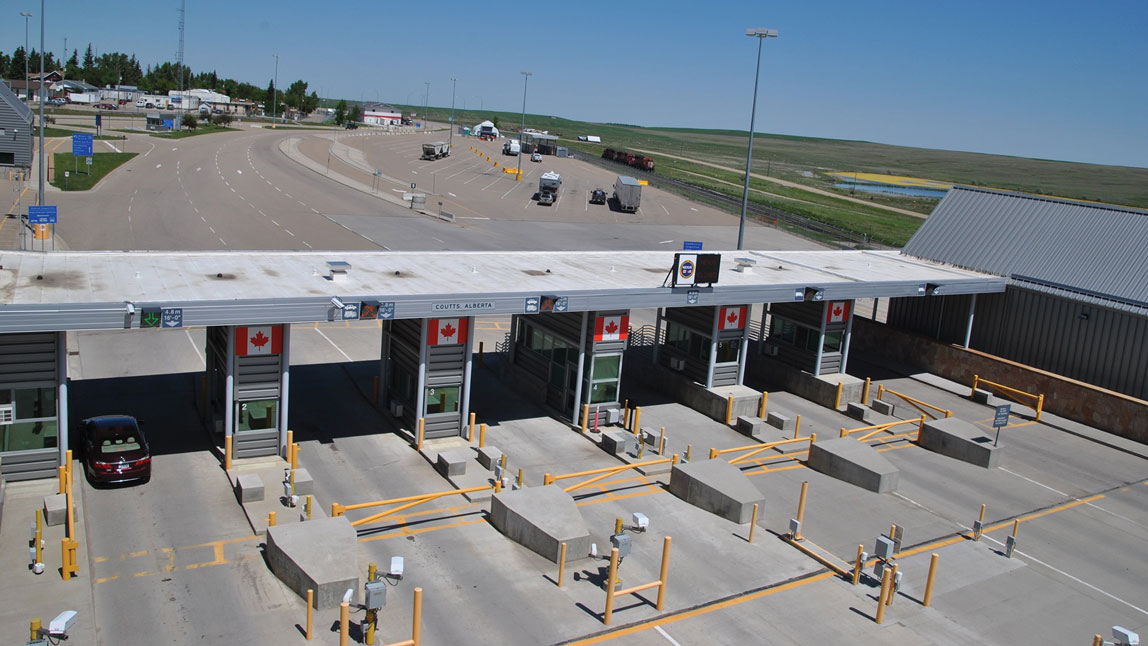
The 24/7 Coutts crossing is Alberta’s busiest, especially in summer.
The wildlife connectivity conference in Banff was excellent. I asked my Alberta colleagues what they thought of their province’s foray into international border security. Most of them, if they knew anything about it at all, just rolled their eyes and sighed. Some expressed dismay at the similarities between Trump’s and Smith’s relentless performative politics. As I left, they wished me luck getting back across the border. Some offered me a place to stay if I couldn’t return to my wife and Falu-red home.
I tried to clear my digital devices of disparaging remarks about Herr Trump. The task proved impossible. As an amateur scholar on the rise of fascism in my paternal family’s Germany, I’m acutely aware of—and have researched and documented—America’s slide toward authoritarianism and the Trump administration’s use of fascist strategies to foment fear and consolidate power. When I moved to Missoula 20 years ago, I became acutely aware of the racism, militarism and jingoism that imbued American society, not to mention the trove of military-grade firearms that have been stockpiled by civilians. I began to warn my American friends that their homeland was ripe for an authoritarian turn. They mostly said I was nuts.
I’ve sent countless messages and emails and made innumerable social media posts about the dangers posed by Trump and his ilk. Before I left Banff I stored as much as I could on the amorphous “cloud” and deleted most apps from my phone. My laptop, however, held an enormous trove of “treasonous” material I was loathe to part with.
The problem is that by the time you get to the US border agents, you’re already in US territory. You can’t just turn around and go back if you sense trouble. If agents were to search my computer, there’s every reason to think they would at best deny me entry. At worst they could detain me. And they might choose to teach me a lesson, to strike more fear into me or anyone who learned of my situation—which, after all, is why authoritarians stoke fear in the first place.
I wanted to try to cross at Coutts. Ironically, this is the site of the trucker protests in 2022, when 1,000 trucks blocked cross-border traffic for two weeks, and where the RCMP seized guns, body armour, a machete and a hoard of ammunition and high-capacity magazines. All of this was far more dangerous than a trickle of drugs and illegal immigrants. Yet premier Smith not only condoned the Coutts blockade but supported it.
Just as Highway 4 bends from south to east and I caught sight of the town of Coutts, I entered the Red Zone, a 596-km2 quasi-military area within two kilometres of the border, along the entire Alberta–Montana border, where sheriffs on Alberta’s new Interdiction Patrol Team can make their warrantless arrests, just like ICE does in Trump’s America. Legal experts say the Red Zone—enabled by provincial legislation in January 2025—is unconstitutional. “How did we get here?” asked professor Shaun Fluker on the University of Calgary’s law faculty blog. “This is the stuff of authoritarian dictatorships.”
Coutts mayor Scott MacCumber said some of his neighbours share Fluker’s concerns. They’re worried they could be apprehended while out for a walk or riding their quad. “What will constitute suspicious activity to the sheriff patrols and what will not?” MacCumber asked.
As I turned south, the border crossing looming, my amygdala fired up like a welding torch. My heart rate quickened. I looked at myself in the rearview mirror and thought about those fun-loving hippies being cuffed and dragged away.
And then, finally, there he was—a US border agent who had the power to ruin my life. I slowed to a stop and looked into the booth. My heart sank. With his long bushy beard and dark uniform, the man sitting before me looked like a Three Percenter hooligan in the insurrectionist mob that broke into the US Capitol on January 6, 2021, hoping to hang Mike Pence.
I smiled and handed him my passport, my green card tucked between its pages.
“Howdy,” he said. “Where do you live?”
“Missoula.”
“How long have you lived there?”
“Twenty years.”
“You have any alcohol or tobacco?”
“No, sir.”
He handed back my identification.
“Have a good day.”
“You too.”
A mile or two on, once I’d passed out of sight, I pulled over and leaned my head on the steering wheel. My cheeks streamed with tears. Not from the stress of the moment or the joy of making it back over the line, but because of the embodied knowledge that those bastards on both sides of the border are only just getting started.
Jeff Gailus is the author of Little Black Lies: Corporate and Political Spin in the Global War for Oil (RMB).
____________________________________________