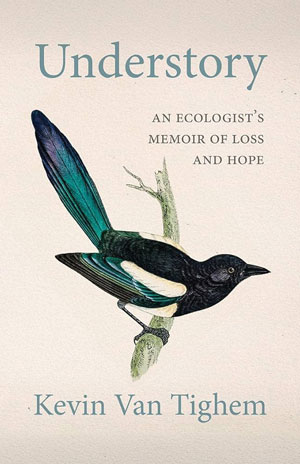
by Kevin Van Tighem
ROCKY MOUNTAIN BOOKS
2025/$28.00/320 pp.
Kevin Van Tighem is one of Alberta’s most prolific and influential conservation writers. His latest book, Understory, however, is his deepest, most profound work yet. The book is a searingly honest journey into the author’s life from boyhood to adolescence to a young man coming up the ranks of Parks Canada to become the superintendent of Banff National Park. Visceral and poetic, it delves beneath the surface, exploring Van Tighem’s own family history as settlers in southern Alberta, a wider culture of patriarchy and violence, and the tangled legacy that Judeo-Christianity, national parks and resource economy politics have left on Alberta’s landscape.
Understory begins with the unforgettable image of a Brewer’s blackbird, doused in oil from a refinery near Calgary, held in a young boy’s hands. For Van Tighem it marked “the beginning of the end of innocence,” from idyllic days marked by fishing for cutthroat trout with his father in southern Alberta, to searching for ways to repair a damaged world. Van Tighem writes about his young adulthood in the 1970s and early ’80s—hitchhiking to BC, skipping classes to study birds, and dropping LSD—at a time when Alberta seemed hell-bent on bulldozing roads and seismic lines and extracting a drug of a different kind: oil. The author’s coming-of-age realization that the land he loved was also abused was difficult for him to reconcile.
At times he was drawn to activism. In the chapter “Rivers,” Van Tighem shares memories from the fight to protect the Oldman River from being dammed in the 1980s. Paddling the waters and meeting and organizing with people who lived along the river’s banks helped catalyze Van Tighem’s writing career. In the battle to protect Alberta’s last major free-flowing river, he realized both the power of the pen and that “a river is more than just water.”
Perhaps most illuminating is Van Tighem’s unflinchingly honest look at his decades-long career with Parks Canada in Jasper, Waterton and Banff national parks. He confronts mistakes and assumptions he made, and that’s precisely what makes Understory such a satisfying read. The “fundamental mission” of the parks, he writes, should be to draw visitors into a more respectful relationship with nature. At times they do—in the chapter “Grey Ghosts” he describes a hauntingly close encounter with a caribou in Jasper National Park: “We were no longer separate, but together,” he writes. “I felt like this quiet animal had granted me a gift of belonging.” But his description of the politics governing woodland caribou management also shows how we’ve allowed this species to hurtle toward extinction. The parks are failing, he asserts, to change how we care for land and wildlife outside park boundaries.
Understory also questions the darker legacy of national parks, in which Indigenous communities were displaced from their lands and ways of life when the parks were created. In a closing chapter, Van Tighem focuses on a story from his final year as superintendent of Banff National Park, and the rebuilding of a relationship with the Iyarhe Nakoda First Nations, who were excluded from the park in the late 1880s. In 2010 Parks Canada signed a memorandum of understanding with the Iyarhe Nakoda to end their exclusion from the park—signalling a new way forward together. “Eight years after the Stoney people were finally welcomed home, the bison came home too,” writes Van Tighem. Now, over 100 bison roam the mountain valleys. Reconciliation, says Van Tighem, requires the painful task of trying to make sense of our individual and collective narratives on the landscape. “Stories can lead us home,” he writes. “I used to think I knew where that was. Now I listen and hope to learn.”
A lyrical reckoning that burns with honesty and a poetic balm for these perilous times, Understory is a book that will belong on my bookshelf for decades to come.
Trina Moyles is an author and journalist from Peace River.
_______________________________________
Read More from Rocky Mountain Books