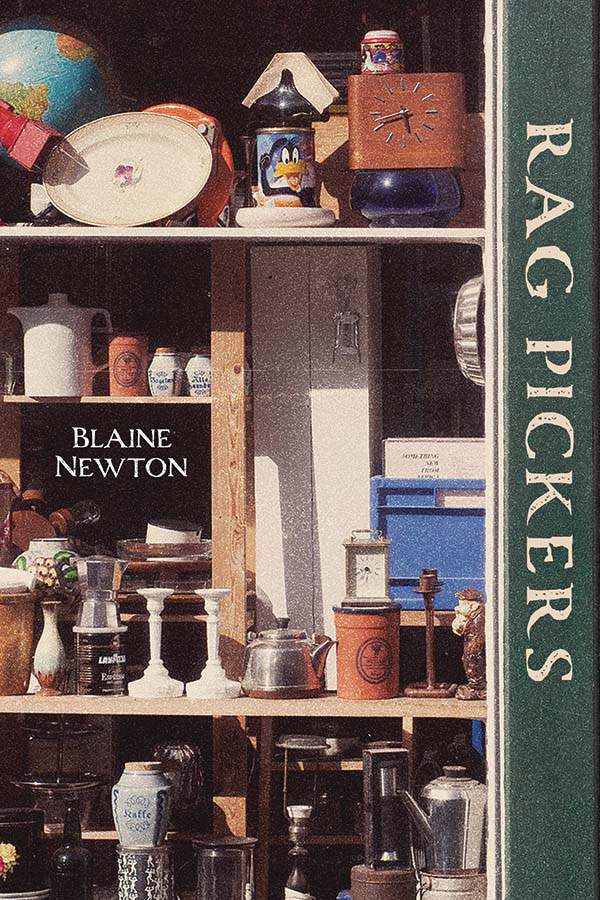
by Blaine Newton
UNIVERSITY OF CALGARY PRESS
2025/$29.99/182 pp.
According to philosopher Byung-Chul Han, “we no longer have any narratives that provide meaning and orientation for our lives,” as storytelling in the digital age is increasingly reduced to mere sound bites of distracted and disconnected information. Reading a short-fiction collection such as Blaine Newton’s Rag Pickers might be one kind of remedy. As its title suggests, the tales aren’t bent on ambitious puffery but are instead humble—and sometimes hilarious—pieces cut from the cloth of humanity. Newton is an award-winning playwright, and his first book features characters engaging with each other in a way that now, sadly, can appear old-fashioned.
The encounters are subtle, nuanced in a way Henry James would surely appreciate, emotive with melancholic perplexity, with characters who often appear out of place, who gaze anxiously from behind curtains, who, like the protagonist in the title story, receive cryptic and useless messages that state “I wish you were dead” concealed within a thrift store jacket lining. The longest story in the collection, “Conversations with Cows,” was a Fringe Festival play and, with its two acts, mirrors the production, in which a young couple wrestle with the shifts in their relationship occasioned by a widening gulf between the kowtowing of making corporate money and the freedom of creating art. Newton is able to impart an essential message here, but rarely with a heavy hand (though perhaps with a surfeit of accretive clauses).
Similarly to Stephen Leacock, Newton is adept with the mistaken identity plot (“Coffee Break”) and the satire (“The Reluctant Poet,” a laugh-out-loud romp in seven cantos). Although he is often funny, even down to incongruous similes, as in “The Ascent of Hank,” when the titular character compares his crush’s eyes to a “standard company-issue Bic Cristal,” Newton is even more attuned to the small gestures between the old and infirm and those assisting them as movers or carers.
Consistently, Newton makes the reader feel. Even as one is guffawing at the erasure of stick people on a divorcee’s car, one is stirred by the way the mother’s hands “that had carried the weight of the bags” were now “fists,” or the “wonderful loaf” William finally wholly accepts at the close of “Downsizing,” or the aged man who imagines himself back on the ice, shooting the puck with a boy he sees “from a distance” before realizing “Time is still and hard, the wind like a hand pushing my face away.” Han stresses that narrative can “stabilize life” with its attention to the temporal. Newton’s rag pickers hit this empathic cue: they slow us down, send us deep.
Catherine Owen is the author of Moving to Delilah (2024).
_______________________________________