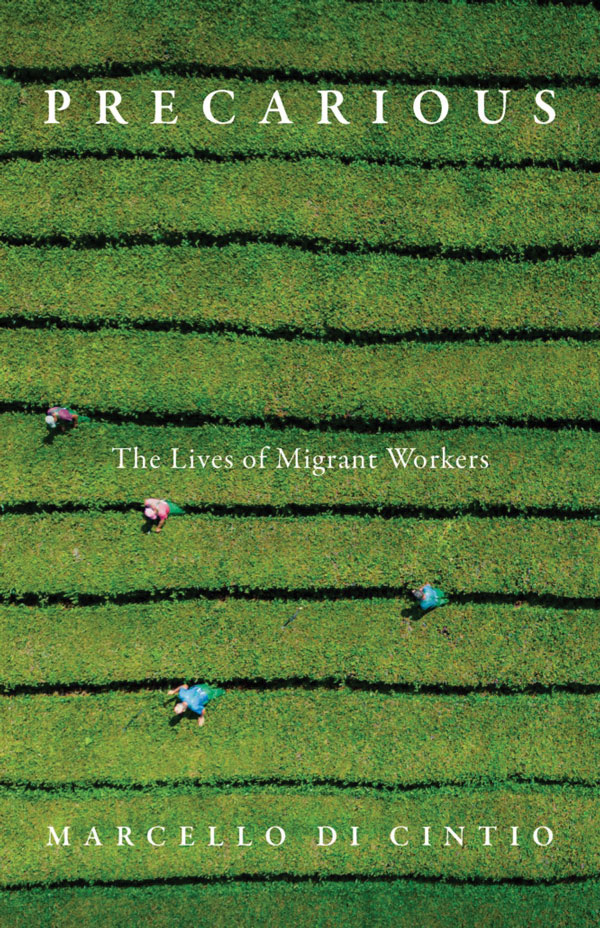
by Marcello Di Cintio
BIBLIOASIS
2025/$24.95/342 pp.
When you buy a coffee at Tim Hortons, do you think about who is serving you? Good chance they are a migrant worker, making minimum wage on a temporary work visa. What do we really know about the lives of migrant workers? For most Canadians, I suspect the answer is “not much.”
The stories of migrant workers are the beating heart of Marcello Di Cintio’s new book, Precarious. He offers deep and rich narratives of their lives and experiences, exploring their pasts, how and why they came to Canada and what their lives have been like since arriving. But unlike most accounts, Di Cintio gives us insights into more than just what happens at work. We hear of migrants’ romances, their joy at giving birth, the pain of being separated from family, the friendships they build. He tells us of farm workers’ soccer tournaments and the ordered chaos of grocery shopping day in a small town. The migrants in Precarious are complete, imperfect human beings, not just “workers” to be exploited and discarded.
Still, there is no escaping the stories of mistreatment at work. Di Cintio is unsparing in revealing the exploitation faced by temporary workers, who are often badly treated by employers, work in unsafe conditions and can’t exercise their rights. The stories are upsetting. They are powerful in their authenticity.
Precarious, however, is more than reportage. Di Cintio outlines the deeply racist history of Canada’s immigration policy and the equally racist underpinnings of its temporary-migrant programs. He outlines the various programs’ policies that create the conditions for mistreatment—such as closed permits that make it nearly impossible to leave a bad job, or the power employers wield through their role in caregivers’ achieving eligibility for permanent residency. One of his great strengths is to interweave these more critical, analytical elements among the workers’ stories, offering just what is needed to understand and contextualize their experiences. He also deftly inserts himself, travelogue-style, just enough to personalize the narrative while ensuring the workers remain the central focus.
Stories of agricultural workers form much of the book, with chapters on caregivers, international students, victims of labour trafficking and undocumented migrants revealing a mixture of different migrant worker experiences. While I know there is not enough room to explore everyone, I would have liked to see an even wider range of stories, such as from workers in construction, retail and hospitality, or those from Eastern Europe and Africa. Including them would really bring home his point that most of us have a narrow stereotype in our minds of what a migrant worker is.
Di Cintio bluntly reminds us these temporary-migrant programs are built to create exploitation by rendering migrant workers as “permanent outsiders.” And he does not spare us as Canadians. He was finishing the book at the height of our anti-Trump “elbows up” phase last spring, a patriotic Canadianism he finds ironic. “[O]ur treatment of migrant workers,” he writes, “stands as an aggressive contradiction of who we consider ourselves to be.”
Precarious does not offer solutions, which may cause it to end more pessimistically than hoped. But solutions are not Di Cintio’s, or migrant workers’, job. It is up to us, as privileged permanent residents of this land, to speak up and be the voice for political change.
I want to say this book is recommended reading for anyone who is concerned about the treatment of migrant workers in Canada. But what I need to say is that this is a must-read for anyone who has never thought much about the migrants living among us. After reading it, hopefully you will finally see the human being pouring your double-double.
Jason Foster is the director of the Parkland Institute and the author, most recently, of Gigs, Hustles & Temps (2023).
_______________________________________