The soil of the tilled fields and prairie near Bow Island in southeastern Alberta is dust, the same dust that Captain John Palliser might have tried to brush from his clothes in 1859. The Irish country gentleman, hired by the British Crown to survey the economic potential of the land between Lake Manitoba and the southern Rockies—the area now known as Palliser’s Triangle—wrote in his journal that the land here was “relatively useless to agriculture” and would forever be unfit for settlement.
Evidence in the surroundings shows that Palliser was correct, for a time. Patchy remnant shelterbelts of hardy caragana and feral crabapple trees and the unpainted, wind-tilted shacks and timber-gutted barns of old farms mark like gravesites the long-ghostly hopes of early-century dryland homesteaders, their dreams long-since blown away like dust by bad farming practice and countless chinooks.
But today, where the broken dreams and mostly unbroken prairie had been, there are now leafy greens, ochred seedheads and shiny golden stubble of a dozen kinds of cash crops. Leggy-wheeled, spray-fuzzed irrigation pivots spread in all directions like aluminum-and-rubber centipedes, each nearly half a kilometre long. And near and far, clutches of shiny galvanized steel bins rise—tonnes of grain in each.
Those early, failed homesteaders might be mystified at the prosperity of this remote corner of the province today. John Palliser would be stunned. The first answers to this mysterious reversal are in the landscape itself. The useless land Palliser referred to was actually an area of mixed sandy loam soils, well suited for growing high-value crops such as vegetables, but too porous to hold water. And whereas the great plains to the east are flat and largely featureless, the land here slopes in great ocean swells gently down toward the hidden valley of the South Saskatchewan River. After the dustbowls of extreme drought in the 1930s drove most farmers off this land, the province invested heavily in the 1950s in industrial-scale irrigation systems that brought water from the South Saskatchewan up onto the shortgrass prairie.
Adding water to sandy loam in a region that receives the highest number of sunshine hours per year in Canada wouldn’t have been enough for such a transformation, though. The other critical ingredient that would make this land flourish is here, in the din of a potato harvest operation run like a military campaign, with pop-up factories, fleets of trucks, and dawn-to-dusk frenzy: an army of temporary labourers as available, cheap and disposable as the water of the river below.
In the main farmyard where the potato factory is set up, the driver of a full spud truck performs a lumbering yet precise manoeuvre, slipping around an emptied outgoing truck and pirouetting into a waiting position. He looks for the signal to reverse from the backer, a Cree man of slight build, 64-year-old Elmer Crookedneck. Elmer is dressed in safety gear and giving signals like an aircraft marshal on a flight deck. When the truck is in position at the factory’s receiving conveyor under Elmer’s guidance, the driver—another Cree man, stocky, in jeans, rodeo buckle and cowboy boots, 58-year-old Dwayne Ernest—jumps from the high step of the truck to scoot back and help Elmer with the controls of the tipper bed. The two men shout to each other over the din while they work buttons and levers, and another five tonnes of large, dirt-clad golden potatoes begins to roll out of the tipper chute in a steady stream onto the conveyor.
Dwayne spends a few minutes helping Elmer with “grading,” the primary job at a potato harvesting factory. The two scan the stream of spuds rolling up the conveyor towards the first giant holding bin, and reach over the clattering belt to grab and throw into smaller loader bins behind them whatever they can of the rocks, damaged spuds, potato vines and lumps of clay the size of footballs: anything that is not a good potato.
The tipper empties, and Elmer directs the change-out of Dwayne’s truck for the next in under a minute. The river of potatoes rumbles up to the belt past two Mennonite boys working brooms under the conveyor and passes by the watchful eyes and quick hands of six Mennonite women in the wooden grading shack built over the conveyor behind the second holding bin. The stream of spuds will spill onto another conveyor and travel 80 feet or more past five more Mennonite women graders, then climb past two Mennonite men working at another conveyor that angles high into the mouth of the nearest of the two giant storage bins. The fully graded stream of potatoes will finally pile out where two more Mennonite women are moving high and deep in the shadows of the bin, directing the unloading end of the conveyor.
None of these workers nor most of the dozens of truck and tractor drivers and other workers are permanent employees of this farm. They are what economists call “reserve armies of labour,” underemployed populations available and ready to show up for a few weeks at harvest time when suddenly thousands of drivers and backers and graders and pilers and sweepers are needed on farms across southern Alberta, to work like mad until the fields are empty and the bins are full. And people like Elmer and Dwayne and a handful of others represent the last of the forgotten army of thousands of Cree workers—mostly from northern Saskatchewan—who for crucial decades were critical to farming operations like these and instrumental in building this corner of the province into the vast, wealthy agricultural empire it is today.
An army of temporary labourers is as available, cheap and disposable as the water of the river below.
Few Canadians know the legacy of Cree people from Saskatchewan working on southern Alberta farms. The Potato Growers of Alberta’s 50 Years of Working Together commemorative book at the old irrigation museum in Taber does not contain a single photo or word about Cree workers in any of its 400-plus pages. Even the Dutch-Canadian farmer I met a few kilometres from here didn’t seem to know much about Cree workers. “I used to use Dutch exchange students,” he says with a shrug. “Now I only use Mexican Mennonite workers.”
Yet many untold thousands of Cree people have worked on southern Alberta’s farms in the last half century, especially in sugar beet and potato production. Ron Laliberté—a Métis man and retired professor of sociology and indigenous studies—spent months interviewing Cree workers and beet farmers in southern Alberta in the early 1990s. He says the Canadian government began recruiting Cree labourers for sugar beet farmers after the latter lost easy access to labour by Japanese-Canadians “evacuated” from BC during the Second World War. The first buses in 1953 brought 120 Cree workers. By the 1980s the number had climbed to 3,000 Cree workers and at least 2,000 Metis and non-status Indians per year—the largest employment of First Nations people in Canada since the days of the fur trade. By the 1990s Cree workers made up 85 per cent of the labour force on sugar beet farms. During some seasons, up to 95 per cent of the men of some reserves in northern Saskatchewan were working on farms in southern Alberta.
Laliberté says that for those not willing to come of their own accord, the sugar beet industry pushed the government to cut social benefits during the months the Cree workers were needed down south. He says the Cree workers, always using humour to cope, started calling themselves “Grab-a-hoe Indians.”
The work at the factory pushes on under floodlights until nearly 9:00 p.m. The Mennonite boys and young women head straight for their family homes in the surrounding hamlets and farms. Elmer, Dwayne and two more Cree men—Dwayne’s brother Clem Ernest, 47, and their nephew, Jeremy Crookedneck, 27—make a quick supper in the shop kitchen, the same as they had for lunch: ham sandwiches with Velveeta slices and cans of Coca Cola. They take turns in the single shower and climb the stairs up to a storage room above the kitchen where they have four cots, a small living area for boots and gear carved out of a jumble of racks, boxes, desks and old computers. When I arrive, Dwayne is seated on a cot at the back of the room, pulling off his boots. “It’s his birthday today,” he says, pointing with his lips, Cree-fashion, toward the bed across from him, where Elmer is already asleep.
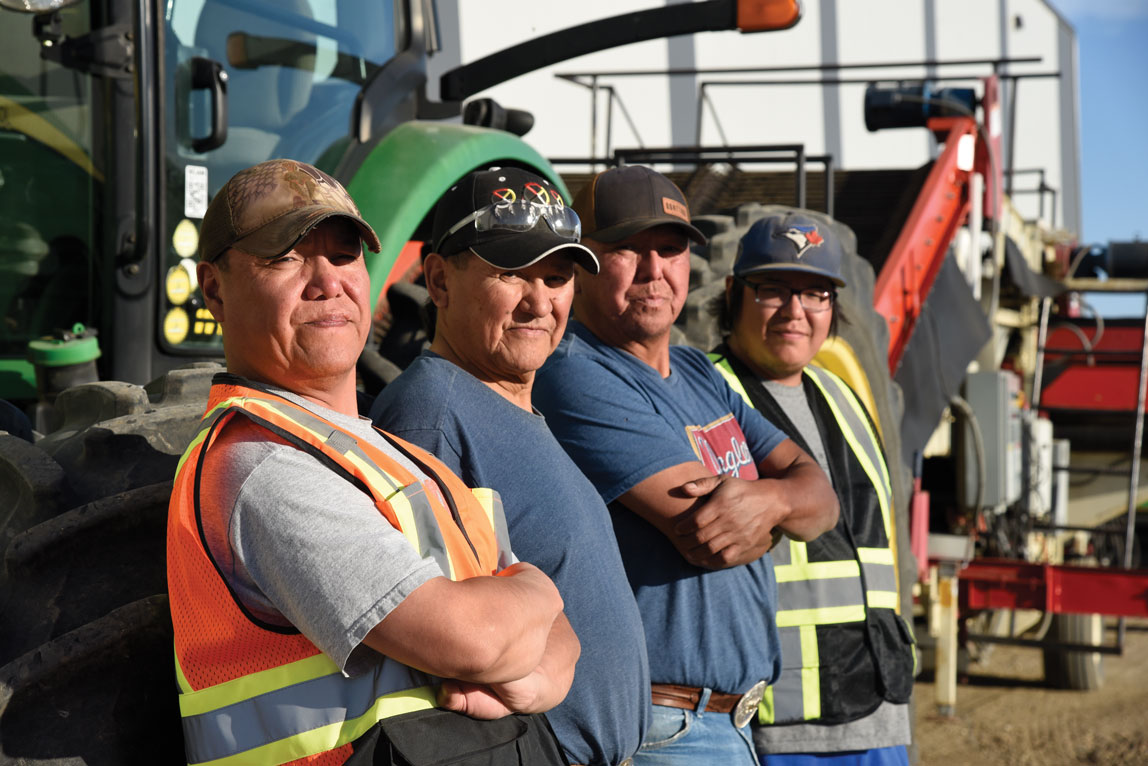
Left to right: Clem Ernest, Elmer Crookedneck, Dwayne Ernest and Jeremy Crookedneck.
I have known these men’s families since I was a boy and my preacher dad would take our family to the Little Island Lake reserve at Ministikwan, Saskatchewan, for camp meetings. Dwayne’s crews used to meet me at the racetrack in Lethbridge on a Sunday afternoon every harvest. After the races, we would have a kind of Thanksgiving dinner together at my house. Ten years ago my dining and living room would be full of Cree men and women around the table and at TV trays. Last visit, there were only five Cree men at our table, no women. This season Dwayne told me there would be only four in the crew, and they didn’t have gas money to make it to Lethbridge on the Sunday. I asked to come out to the farm at Bow Island to witness what might be one of the last crews, before their people’s legacy of work here fades away, unremembered.
Elmer wakes up, turns and sits on the edge of his cot. His T-shirt has the picture of a rodeo bronc rider and the words “Bucking Cancer!” on the front. He has been at the work for nearly a week already. He looks weary. He speaks to Dwayne in Cree for a few moments before turning to speak with me.
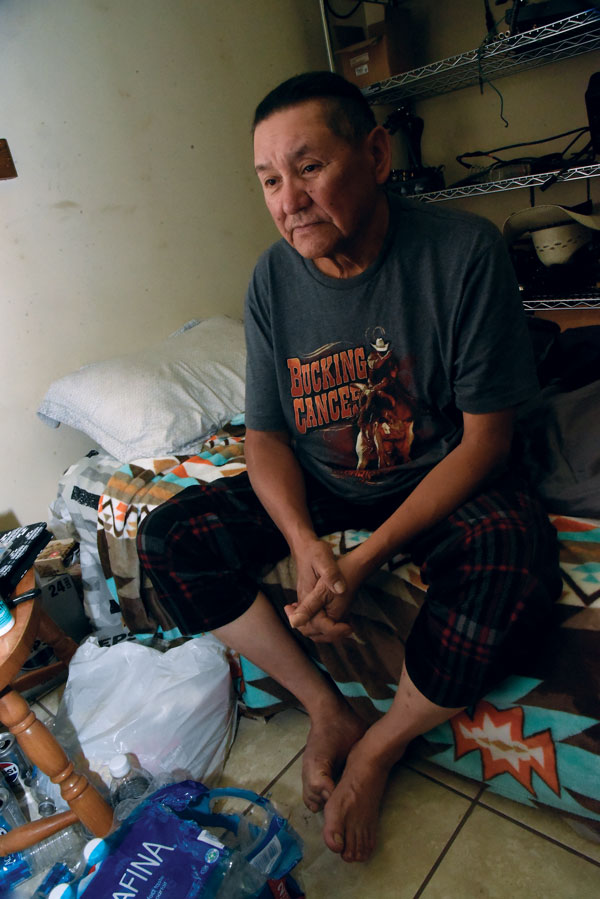
Elmer Crookedneck.
“One of my first memories is coming down here by bus from Meadow Lake,” he says. “We stayed at a house in Vauxhall, my whole family. I started hoeing sugar beets when I was 10 years old. A few years later, we started working potatoes, and have ever since. One of my sons was born here during a harvest 24 years ago.”
Elmer says this is his first job since he was diagnosed with prostate cancer five years ago. After surgery, the cancer was still there, so he had to do radiation therapy. He tried to work driving heavy equipment after the radiation but couldn’t last more than a few hours a day. He says he took this job because he has family to support, kids and grandkids, one living with him. “And I would rather work than get money for free.”
The next day I tag along with Dwayne in his spud truck to a harvest “circle” about 20 km from this farm, one of a conglomerate of five farms called Quattro Ventures Inc. Irrigation farmers use the term “circle” to mean the 130 acres that an irrigation pivot can cover out of the 160 acres of a typical quarter section. This conglomerate farms 162 circles, or about 23,000 acres, with 40 per cent of them dry, 60 per cent irrigated. The company agronomist, Emily Ford, says that because potato crops must be rotated to prevent scab and other diseases, they follow a “one-in-six” rule, only planting a circle with potatoes once every six years. So, to be a potato grower, you need access to a lot of land. In the off years the company will plant other high-value crops such as peppermint, beans, peas, seed canola and hemp. But potatoes remain king. (Estimated value in southern Alberta: $3-billion per year.) Ford says because of increasing water scarcity, the irrigation district allocates only 10 inches of water per year per acre for potatoes. She says a good crop requires 18 inches of water, about 1,800 cubic metres (nearly half a million gallons) per acre. Farmers cover any deficit by borrowing water allocations from their other, less water-intensive crops such as wheat.
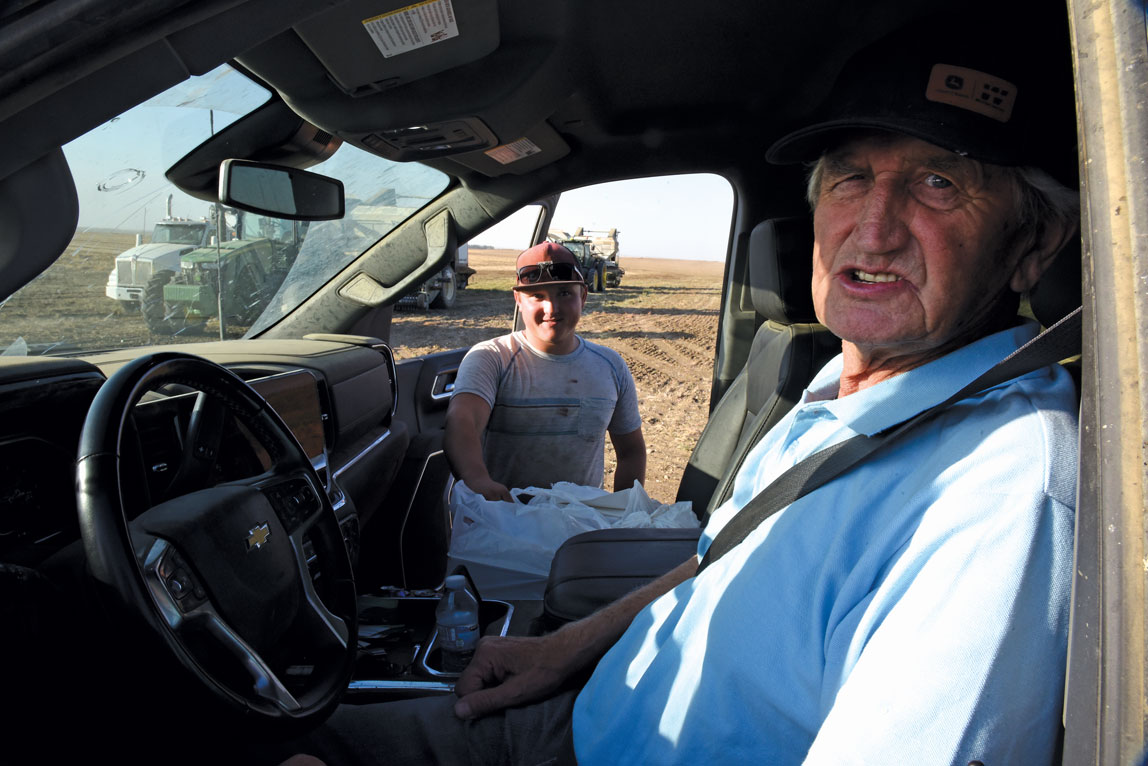
Neighbouring farmer Tony Varekamp delivers meals to Corny Neufeld and other Mennonite workers.
Dwayne, like Elmer, has been working on southern Alberta farms since he was a boy and has spent the last 22 years working for this one. He says he can make more money in three days here than in three weeks of driving school bus back on the reserve. He also drives truck for the farm during spring planting and other harvests. In total, he works here about three months of the year. He says he keeps coming back because of his friendship with the farm owner, Lloyd Ypma. Each season, he tries to recruit other people from the reserve to come work with him. Fewer come each year.
At the field, Dwayne steers his large “tipper” truck into position at the end of a furrow and waits for the call to tag-in when the harvester has filled the truck ahead. The harvester pauses only moments for Dwayne’s truck to line up under the unloading spout, then the machine and truck move in tandem at pace, both harvesting and transferring the fresh spuds simultaneously. The moving transfer takes only five minutes. The harvester waves off the filled truck and calls in the next. Dwayne drives back to the main farm in the blinding dust of other trucks, artfully dodging trucks from other farms at gravelled intersections, no thought of slowing down.
The reason for the hurry is in the grey sky to the north. Farmers grow potatoes as late into the season as they can for maximum yields, but if they don’t get the crop off before the first freeze, an operation like this can lose millions of dollars in a single night. Drivers like Dwayne wake at 4:30 a.m. to be out to the circles by 5:15. The factory crew starts at 5:30 when the first loaded trucks are coming in, and everybody works until the last trucks come into the factory well after dark, unless the weather is too hot. Operations shut down for heat, not out of concern for the crews but because putting hot potatoes into cool storage bins could cause the whole lot to rot.
Because of the frenzied pace of the work and the exhaustion of the men at day’s end, it is hard to interview some of them during the week. But as most of the potato farms around Bow Island are owned by church-going Dutch Calvinists, the crews get Sundays off and sometimes a Saturday evening like this one. I find the Ministikwan crew sitting in camp chairs in the dark around the tailgate of Dwayne’s pickup parked in the farm shop—now eerily quiet—sharing a pack of Bud Lite.
The men tell me Elmer has already gone to bed. They call him “mushum,” the Cree word for “grandfather.” Dwayne and his brother Clem have been visiting quietly, nursing their beers, while nephew Jeremy plays a game on his phone, coping. When I take out my camera, Dwayne and Clem hide their beers. Even though it’s only a few hard-earned drinks at the end of a long week, they know the stigma about Native people and alcohol.
Jeremy puts his phone away for a few moments to tell me this is his first harvest and first real job. He says he wishes he had weighed himself before he came. He had trouble staying on his feet the first few days, backing trucks and chipping soil from the inner sides of their tipper beds, but has adapted and feels like he is getting into shape. He wants to get a permanent job when he gets home to the reserve. His uncles tell him they’re proud of him.
Clem is quiet, serious, a deep thinker with a strong jaw. Tonight is the first time he speaks to me. He asks if I know how many Native people have lived on these lands, how many languages they speak, how many thousands of years they have been here. And how many Cree people used to work on these farms.
He tells me about seeing old photos of his grandparents and parents hoeing sugar beets, thinning and weeding in the blazing heat, sometimes three times per field per season, through spring and long summer days. “It looked like the cotton fields down South,” he says. “The pay was something like that, too.”
Clem and Dwayne confirm what Laliberté says he heard when talking with Cree workers in the early 1990s. Cree people started to lose their place in the sugar beet fields in the 1970s when farmers started bringing in dual-nationality Mennonites from colonies in Mexico, who would work for less money, sometimes bidding for fields at half the rate that Cree people were paid. When farmers started using newly invented herbicides to get rid of weeds in the 1980s and 1990s, the “Grab-a-hoe” jobs disappeared altogether.
By the 1980s, 3,000 status Cree and at least 2,000 Métis harvested sugar beets in southern Alberta.
Meanwhile, Cree men and women had started working potato harvests in the late 1960s. Sugar beet farmers needed large amounts of labour during the growing months but just a few drivers at harvest. Potatoes needed little work in the growing season but massive reserve labour for harvest, especially for grading. The Cree first worked for the same Japanese-Canadians who had come as involuntary labour from BC for sugar beet farms in Alberta during the war. Many of those Japanese families had had market gardens in BC, and by the 1950s started to buy small plots to grow vegetables for market in southern Alberta. When the Japanese introduced methods of flood irrigation using now available water from the South Saskatchewan, they showed that money could be made in growing potatoes. And when they bought more land, and their machines could harvest four or eight or sixteen rows instead of two, and farms became too big to run with family labour, these early Japanese farmers had access to an army of reserve labour already available: the Cree workers from the sugar beet fields.
Japanese-Canadian farmer Mas Nishima, 88, of Taber, tells me that without the Cree workers, many farmers would have had to plow their crops under. “They saved my farm and a lot of other farms in southern Alberta,” he says.
With all the elements for success—the know-how, the sun, the soil, the water and the cheap, available temporary labour—the potato sector exploded. New processing plants followed. Then came Dutch-Canadian farmers from Ontario with money to buy land and equipment and go bigger. Many of them had no history working with Cree people, no memory of them, no special ties like friendship.
Clem explains that in the early days, there were only Cree people working sugar beets and potato harvests, on every farm. “What you see here today, the Mennonites, that was all us back in the day, men and women,” he says. “Then we got pushed out. The Mexican Mennonites worked cheaper.”
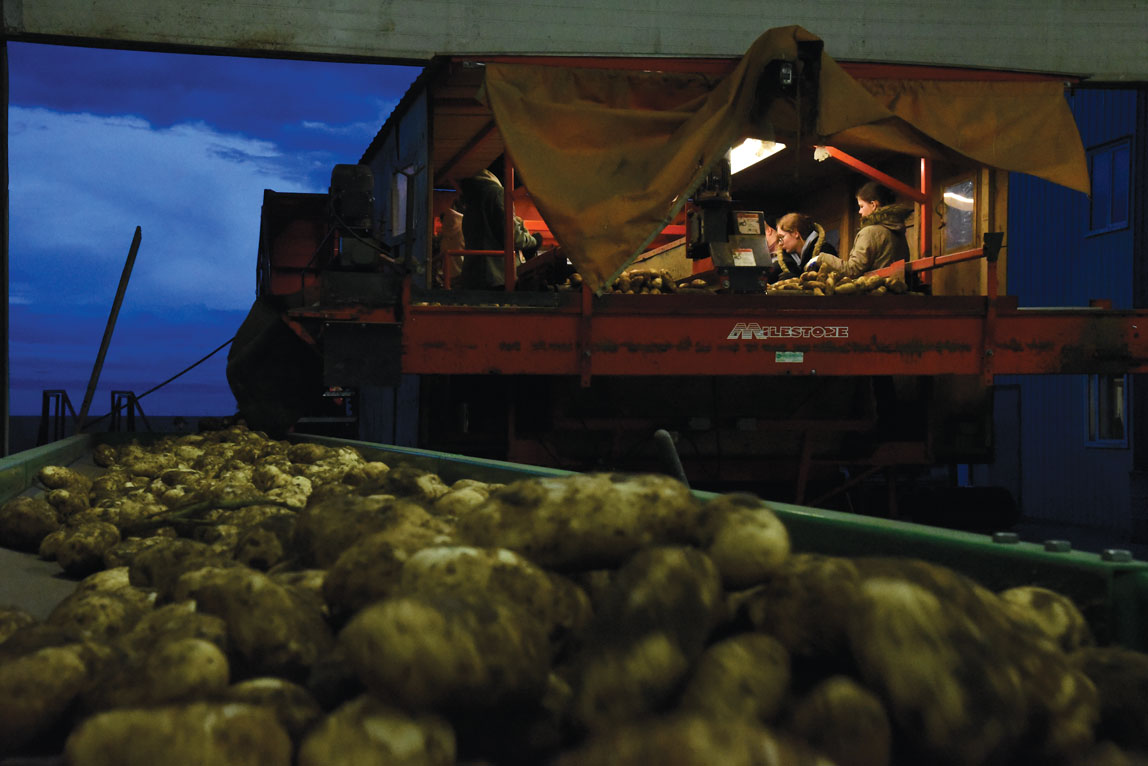
In the pre-dawn chill, Mennonite women grade potatoes on the conveyor
Just as importantly, according to Laliberté, after those Mennonite families settled permanently in southern Alberta, they became more immediately available than the Cree from northern Saskatchewan. Cree families would come back the next season and go farm-to-farm looking for work, only to find their old jobs had already been given away. And some farmers, and Cree people themselves, would say that Mennonite workers did not have the same problems with alcohol that made some Cree workers—most of them survivors of residential schools—“unreliable,” especially after a few weeks of hard labour, long hours, no rest and bad living quarters, often just abandoned chicken coops or cow sheds. Mark Miyanaga, co-owner of Triple M Farms near Taber, later tells me that despite any problems a small number of Cree workers did have with alcohol at times, they were as a whole as reliable and hard-working as anyone.
Laliberté says that remarkably, however, he never heard of any conflict between the Cree and the Mennonites or other people who replaced them. Clem confirms this: “Our people are good to get along with,” he says. “Whatever happens, happens.”
Elmer and Dwayne know of only two more crews of Cree men in the area. Cousin Emil is working on one nearer to Bow Island, and cousin Brian is working on a Japanese-owned farm near Taber. “Brian says that farm is going to be hiring ‘Mexican Mexicans,’ next year,” Dwayne says, using air-quotes. “Real Mexicans.”
“So, this might be the last year they hire any Cree people,” he says.
“Yeah, but we’ll still be around,” Clem says, jutting his jaw a little more. “Just maybe not here.”
I check in with Elmer throughout the following week. He never slacks off in the work. But on the next Thursday night, after nearly two weeks of standing on his feet backing trucks in, 15 hours a day, his ankles swell to the size of his knees. The pain keeps him awake all night. On the Friday morning, the swelling is too much for him to put his boots on. “I wanted to stay until the end,” he tells me. He will drive the 700 kilometres home alone that day, bringing the number of the last crew down to three.
Virgil Grandfield is grateful to Lloyd Ypma for letting him camp at his farm and document the work of Dwayne’s crew.
Text and photos by Virgil Grandfield
____________________________________________