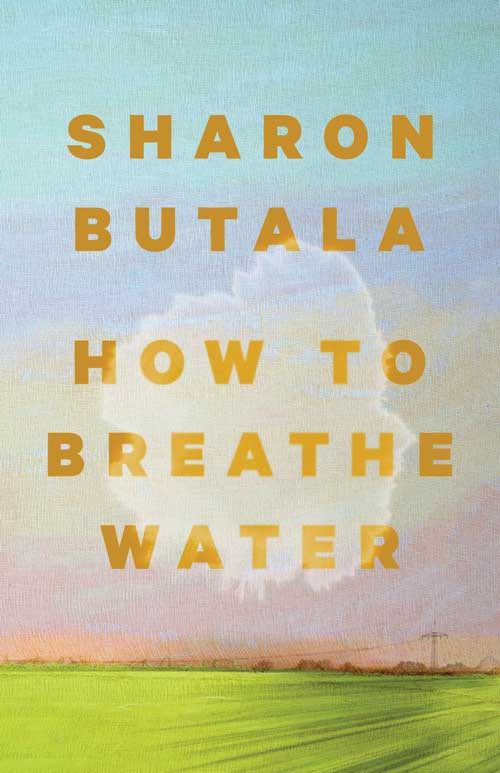
by Sharon Butala
FREEHAND BOOKS
2025/$24.95/250 pp.
How to Breathe Water, Sharon Butala’s 23rd book and third memoir, begins when a friend invites her to visit the Museum of Human Rights in Winnipeg. Almost 81, Butala recognizes the trip might be her final opportunity to immerse herself in the prairie landscape she’d once lived in and loved. Luckily for us, she accepts the invitation.
Part prairie history and part manual for how to navigate memory and age with dignity in an ageist culture, the memoir uses the one-week road trip in July 2021 as its frame. Travelling the Trans-Canada Highway and quieter backroads, Butala finds that town names and places stir “the ceaseless drip of memory” and lead her to cover a host of topics: traumatic early childhood memories, relationships with her parents, Canada’s shameful history with First Nations people, grief, loneliness, isolation and a longing for home.
The author writes of her long-held belief that she’s on the outside looking in. Ostracized in her early career for writing about people in a rural community where “anyone not born there is almost never fully accepted,” she also feels somewhat left out of the writing community, in part due to the stricter cultural expectations for women artists, who are often described as “neglectful,” especially if they are mothers who focus on their art “rather than on their children.” Addressing the scandal that followed Alice Munro’s death (Munro’s second husband had sexually abused one of Munro’s daughters), Butala, nine years younger but of the same working-class rural background, situates Munro’s response within the early teachings she would have learned: “Life is bitterly hard… nobody gives a damn about you… suck it up… and never forget that you’re on your own.” Being hurt was part and parcel of being alive, and it was best not to talk about it. Butala doesn’t apologize for Munro’s actions, nor does she feel the need to; rather, she places Munro’s response within a cultural context. She wasn’t “Saint Alice.”
Butala’s greatest gift is her language. Her descriptions of prairie landscapes and endless skies make the seemingly ordinary extraordinary. Wind is “not a flashy hot or a pale peony pink, but a dulled brownish pink.” It moves “so fast that the poplars… snap and dance in expectation.” Readers feel the humidity and heat that cling to the air-conditioned car and make sleeping in an upstairs lodging at a bed and breakfast impossible.
The recipient of numerous awards and honorary doctorates, Butala examines her career and wonders what she might have missed as she laboured obsessively over manuscripts that “seemed more important than actual life,” especially in a publishing world that tends to celebrate the “new and emerging” writer while shelving the “seasoned” one. And what a loss, for “in the revisiting of life that the old seem to need to do, often we see events in a new light,” and “even allow ourselves to conclude different things about who we are and who we have been.” These are valuable lessons for readers and not to be missed.
At 85, after living for 15 years in Calgary, Butala succumbs to her deep regional attachment to Saskatchewan and returns. The move nearly kills her, she writes, but in Saskatoon she has “memories in many corners.” In Saskatoon, “I know who I am,” and for the memoirist, that’s critical information. Smart, honest and moving, How to Breathe Water is a profound meditation on family and history, an elegant exploration of mortality and a clarion call to strive “for a life fully lived.”
Theresa Shea’s third novel, Dog Days of Planet Earth, is forthcoming in fall 2026 with ECW Press.
_______________________________________