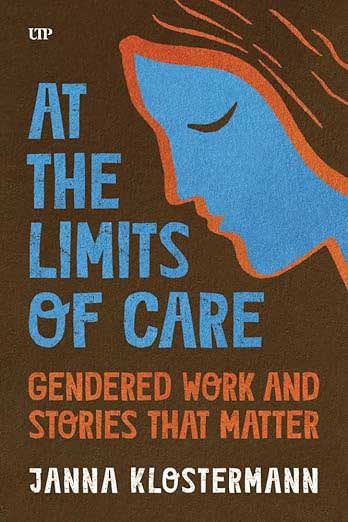
by Janna Klostermann
UNIVERSITY OF TORONTO PRESS
2025/$24.95/188 pp.
Janna Klostermann’s new book, At the Limits of Care, comes at a necessary time. The book looks at the lived experiences of careworkers, who even after the COVID-19 pandemic remain unappreciated for their work. Klostermann, a sociology professor at the University of Calgary, drew upon her graduate research for this book, in which early on she writes candidly of her time working at L’Arche, an international non-profit organization of communities that provide support to people with developmental disabilities. It was this work, and the experiences of hard, underpaid labour and structural challenges (defined now as “moral injury”) that contributed to a deterioration in her mental health and to leaving the agency, and the work, behind.
Motivated by her experience at L’Arche, Klostermann went on to study the conditions in which careworkers labour, focusing in particular on the intersection of carework with gender. Many carework jobs, such as in the non-profit sector and healthcare, are female-coded, and the work is undervalued and underpaid. Some of the interview participants she spoke to for her research (described in the book) are open about their experiences, while others are hesitant and fearful to speak. In non-profit organizations that provide services to people with developmental disabilities, nearly all the jobs are non-union and are done mainly by women and immigrants. I also began my social work career in this field and heard stories from many careworkers about the fear they had in advocating for themselves—stories of being given the most challenging clients and of work visas “mysteriously” unrenewed.
At the Limits of Care still has traces of the academic thesis it came from, with passages on methodology that the average reader might glide through. Those readers would benefit from absorbing the whole. Klostermann’s narrative voice is strong and has authority, and the process-on-process structure of the book is key, I think, to its central concern. Carework is personal, situated in relationship and in the body. How do we keep those values of care and service, however they are defined, she asks, while not exploiting the people who provide it?
By the book’s end, I couldn’t stop wondering—I still am—what comes next. Klostermann imagines possibilities of how we might redefine carework to make it more equitable. I fear, however, that the careworker’s experiences of burnout relayed in detail in the book leave little room for hope. Greater recognition of carework is needed. And maybe, for myself and anyone involved with carework—all of us, really—it’s about reckoning with that word “limits.”
Bryn Evans is a writer and social worker in Calgary.
_______________________________________