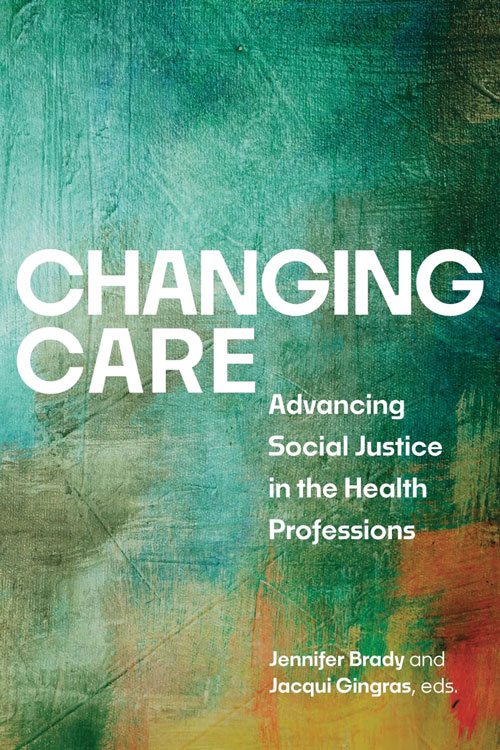
edited by Jennifer Brady and Jacqui Gingras
UNIVERSITY OF REGINA PRESS
2025/$45.95/384 PP.
As an anthropologist-turned-doctor that cares for people who are at high risk of poor health outcomes yet also face the highest barriers to care, I found Changing Care: Advancing Social Justice in the Health Professions to be a lifeline. Edited by two Canadian feminist scholars—dietitian Jennifer Brady and sociologist Jacqui Gingras—the book is rich with subversive strategies, examples and practical tips demonstrating not only why but also how we can arrive at more socially just health and social care. The collection transcends discipline-based silos while challenging oppressive practices and structures. Drawing broadly on anthropology, nursing, social work, occupational therapy and more, the authors guide us through geographies traversing classrooms, clinics and communities from coast to coast.
Sarah L. Dobrowolski’s chapter, “Critical Rooting,” will resonate with those who feel that education of healthcare providers too often promotes a detached, scientific “gaze” while disregarding, in the name of objectivity, the practitioner’s own position vis-à-vis patients and clients. Dobrowolski describes how we can counter such habits by practising and teaching “critical reflexivity,” a “process of deepening our understanding of who we are and how we are in relationship with others.” This focus, she explains, better equips healthcare providers to create and sustain a collaborative, social justice-oriented practice.
“Documentation as a Tool for Oppressive Violence and Resistance,” a practical chapter by occupational therapists Marie-Lynn Grenier and Janna MacLachlan, challenges the myth of healthcare practitioner neutrality. How we document clinical encounters is identified as a “deeply political act” that wields “the potential to either sustain or resist dynamics of power and hegemony.” Moving quickly beyond theory, the bulk of the chapter workshops how to teach and model clinical charting and note-taking in a way “that includes the service user’s truth, affirms their rights and recognizes/honours world views other than the ones held by Western institutions.”
At the peak of the COVID-19 and drug poisoning epidemics, many jurisdictions in Canada were instructed, for fear of virus transmission, to cease rescue breathing and give only chest compressions when responding to an overdose. Communities where drug poisoning events were skyrocketing faced a terrible dilemma. My favourite chapter in Changing Care describes how a peer-led group in Toronto resisted this policy. In “The Right to Oxygen,” by Christian Hui, Nick Rondinelli and Samuel Lopez, voices of lived experience and expertise detail how non-medical responders were trained to use a hand-held mask in place of mouth-to-mouth rescue breathing. This both empowered community members and saved lives. The authors point out that “[g]iving lay responders more tools and options will make all the difference and is simply the right thing to do.” At that time in Calgary, a grassroots group I work with did the exact same thing. It was physically, mentally and emotionally taxing. Sometimes, it was heartbreaking. I am grateful to these authors for their tenacity in finding a way to care for their community under great strain, for demanding that policy makers take heed, and for reporting it here so others can learn from and be inspired by their knowledge and courage.
Although Changing Care is full of techniques that individual practitioners and small communities can apply to effect change, more attention could go to policy- and systems-level advocacy. Additionally, the editors acknowledge gaps regarding mental health, disability, non-binary and trans justice, but also declare their intention to address these issues in a second volume. If they do, I look forward to reading it. In the meantime, Changing Care is both a refreshing critique and practical guide for anyone who holds a stake in health and social care. That is, all of us.
Bonnie Larson is a clinical assistant professor of family medicine at the University of Calgary.
_______________________________________