As I was driving home on a chilly Monday night last October, I saw a small group of people at the side of the road with a folding card table and hand-lettered sign reading “Calgary-Bow MLA Recall Petition.” I hit the brakes, circled around and pulled up next to the Bowness Car Wash. My six-year-old daughter in the back seat wailed—we’d been minutes away from eating homemade pretzels. “This’ll just take a second,” I promised.
I didn’t immediately recognize the woman in a toque and red and black plaid coat, but she remembered me. It was Tania, my other daughter’s one-time preschool teacher, now a public elementary school teacher and volunteer with the campaign to recall local MLA—and Minister of Education—Demetrios Nicolaides. She introduced another volunteer, Trevor, a big-shouldered man in a red “When We Fight, We Win!” shirt. He turned out to be my older daughter’s former Grade 1 gym teacher. Small world.
We chatted about the new recall campaign, ballooning K–12 class sizes, the ongoing teachers strike, the connection among all of these. “We do have a bit more time on our hands these days,” Trevor joked. “But we’re not all teachers,” Tania said. Earlier that day I’d read in the news that “Recall Nicolaides” had been started by an oil and gas geophysicist.
I hadn’t realized, however, that the campaign was already out collecting signatures. Politics in Alberta these days moves fast.
A young couple with a baby was filling out the petition—name, address, contact info, confirmation of vote eligibility, date, signature. A pickup truck honked as it pulled up. A man in tan overalls hopped out and joined the line. Tania gestured to the table, with its pens and clipboards. “You live in the riding,” she said. “Are you going to sign?” My six-year-old was grabbing my arm. She was cold. She was hungry. One second is over! Maybe next time, I told Tania.
In fact, I had questions before I was willing to add my name. Try to remove our MLA, outside of an election? What exactly would we be signing up for?
A frequent criticism in Alberta is that our political representatives face too little accountability. “When most of us stink at our jobs, we get sent packing,” wrote the Canadian Taxpayers Federation in 2020. “[But] that standard doesn’t apply to politicians.” Citizens’ main recourse is elections. Between elections, leaders are reluctant to sanction MLAs for fear of damaging their party “brand” or undermining caucus solidarity. MLAs are reluctant to criticize leaders, who could refuse to sign their nomination papers. But citizens can try to hold politicians accountable in another way. Recall votes—found in almost two dozen countries, most famously at the state level in California (which has had 182 recall campaigns!)—are a way for citizens to take charge. They decide whether or not their elected representatives should be removed before their term is up.
Recall reflects the idea that MLAs are delegates of electors, morally bound by constituents’ preferences. If enough constituents are dissatisfied with an MLA’s performance, they can remove that MLA from office. Recall requires limits to prevent frivolous use. Californians’ recall efforts failed for decades before governor Gray Davis was removed in 2003, in a contentious campaign The Guardian dubbed “a circus fit for the fruit and nut state.”
Albertans have long favoured recall. Premier William Aberhart enacted recall in 1936, only to kill the law after the people of High River made him one of its first targets. In the 1990s Reform demanded recall. So did the provincial Liberals. Recall “gives people an element of control over their politicians,” said leader Laurence Decore. “It also gives MLAs the power to tell their leader they can’t vote for a bill, because their constituents wouldn’t stand for it.”
With recall, citizens decide whether or not their representative should be removed before their term is up.
Then along came Jason Kenney. On the 2019 campaign trail he said his government “would introduce a Recall Act allowing voters to fire their MLA in between elections if they’ve lost the public’s trust.” (For clarity he tweeted FIRE in all-caps.) In 2021 his promise—applied to mayors and councillors too—became law. It would be a two-step process. Collect enough signatures, and you trigger a yes/no vote. If constituents vote the politician out, you trigger a by-election.
Kenney’s legislation was criticized as both vindictive and token. It seemed aimed at municipal and NDP politicians, a tool to silence progressive voices. But the National Post’s Colby Cosh, a recall champion, called the law “weaksauce.” A campaign required valid signatures from 40 per cent of a constituency’s voters: for MLAs, often close to 16,000 names; for mayors, hundreds of thousands. Organizers had only 60 days. They couldn’t launch a recall campaign until 18 months after an election and not within six months of the next one.
Proving left- and right-wing critics alike correct, the first target of recall, in 2024, was Calgary mayor Jyoti Gondek. The campaign collected 69,344 names, or only 5.4 per cent of the city’s population. Organizer Landon Johnston called the threshold “always impossible.” But the stigma clung to Gondek, who then finished third in the 2025 mayoral race. Johnston parlayed the spotlight into a successful run for councillor in Ward 14. And the campaign, wrote the Calgary Herald’s Rob Breakenridge, “exposed some of the shortcomings of the recall process itself.”
A week or so after my chat at the car wash, I was passing the Bowness Ratepayers Scout & Guide Hall and saw a familiar roadside table and signs. I’d just read in the news that recall papers had been served for Airdrie-East MLA Angela Pitt. I’d seen a video of Calgary-North West MLA Rajan Sawhney abandoning the podium as her audience chants “Re-call! Re-call! Re-call!” A website calling itself “Operation Total Recall” claimed that many more such campaigns were in the works.
One reason for newfound interest in recall was that Danielle Smith had changed Kenney’s rules. Campaigns could now start sooner, just a year after an election. Volunteers had an extra month to gather names. The signature threshold could be lower too, based now on previous voter turnout rather than electorate size. Recall Nicolaides was suddenly no longer alone. I pulled over to ask the volunteers how they felt about this.
On this evening, Tania and another volunteer were confirming by flashlight that a woman who wanted to sign did in fact live in the riding. When the lineup eased, I asked them: “Have you seen the Total Recall website?” They laughed. Tania downplayed their influence. “But something’s definitely happening,” the other volunteer said. “I think the Forever Canadian campaign opened up a lot of eyes.” (Former deputy premier Thomas Lukaszuk’s citizen-led anti-separation petition had amassed 456,000 signatures.) “And then the notwithstanding clause—that just blew it up.”
In late October 2025 Smith’s government had invoked the clause to force 51,000 striking teachers back to work, the first time this power to deny Charter rights had been used in Alberta. The move was widely condemned. Though Recall Nicolaides was already well underway by then, the organizers behind Operation Total Recall cited abuse of the notwithstanding clause as their catalyst: “When fundamental rights are set aside, it creates a precedent that affects us all.”
Tania didn’t ask me to sign the petition this time. Maybe she thought I already had. Or maybe she was feeling a surge of validation. Something was happening in Alberta.
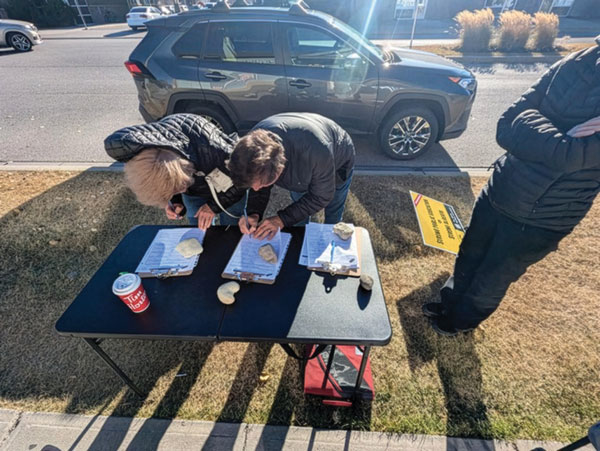
Signatories in Calgary-Bow. Yeremiy: “Recall was the only tool I could see to hold my minister and my MLA accountable.”
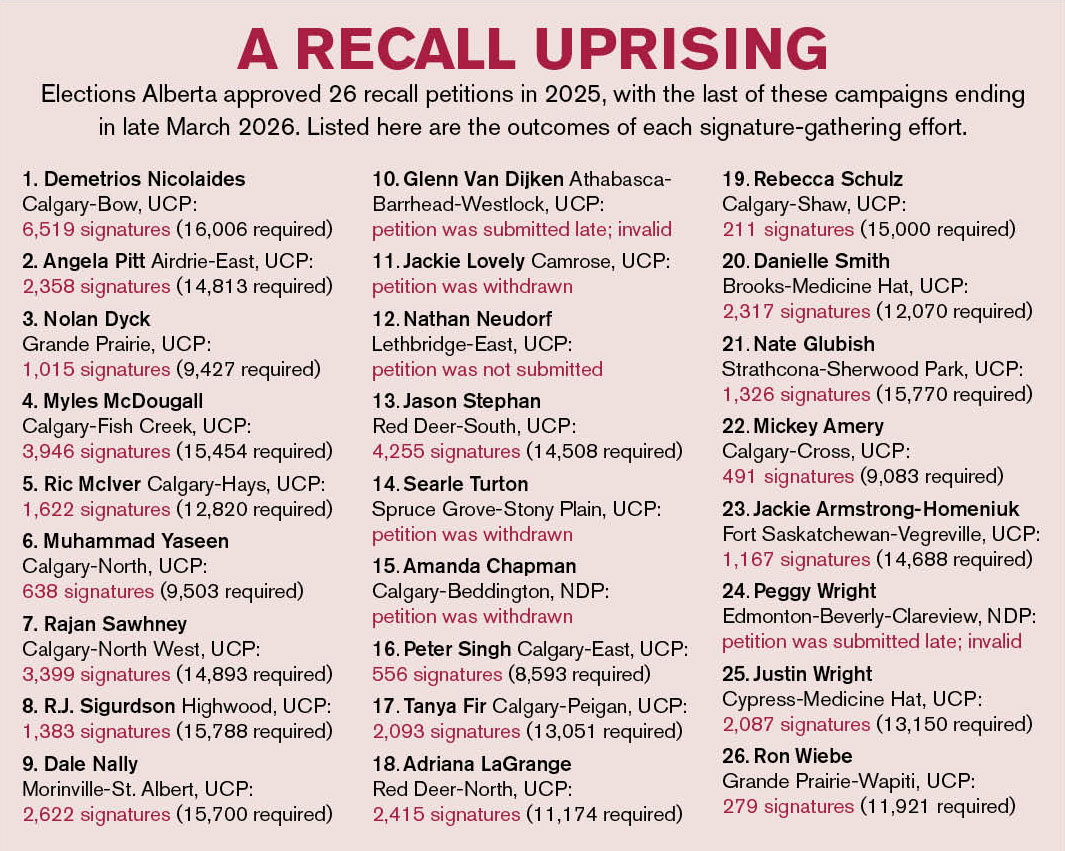
And then the recall dam burst. November 10: Grande Prairie MLA Nolan Dyck. November 14: Calgary-Fish Creek MLA Myles McDougall. November 14: Morinville-St. Albert MLA Dale Nally. On it went. Jackie Lovely (Camrose). Jason Stephan (Red Deer-South). Searle Turton (Spruce Grove-Stony Plain). Social media was buzzing: Who wants a new MLA? Operation Total Recall was now calling for 44 UCP MLAs, nearly the entire caucus, to be removed.
By the end of the year some 26 recall campaigns had been approved by Elections Alberta. Premier Smith, as MLA for Brooks-Medicine Hat, was among the targets. Recall Nicolaides itself was now only weeks from its deadline—January 21—to collect enough signatures. Further recall applications dried up as either an MLA was deemed “impossible” to recall or citizens watched events in Calgary-Bow and beyond, playing wait and see.
Elections Alberta announced it needed additional staff to verify potentially hundreds of thousands of petitioner names and addresses and to confirm the eligibility of canvassers. This meant a substantial budget increase. A UCP-controlled legislative committee said no, which would have effectively killed recall in Alberta. Their refusal was ridiculed even by staunch conservative pundits, and the committee caved. Wrote Edmonton Journal columnist Lorne Gunter: “They [the UCP] made their bed and now they have to lie in it.”
Proponents were required to make their case in a statement not exceeding 100 words. Recall Nicolaides’s Jenny Yeremiy wrote that her MLA, as minister, showed “a clear failure to support public education,” citing privatization, more public funding for charter and private schools, overcrowded classrooms, insufficient staff and inappropriate curricula. MLA Mickey Amery, wrote his complainant, “supported policies that put vulnerable groups at risk and increased the cost of living.” Danielle Smith’s “disregard for local expertise and community voices” left her constituents “without accountable leadership.” Many statements cited the notwithstanding clause.
MLAs mounted a common defence: I do meet with voters, I do listen, our UCP got a mandate from Albertans. But Nicolaides, as the first up, set the tone. His recall, he argued, was illegitimate. The recall process should be reserved for “breaches of public trust, ethical violations or dereliction of duty,” not “dissatisfaction with government policy.” Using recall to “overturn an election,” he wrote, “undermines stable governance and the electoral process.”
The irony of UCP MLAs being targeted by a law they themselves had enacted only months earlier—unanimously, and over the objections of the opposition—wasn’t lost on anyone. Cosh, the pro-recall National Post pundit, likened Smith to Dr. Frankenstein gaping at his monstrous creation. “It is, frankly, just a bit silly for UCP politicians to now insist that recall was only to be used in cases of misconduct or incapacity,” he wrote. “If recall itself is legitimate, its semi-organized use to put collective pressure on governments must be legitimate.”
As recall spread, Kenney chimed in. He’d never intended his law to be used as a weapon, he told the CBC, but as an “ultimate tool of accountability” if a politician did “something absolutely egregious, illegal, grossly unethical.” Years earlier Kenney had given only two justifications to FIRE one’s MLA: If they’d “lost the public’s trust” or “broken promises.”
Elections Alberta’s “Recall FAQs” webpage, at “Valid reasons to recall,” says only: “There is no set criteria.”
Other jurisdictions erect guardrails. Florida, for example, limits recall to cases of “malfeasance, misfeasance, neglect of duty, drunkenness, incompetence, permanent inability to perform official duties, and conviction of a felony involving moral turpitude.” In Alberta simply being an MLA is enough.
The irony of UCP MLAs being targeted by a recall law they themselves had enacted only months earlier wasn’t lost on anyone.
Alberta’s recall law, as written, created other issues as well. Among the 26 MLAs subjected to recall was Calgary-Beddington’s Amanda Chapman, one of two NDP members caught up in the melee. The proponent, Laurie McCormack, offered as pretext that Chapman “chooses harsh partisan attacks likening Alberta’s elected government to extremists, and backs public sector unions over… families’ real priorities.” Similarly, NDP MLA Peggy Wright (Edmonton-Beverly-Clareview) deserved recall because she—per her complainant—“facilitates the exposure of children to sexualized material.” Wright was said to be “routinely inaccessible” to this constituent and “doesn’t return emails or calls.”
Then there’s the recall effort against Lethbridge-East’s Nathan Neudorf, which appeared to be bogus, organized perhaps by an ally of the UCP MLA himself. The stated case against Neudorf by “Ryan Tanner” was conspicuously lacking specifics: “Recent voting activity from him demonstrates a disconnect and his inability to meet the needs, desires and expectations of those he represents.” As reported by the CBC, would-be canvassers in Lethbridge emailed Tanner to help collect signatures. They never heard back. No petition locations were posted. No website was created. (Ultimately no signatures were sent to Elections Alberta.) But as long as a recall campaign against Neudorf was officially registered, no other one could be started.
Neudorf eventually declared, at the legislature, “I’m not actively involved in my own recall.” As a letter to the Lethbridge Herald pointed out, “This seems like a feeble equivocation. Were you passively involved, or were you aware it was going to happen before stepping back for plausible deniability?”
The law allowed for more abuses. MLA Dale Nally claimed that Joshua Eberhart, his recall campaign’s organizer, “does not vote in provincial elections,” so the effort was thus “without merit.” The campaign was allowed to go ahead, and Elections Alberta later determined Nally had violated election law.
Recall Gondek’s Landon Johnston told CTV News he suspected his petition was used by other conservative political actors for their own data-gathering. “I warned the privacy commissioner halfway through this project,” he said. “Anyone can co-opt this petition for their own gain.”
I was at home, sick, on a snowy mid-winter afternoon when the doorbell rang. On my porch were two older men, wearing parkas, toques and canvasser IDs and carrying shiny elections-grade Recall Nicolaides signs. They identified themselves as fellow Bownesians. “Have you heard about the campaign to recall our MLA?” the shorter man asked.
By now? With nearly a third of Alberta’s MLAs being recalled…? Oh—I’d heard.
I stepped outside to keep the dog inside. We chatted about Smith, her forcing teachers back to work, her flirting with separatism. The taller man said he’d voted UCP in 2023, and “that was a mistake.” He called Smith “Trumpy.” I said I sympathized with their anger.
But I told them I didn’t have much love for recall. I knew of its dubious record in the US. I didn’t like it when Kenney brought recall north. The anti-Gondek campaign struck me as baseless and sexist. Now opposition MLAs were being targeted out of spite. I was certainly amused by the UCP getting a taste of its own medicine. But I found myself agreeing with aspects of the Nicolaides defence. These were largely policy disagreements. The policies in question were perhaps stupid, or narrow-minded, or cruel. Ideally they’d be indefensible at election time. But none of these recalled MLAs stood accused of a conflict of interest or serious crime. And if one UCP MLA should be recalled for bad policy, so should they all.
The men said none of this mattered. Fact was, the UCP had brought in recall, and what was happening to them now was legal and just.
I couldn’t disagree. But I was sick, and in bare feet, and we could see our breath. The men asked if I’d sign the petition. I said recall didn’t exactly align with my idea of Alberta democracy. They said they respected my position. Then the shorter man, as he turned to walk away, gently pushed back one last time. “You know—they’re [the UCP] changing the rules of our democracy,” he said. “They’re taking away our rights. What else are we supposed to do?”
The Smith government has changed the rules. It not only used the notwithstanding clause to force teachers to work under contract terms that 90 per cent of them had voted to reject, it used the clause three more times that fall to override Albertans’ rights. It gave itself the power to decide whether a proposed referendum question violates the Constitution. It changed election laws, reinstating corporate and union donations to parties and political action committees (PACs) and suppressing the vote by restricting special ballots and requiring more ID. University of Alberta political scientist Jared Wesley wrote that these changes, alongside making recall easier, “mark another step in the Americanization of Alberta’s democratic institutions… and are the latest in a long list of democratic transgressions in this province.”
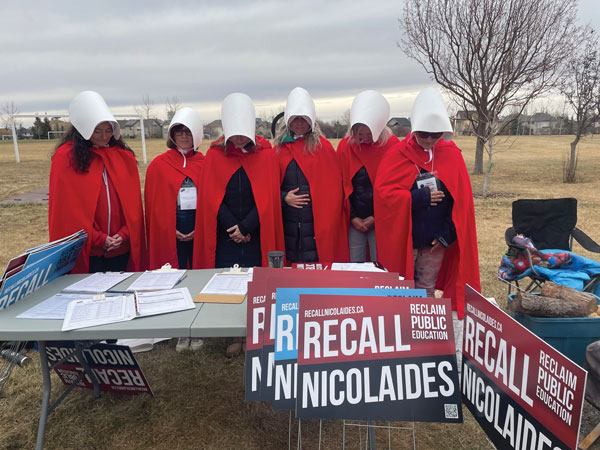
Campaign volunteers, fall 2025. Yeremiy calls recall a “gift” from the UCP: “It’s helping us build from the ground up.”
When I spoke on my doorstep with the gentlemen from Recall Nicolaides, they said the team had collected “maybe 6,000” signatures. Their aim was 16,006 signatures, or 40 per cent of the voter turnout in Calgary-Bow in 2023—and, really, they needed still more names to be on the safe side. Their three-month timeframe was fast closing. It didn’t look good for the campaign. And a more personal deadline was also looming. I had to decide if I’d add my name to the petition.
I decided to call Yeremiy. The woman who’d organized against Nicolaides—and inspired citizens from Medicine Hat to Grande Prairie to take up pens against their own MLAs—had told media she’d never planned to launch a recall, not even after Smith eased the rules. She’d tried to meet with Nicolaides to share her concerns. He dismissed her. When they finally spoke, at his office, he was aggressive and threatening. And so recall, she told the CBC, was “the only tool I could see that was capable of holding my minister and my MLA accountable.”
I asked her what she’d thought when Kenney brought in recall. “I remember wondering: What are they up to?” she said. “And then I remembered it being applied to Jyoti Gondek and thought, Oh, that’s what it’s about. I get the impression it was put in place in case the NDP got elected [in 2023], so they had a way to undermine the government.” She found that others troubled by Nicolaides’s record nonetheless had misgivings about recall. “[People] commented at the doors and at various signing locations about the recall action—not wanting to support it in any way.”
She said that “the way I could justify it” is that this UCP government doesn’t listen. “People who put forward thoughtful alternatives for this province are completely ignored.… And when [an MLA] does stand against anything within that party, they’re dismissed from their roles.”
Yeremiy believes this lack of accountability is getting worse. “I can use a specific example,” she said. “When the Eastern Slopes were opened up [to coal mining in 2020], it caused public outrage, and there was a response from the minister at the time. She reversed the action.” In fact, Kenney’s energy minister, Sonya Savage, had said that the 44-year-old policy protecting parts of the Rockies would be reinstated and that citizens would be consulted if her government ever again tried to make changes to it. “An important part of being a responsible government,” Savage had said, “is to admit when you’ve made a mistake and to fix it.”
But the Smith-era UCP is shameless, said Yeremiy. They’re unwilling even to slow down, let alone reverse. “We’ve seen that with coal. We’ve seen that with healthcare. We’ve seen that with education. We’ve seen that with the renewables moratorium. Literally everything this government has done, there’s no means for the public to put a stop to it.”
Yeremiy said the three-month-long petition effort had been “exhausting.” I wasn’t exactly surprised when she told me they were unlikely to get enough signatures to trigger a recall vote. But then she described the campaign in a surprising way. “They [the UCP] have given us a gift with this recall legislation,” she said. “It’s forcing us to speak with our neighbours. In the environmental and social justice movements, there’s a lot of camaraderie and solidarity. But at the end of the day we have to be able to talk to the people who live beside us.” She described a recent Eastern Slopes meeting in Canmore. “It was mostly local, and they offered great thoughts. But the challenge is we’re not bringing new people along. So what [recall] is doing, its gift, is it’s making us speak with people who normally aren’t interested in these important issues.”
I’d been thinking for weeks about recall as a provincial issue. But Yeremiy wasn’t focused on other recall efforts across the province. She was organizing dozens of her neighbours, many she’d never met before, to engage in local politics. They in turn were speaking with their neighbours, thousands of them, at the car wash, at roadsides, on doorsteps. About politics. About important issues. Class sizes. Charter rights. Representation. They were, as community organizers like to put it, “connecting with systems of power to enact change.”
This idea “came from my being a geophysicist and liability expert,” Yeremiy said. “We have to do land-based organizing. I go to meetings, talk about the land, have conversations. But the challenge, with people all over the province, is we’re not doing it in our own community. So recall is ultimately about governing ourselves. That’s what this gift is. It’s helping us understand how to build from the ground up.”
On a Sunday afternoon in late January I drove to the Foothills United Church in Bowness. My eldest daughter was with me. We’d been running errands; this was our last stop. The church, built in the 1940s and plastered in white stucco, had a Recall Nicolaides sign poking out of its dead grass. People were filing in through the main doors.
We saw Tania at the petition-signing table in the vestibule and said hello. She hadn’t seen my older daughter, her former student, in nearly eight years. Two other women, volunteers I hadn’t yet met, were at the booth. It was loud, but we chatted awhile. Their signature-collecting efforts would “absolutely fall short,” they said, their deadline now days away. Probably well short. But today was a celebration. A band was playing in the main church space. A Raging Granny passed by in an oversized floppy green hat. My daughter returned to the table with a cookie and a handful of pretzels.
I remained unconvinced about the idea of recall. If anything, Alberta’s recall insurgency strongly directs us to fix representative democracy. Rather than try to pick off MLAs between elections, one by one or 26 at a time, we need to curtail the vast power of party leaders, demand more free votes in the legislature, disallow corporate donations to parties, and protect the authority of independent watchdogs. And our elections must be proportional. First-past-the-post poisons the well, often elevating to positions of power “representatives” who are supported by a fraction of their electorate and ignore everyone else. Small wonder we end up in acrimony.
And yet I’d spent more time than ever over the past three months—outside of an election period—talking about politics with people in my community. I’d met neighbours. I’d discovered they had similar concerns to mine. Recall Nicolaides canvassers had done this and then some. A few told me the campaign had awakened them to the power of organizing. It had even given them hope. One volunteer, Rob, told me he’d had fun: “Just going out and collecting signatures has been such a positive experience.”
Yeremiy would be asked by a Calgary Herald reporter whether too few signatures would constitute failure. “Not even a little bit,” she said. “I feel so much more empowered than I did before this started. Most people involved in this petition have never been in politics before, (but) they felt compelled to do something, watching the misdirection of this government.”
Tania handed me a pen. I signed the petition. My daughter cheered. This list of names was an imperfect but unmistakable message to my MLA, my government and every citizen of Alberta. And if I couldn’t get behind recall itself, I would stand with my neighbours.
Evan Osenton is editor of Alberta Views. His “We Could Prevent a Mass Shooting” (Dec 2024) and “Who Wants Albertans to Gamble More?” can be found in AV’s online archives.
____________________________________________