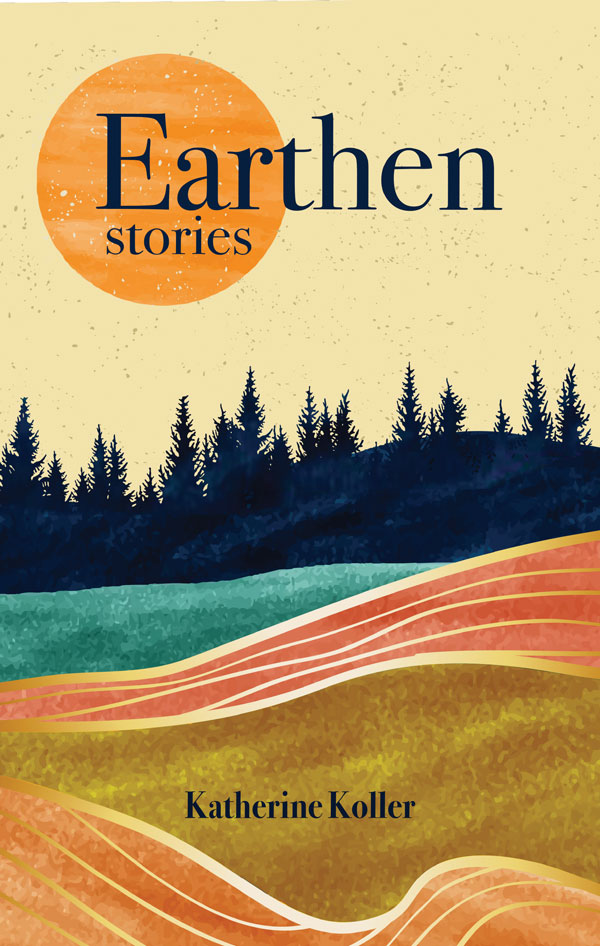
by Katherine Koller
ENFIELD & WIZENTY
2026/$22.95/180 pp.
Katherine Koller is a screenwriter, playwright, university lecturer, novelist and short-story writer in Edmonton. Earthen is her second short-fiction collection. Per the title, these pieces all connect to the natural world. The characters may be living in an ancient culture, a dystopian future or the present—they may not be human—but they all exist, commune and often suffer in connection with the earth.
The first story, “You Can Have More,” finds elderly Mavis catching a teenaged potato thief in her garden one night. The boy is as feral and hungry as a coyote, and over just a few pages, his need and Mavis’s will to meet it with her own loneliness and abundant offerings feels so primordial in its humanity that I was ambushed by tears.
There is enormous loss in these stories: bereft mothers recall lost children; a girl loses a favourite tree to a chainsaw; another is drugged at a party and nearly loses her life; a man loses his wife in a car accident; a young woman loses her hands and mothers her baby with stumps. The tone of the collection often feels elegiac, as if in sympathy with the besieged natural world. And yet there is hope, escape and renewal in these stories too.
Many of the pieces are complete stories, while others are vignettes. I found occasional shifts in point of view, deus ex machina coincidences, and unconvincing dialogue distracting at times, but the audacity and range of the writing kept me turning pages despite whatever unevenness.
Koller is masterful at scene setting with telling detail. In the story “Harvest Supper,” two catty sentences deftly convey all the disapproval a widowed mother feels toward her son’s boorish family while indicting her daughter-in-law’s lack of thrift: “As usual, Peter and his family arrived a half-hour late and placed their pinging cellphones face up beside their water glasses. The two teens, Jaylee and Jonathan, unaccustomed to bones and skin from a whole chicken, picked at their meat.”
A bumper crop of fantastical narratives comes in the final third of the collection. “Maiden of the Plains” is a story of magic and brutality rivalling the grimmest of the Grimms’ fairy tales. “The Plug” is a tight and suspenseful dystopian story of renegade human survivors fleeing an AI-managed society. “Apple Bread” is written from the point of view of a blighted apple tree with a special connection to the homeowner in whose yard the doomed tree stands. I marvelled at Koller’s imagination, skill and bravery in producing this diverse collection under the banner of the organic. As she writes in “The Plug”: “It’s a risk, all that tilling, bending, digging, patting, then watering, watering every day until something green begins to show.”
Jane Kubke is a writer in Calgary.
_______________________________________