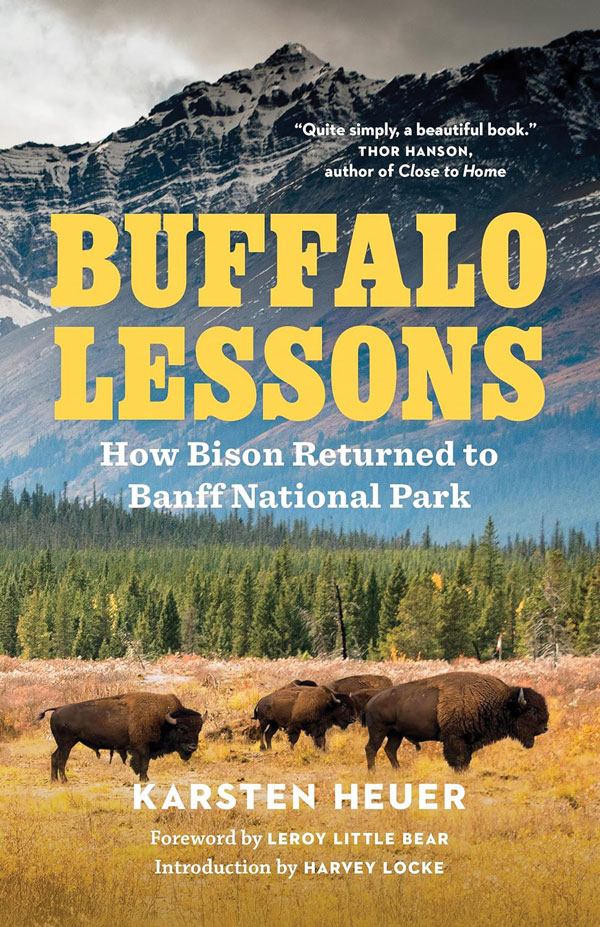
How Bison Returned to Banff National Park
by Karsten Heuer;
foreword by Leroy Little Bear;
introduction by Harvey Locke
GREYSTONE BOOKS
2026/$28.95/192 PP.
Alberta writer Robert Kroetsch once said he believed that “Books find their writers.” A book will come into being when it finds the writer most likely for the story. Viewed from this perspective, the Porcupine caribou herd found Karsten Heuer to tell their story in his 2007 book, Being Caribou: Five Months on Foot with an Arctic Herd, and his life partner, Leanne Allison, to film it in Being Caribou. “Karsten,” writes conservationist Harvey Locke, “was an adventurer with an enormous capacity for rough travel and an appetite to initiate big projects.” Heuer’s big project to hike and explore the possibility of a wildlife corridor running north–south through the west resulted in his first book, Walking the Big Wild: From Yellowstone to the Yukon on the Grizzly Bears’ Trail. In his latest, Buffalo Lessons, he writes: “Y2Y’s vision to connect and protect reserves along the Rocky Mountains with wildlife corridors was so meaningful to me that I decided to hike its 3,400-kilometre distance, as a wolf or grizzly might, to see if the concept was possible. I discovered it is.” From the start, then, Heuer’s biology degree and his desire to see the world from the points of view of other animals coalesced to make him the perfect warden for the reintroduction of buffalo to Banff National Park, and an ideal storyteller for northern caribou and plains bison. As Leroy Little Bear writes in his foreword, Heuer and Allison were first “cariboued,” and then they were “buffaloed.”
The chapters are sequenced chronologically as the project unfolds and are titled as a series of the “lessons” Heuer and his small team learned both from experienced buffalo managers and from the animals themselves. Some of the titles sound managerial (“Seize Opportunity,” “Leverage Your Success”) and others more like insights into bison psychology (“Embrace Individuality,” “Make Your Idea Their Idea”). Given that an attempt in the 1970s by Parks Canada to restore bison to Jasper National Park failed when the animals dispersed way beyond the park, Heuer undertook a lot of research and preparation in advance. While the book might work too as a manual for wardens and ranchers, its scientific, ecological and even spiritual material makes it a compelling read akin to the works of Alberta naturalists Andy Russell and Charlie Russell, former park warden Sid Marty and UBC forestry professor Suzanne Simard. It also reminded me powerfully of Freeman House’s Totem Salmon: Life Lessons from Another Species, another rich account of species restoration.
For a book that details the reintroduction of these animals, it is surprising when the prologue begins with Heuer having to shoot one of the buffalo whose life story he had been party to from its birth. But it has ventured beyond the invisible, largely unfenced boundaries of the park, a trespass the Alberta government will not forgive. Even prior to the first chapter, then, two deaths, both premature, have been recorded or anticipated: that of this young wayfaring bull and that of the author himself. Heuer wrote the book during the final months of his life, and it has been published posthumously. The loss of this man who, together with Allison, in essence apprenticed himself to other-than-human animals to understand their specific ways of being, is deeply tragic.
Throughout, Heuer details the remarkable amount of labour involved in this ambitious project. I was blown away by the physical work, skill range and stamina demanded of the wardens, and the logistics. Heuer had to plan for everything from age, number, biological sex and genetics right down to rubber tubing for the animals’ horns so they would not gore one another during transport from Elk Island to Banff National Park. First Nations’ managerial and spiritual expertise with the buffalo were also integral to this project of ecological restoration and reconciliation. Heuer writes that when not sorting animals “I helped erect teepees, partook in pipe ceremonies and listened to prayers, speeches and songs to bless the animals and the upcoming transfer [from Treaty 6 to 7]…. Looking across the teepees and feeling the drumbeats of Native singers in my chest, I saw I was just a Parks Canada pawn in something much larger about to play out: the prophecy of bison returning from the sky and the mountains.” Anishinaabe writer Richard Wagamese characterized humility as “the ability to see yourself as an essential part of something larger. It is the act of living without grandiosity.” This sense of humility with which Heuer approached the world, allowing him to enter at times into profound relationship with the land, also finds ironic expression in his mildly self-deprecating humour about his role in parks bureaucracy and playing “poker” with wily bison.
Buffalo Lessons does not aspire to didacticism but to be a gift to those who come after in the same way as the buffalo are a gift to the land and the people who live here. Printed on FSC-certified glossy paper with lots of photographs of the bison and some of the wardens, including Heuer, who reintroduced the animals into their ancestors’ territory and witnessed how they transitioned to a free-roaming life in the mountains, this book represents only part of Karsten Heuer’s legacy of science, activism and commitment to the multispecies world we inhabit, whether we realize it or not. Buffalo are now living wild in the Rocky Mountains of Alberta!
Pamela Banting writes articles about park warden literature, multispecies studies and ecocriticism.
_______________________________________