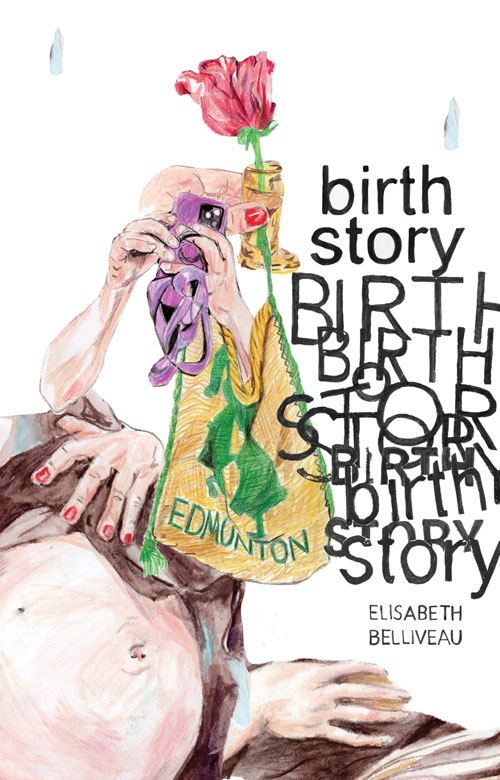
Birth Story
by Elizabeth Belliveau
Conundrum Press
2026/$20.00/200 PP.
As far back as I can remember, I’ve practised a form of divination that involves opening a book to a random page and scrying it for portents, the way a wise woman might wax elegiac or auspicious, having pulled a card from the tarot. When I subject Elisabeth Belliveau’s graphic novel Birth Story to this practice, I land on a left-hand page image of a woman almost entirely obscured by her long avenues of tears—each running its own course the way raindrops travel at turns directional and pell-mell across a window pane. All details of her face are besmeared by black brush strokes save her pretty eyes with their pretty lashes; on the right-hand page is a drawing of the Edinburgh Postnatal Depression Scale, with statements like “I have felt sad or miserable,” with check boxes that demand a disclosure of how true the statement is. Painted tears are splattered on the test sheet. Portent, indeed.
Belliveau’s autobiographical story of her pregnancy, delivery and postpartum period unfurls in quirky, gorgeous, dark and leaky black ink drawings and sparse hand-painted text. The centrefold features a woman’s spread legs, not seductive but torn asunder—the necessary and traumatic cost of doing the business of life-making: “still can’t look, maybe never, fine with me.” Scenes of both daily and baby bric-a-brac—wine glasses, snot suckers, COVID rapid tests—and interpretations of historical and contemporary artworks (from obscure medieval Italian paintings of heaven and hell to many renditions of the Madonna and her child to Judy Chicago’s The Birth Project) populate Belliveau’s pages, along with the old-man-faced, chubby-fingered, button-nosed baby who compelled this story in the first place. The mermaids of the Fountain of Neptune are drawn gushing water from their nipples—mother’s milk springs eternal—while baby is pictured in a Jolly Jumper, and mom’s body is illustrated as varyingly dismantled, bespeckled, engorged, happy, delirious, exhausted, sick and sunglass-wearing-hair-blowing-in-the-wind kind of free. “I learn that families are made of sleep and forgiveness,” Belliveau writes.
Like childbirth, Belliveau’s novel is not for the faint of heart; it lays bare the dehumanizing aspects of our current medical-industrial infrastructure that treats pregnancy and birth as illness instead of natural, instead of miracle. It also attends to the patronizing cultural pressures applied to mothers and mothers-to-be, and the physical and emotional duress they endure to bring life forth. Yet, like the hard-won fruits of childbirth, Birth Story yields a picture of a love so wild, holy and effervescent that it is ultimately ineffable. A portrait of two hearts, rendered so.
Anna Harbec is a writer and librarian from Lethbridge.
_______________________________________