
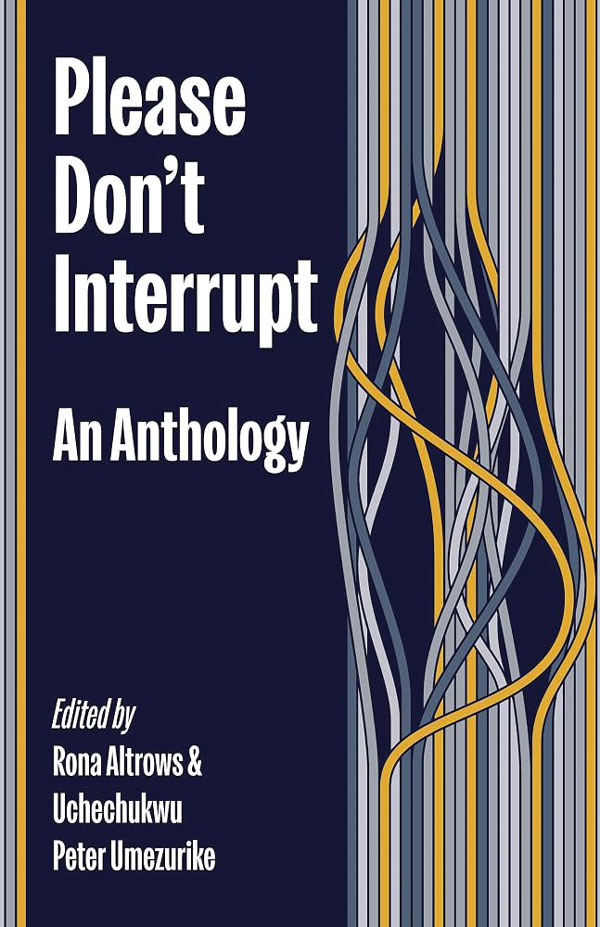
Edited by Rona Altrows and
Uchechukwu Peter Umezurike
GRIOTS LOUNGE PUBLISHING
2025/$23.99/175 pp.
When conceptualizing and organizing any kind of anthology one must consider subject matter, style, diversity, tone and, most vitally, audience. Please Don’t Interrupt, a slender collection edited by Rona Altrows and Uchechukwu Peter Umezurike, assembles a range of genres and approaches to address the ubiquitous issue of being interrupted: by family, immigration, neuroses, illness, trauma, objects and memory. As Altrows states, “Everyone faces interruptions.”
As I read I kept questioning what an audience needs from a thematic anthology. For instance, could seven sections of uneven length (one featuring three poems) have been more powerfully condensed to four or five? Will the reader yearning for direct non-fiction essays be put off by a run of more-obscure poems between them? And the most considerable issue: if a reader seeks a literary text, like Wendy McGrath’s tale “The Playhouse” (“the shepherd’s eyes were open, the blood pooled around its head like a halo”), will they be willing to read the bare-bones didacticism of memoirs such as Ademola Adesola’s “My Canadian Student Visa Experience and an Interrupting Bureaucracy” (“We read the available information on the IRCC portal”) or Theresa Wouters’s “Baby Interrupted” (“I flushed away the pity pot and became the best version of me”)? Regardless of how welcome divergent and varied voices are, these pieces seem directed at different audiences.
Despite these considerations, this anthology has a number of striking pieces that shape its nebulous topic in unique ways. The memoir “Crawling,” by Dustin Archibald, presents a palimpsest of memories that enter a father’s head as he recalls his son’s distractedness while, snared in recollections, he has “missed most of it.” The poems “Passenger,” by Jide Salawu, “My Father’s Left Ear has been Hurting for Thirty Years,” by Umezurike, and Samantha Jones’s textual elisions in “Intrusion” are all stellar, the first two evoking the terrible fragmentations of traumas, emphasizing metamorphosis amid “the blue flames of Pearson summer” or the “bullets roasting flesh.” And Thea Bowering’s fictionalized account “Quicksilver” underlines how a female writer’s quest for an “authentic self” can be compromised by sexist negotiations, here with a nasty interviewer, his “peach-coloured hair combed straight back,” who had “once tried to kiss her neck without invitation.”
“And there will be no more interruptions” is how Ellen Kartz ends her memoir “Back to the Page” (and the anthology itself). That tension between the myth of complete absorption and the reality that our lives will forever be fissured is the core takeaway of Please Don’t Interrupt.
Catherine Owen is the author of Moving to Delilah.
_______________________________________


