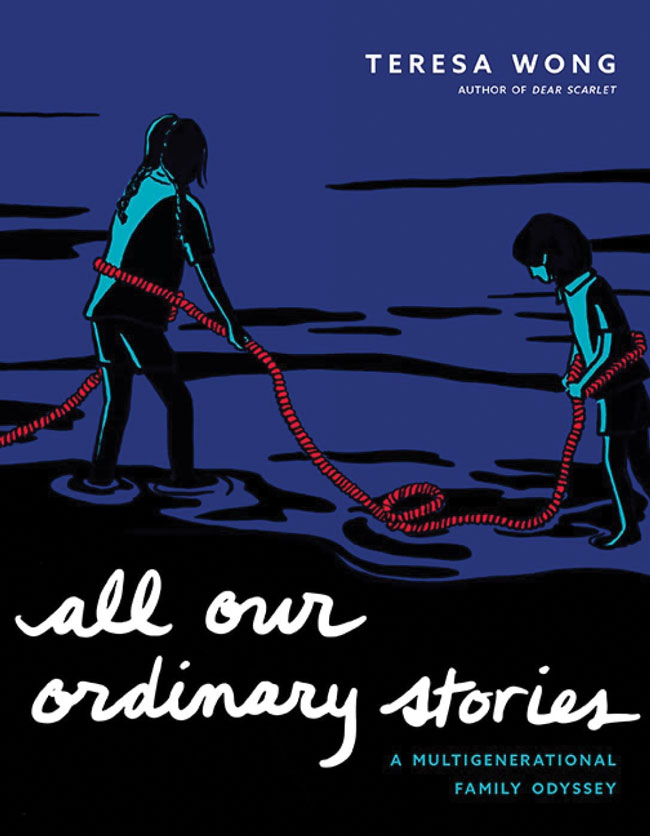
by Teresa Wong
ARSENAL PULP PRESS
2024/$24.95/240 pp.
All Our Ordinary Stories, a graphic novel memoir by Teresa Wong, is a profoundly moving meditation on entangled family histories—one in which the pairing of text and image convey a depth of storytelling akin to great cinema. The collection feels simultaneously mundane and multitudinous: an auntie regaling you with stories; a crash course in Chinese-Canadian history; a deadpan long form comic on life with immigrant parents; a gut-punch of a confessional memoir about grief, mothers and the emotional distances from those who might be geographically nearest to us.
The book is episodic, wide-ranging and non-chronological, anchored by Wong’s assured narrative and minimalistic black-and-white illustration. Beginning with the aftermath of her mother’s stroke, the narrator unspools her own life with wry humour and acute attention. She traces the contours of her first-generation upbringing in Calgary, watching her mother serve Chinese food at the mall food court. She absorbs English from TV shows while translating for her parents. She navigates the heartache of language loss in herself and her own experience of parenthood. She gathers fragments about the lives of her grandparents and documents her parents’ escape to Hong Kong during the civil war. Later she travels with her mother to Hong Kong and China, where her in-betweenness, a hallmark of diasporic identity, becomes even more pronounced. Stark, at times sparse drawings bring focus to the words, and Wong’s voice is measured and self-aware. Her work excels in the use of negative space, which reinforces a central focus of the book: the idea of absence. What is unsaid—or cannot be said—resonates just as loudly as what is actually spoken.
As a lover of graphic novels, I found the simplicity of the illustration noteworthy. While Wong does employ more dynamic, detailed drawing, it is reserved for flashbacks, such as the Cultural Revolution and her parents’ harrowing migration. The contrast seems to convey the horror and persistence of transgenerational trauma and memory, juxtaposed with the bareness of everyday banalities. But even in her default style, Wong’s gaze is remarkable in her penchant for the tangible and material. Seemingly innocuous visual details linger far beyond the page, such as the preparation of fruit as a familial ritual of care, chopsticks in a dish-drying rack, the rare touch of a hand. For those who appreciate visual media with transportive storytelling, All Our Ordinary Stories is a vulnerable, stunning work of art. For those who have lived similarly in-between lives, and who recognize themselves and their own families in this work, it’s something more—transformative and transcendent.
Céline Chuang is a writer and bookseller in Edmonton.
_______________________________________