I trekked down to the International Brotherhood of Electrical Workers (IBEW) union hall in Edmonton’s Strathcona industrial park on a pitch-black November evening to check in on the state of the federal NDP leadership race. About two dozen union men were there to hear the local leadership candidate, Edmonton-Strathcona MP Heather McPherson, discuss her plan to resurrect Canada’s social democratic party from its worst-ever election defeat.
Of the five candidates pursuing the leadership, McPherson is the only sitting MP, making her the only contender able to introduce legislation. Her recently proposed private member’s bill to ban employer-dominated “company unions,” which earned McPherson a legal threat for specifically naming the Christian Labour Association of Canada, was a big hit at the union hall that night.
Whoever leads the federal NDP after the votes are counted on March 29 in Winnipeg will have a daunting task ahead of them, inheriting a rump party of seven seats and without official party status in the House of Commons. Whether the next leader is McPherson, Avi Lewis, Rob Ashton, Tanille Johnston or Tony McQuail, they will have to chart a path back to electoral relevance.
That path will have to start with the NDP’s traditional base, the working class, whose votes the Conservatives have made a concerted effort to attract under Pierre Poilievre. Writing in the Windsor Star, journalist Trevor Wilhelm noted that in the 2025 federal election, “multiple former orange NDP strongholds once propped up on union shoulders turned Tory blue,” including Windsor-West and London-Fanshawe in southwestern Ontario and Elmwood-Transcona in Winnipeg. The NDP will try to win back members of this socioeconomic group—people who engage in wage labour, working in manual or service-related jobs that lack the economic security and control over their working conditions enjoyed by salaried professionals, workers who can be but aren’t necessarily unionized.
In an interview at the IBEW hall, James Ball, president of Canadian Union of Postal Workers Local 730, recognized that the next NDP leader “has a bit of a struggle ahead of them.” With workers’ wages falling behind inflation, even as they secure gains through collective bargaining, Ball said, “a lot of workers are angry.” Poilievre’s Conservatives are winning them over by “really leaning into the rage bait,” with the leader’s tirades against immigrants, “woke ideology,” “vaccine vendettas” and “global elites preying on the fears and desperation of people to impose their power grab.” McPherson is well suited to winning these voters over, Ball said, because of her campaign’s emphasis on “meeting them where they are and understanding what they need.”
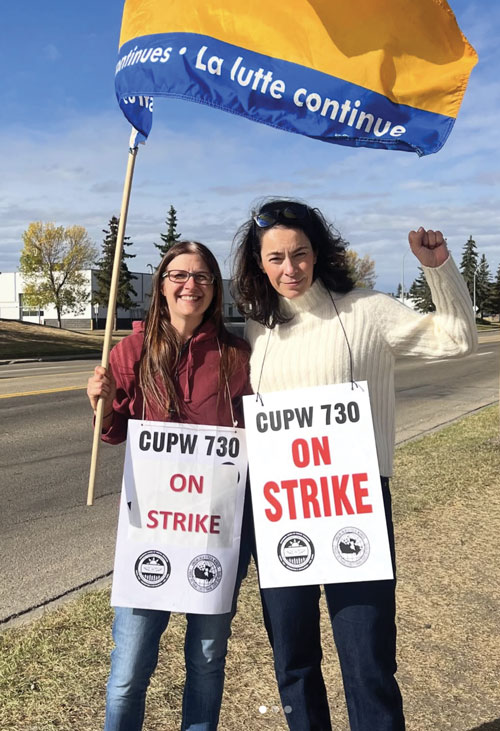
Heather McPherson on the the picket line with postal workers, Edmonton, September 2025
McPherson believes that a major NDP failure isn’t so much what it’s saying but how it says it. “The reason Poilievre was able to resonate with so many people is because he had a disciplined message. He was talking about issues that matter to Canadians,” she said in an interview a couple days before the IBEW event. The NDP, she added, needs to counter Poilievre’s language of anger and fear with a “simple, hopeful” message that at the same time promises policies that appeal to working people.
At her September campaign kickoff, McPherson said the party needs to “stop shrinking into purity tests and pushing people away.” One of her caucus colleagues, Winnipeg Centre MP Leah Gazan, said she was “appalled and deeply disappointed” by McPherson’s use of the phrase “purity test.” “That framing is frequently used to dismiss calls for justice from marginalized communities—especially Black, Indigenous, racialized, 2SLGBTQ+, disabled and immigrant workers—who now make up a major part of the labour movement and the working class,” Gazan wrote on Twitter.
I asked McPherson to clarify who in the NDP is administering purity tests and against whom. She responded in general terms, referring to a tendency in certain progressive circles in which “if you use the wrong words, somehow you get excluded,” which she said is anathema to building a larger movement.
She invoked, by contrast, Zohran Mamdani’s successful New York City mayoralty campaign in 2025, “which I think we’ve all been invigorated by.” McPherson said Mamdani spoke to people “about the things that mattered to them, and he spoke to them in a way that was simple, digestible and easy to access.” His campaign was laser-focused on issues of affordability, a priority from which the candidate wouldn’t waver.
Canada’s social democratic party is coming off its worst-ever election defeat. It lacks official party status in the House of Commons.
The NDP’s messaging, said McPherson, ought to focus on three closely interrelated issues—jobs, housing and the cost of living. “Until those issues are being addressed, we can’t reach Canadians,” she said.
The first leadership campaign policy McPherson unveiled was her housing platform, the centrepiece of which is to establish a federal Crown corporation to build housing in partnership with municipalities, organized labour and Indigenous governments, with a goal of building 1.2 million non-market housing units within a decade. Carney’s Build Canada Homes, by contrast, is focused on offering market-based incentives to private builders. McPherson’s policy also includes creating a National Renters’ Bill of Rights that would cap rent increases and prevent “unfair evictions,” banning real estate investment trusts from accessing public housing funds, and converting corporate-owned housing into co-op or non-profit units through a public buy-in program.
The second policy proposal the McPherson campaign produced was to put “power back in the hands of the people who make the NDP work” by engaging members in discussions around policy, candidate recruitment and training, giving constituency associations more resources and autonomy and hiring regional organizers to enhance coordination between them.
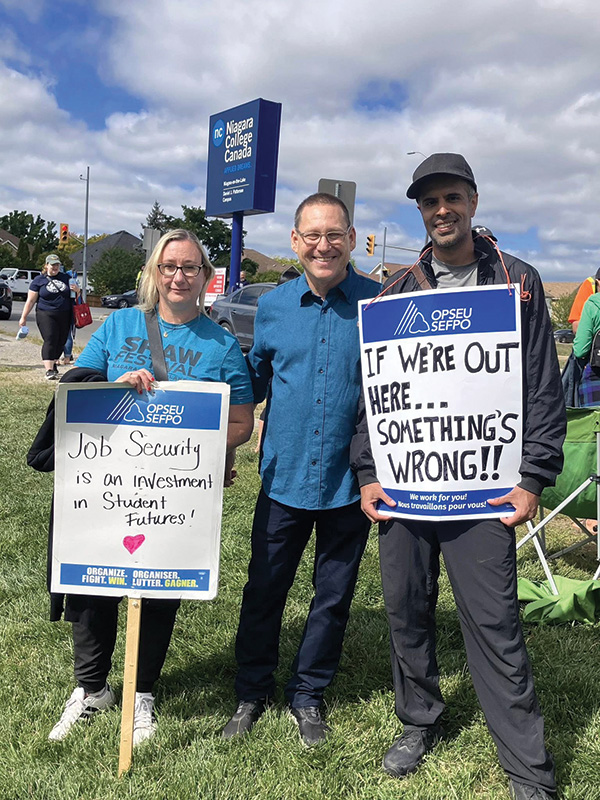
Avi Lewis with Ontario Public Service Employees Union Local 243 members at Niagara College, 2025.
Avi Lewis’s background is not one you might expect from someone leading a left-wing populist insurgency within the NDP. His grandfather, David Lewis, led the party from 1971 to 1975, and his father, Stephen Lewis, was the Ontario NDP leader from 1970 to 1977. Both worked to purge the party of the leftist Waffle movement in 1972.
The younger Lewis’s leadership platform is focused on offering a series of public options in major areas of the economy to challenge the concentration of corporate power, a radical proposal he says will substantially lower consumer costs. Echoing the Mamdani campaign, Lewis is proposing a series of publicly owned grocery stores across Canada, which The Globe and Mail dedicated a Thanksgiving Monday editorial to arguing against—a source of pride for Lewis. “It was significant to me that we had really landed on something that the elites in Canada don’t want to talk about,” said Lewis in an interview, “that they felt the need to respond to it after only three weeks of campaigning from one candidate in a party with only seven seats.”
Despite what the Globe editorial board says, Lewis believes this policy in particular has widespread support. “Working people are pissed off and exhausted by getting ripped off at the grocery store, and these populist-left economic policies for public options are popular across the political spectrum,” he said.
The Lewis platform also calls for a series of regional public telecom companies modelled after the success of SaskTel; postal banking, which is a reality in France, Germany, Italy and the UK; and a public non-profit pharmaceutical manufacturer, which Canada used to have with Connaught Labs before it was privatized by Brian Mulroney’s Conservative government. Like McPherson, Lewis wants to establish a national public housing builder, but his would build a million (rather than 1.2 million) non-market housing units within five years (rather than 10).
Lewis cautions that when politicians and media refer to working-class voters, they’re often referring to one segment of the working class, which he describes as “white skilled-trades guys in hard hats.” These are the workers with whom Poilievre has taken hundreds of photo ops as part of his concerted effort to attract them. “That’s a really important part of the working class,” said Lewis, “but they’re far from the whole story.”
A much larger cross-section of Canada’s working class toil in the service and care sectors. Many of these workers, which include everyone from Tim Hortons employees to long-term-care nursing aides, live in the suburbs, where Lewis acknowledges the NDP has “huge inroads to make,” and are first-generation immigrants. “Those are jobs dominated by women, with a huge proportion of racialized women, and they are underpaid and undervalued, and, in my view, some of the most essential workers in our economy,” said Lewis.
In addition to being “work that builds and maintains the connective tissue of society,” Lewis emphasizes that these sectors also have “very light footprints environmentally.”
On November 27, about a dozen Edmontonian supporters of Lewis gathered in the basement of the Whyte Avenue Boston Pizza to watch the NDP leadership debate on TV. One of them was Stephen Buhler, a former oil and gas worker from rural Alberta who used to manufacture mechanical seals for pipelines and now works as a machinist at the University of Alberta.
Buhler said he finds Lewis’s campaign refreshing because he advocates “bold” policies, such as a public grocery option, “that actually get people excited,” instead of engaging in endless compromises to appeal to “some person that, frankly, doesn’t exist.”
“When I was working in oil and gas, what I really wanted was an option that was not oil and gas. I wanted to help build future solutions that actually protect the planet and ensure we’re not stuck with the oil and gas roller coaster over and over again,” he said.
Rather than engaging in “process after process after process” and “working around the edges” to determine which specific set of focus-group-tested policies the public wants to see, Buhler believes the job of a political leader is to offer bold solutions that will materially improve people’s lives. “I’m seeing Heather McPherson talk about how she wants to consult people. She’s not really giving anything that we can really chew on,” he said. “It’s just kind of vibes.”
The key to winning back working-class support is to provide “solid and concrete” policies that support labour priorities.
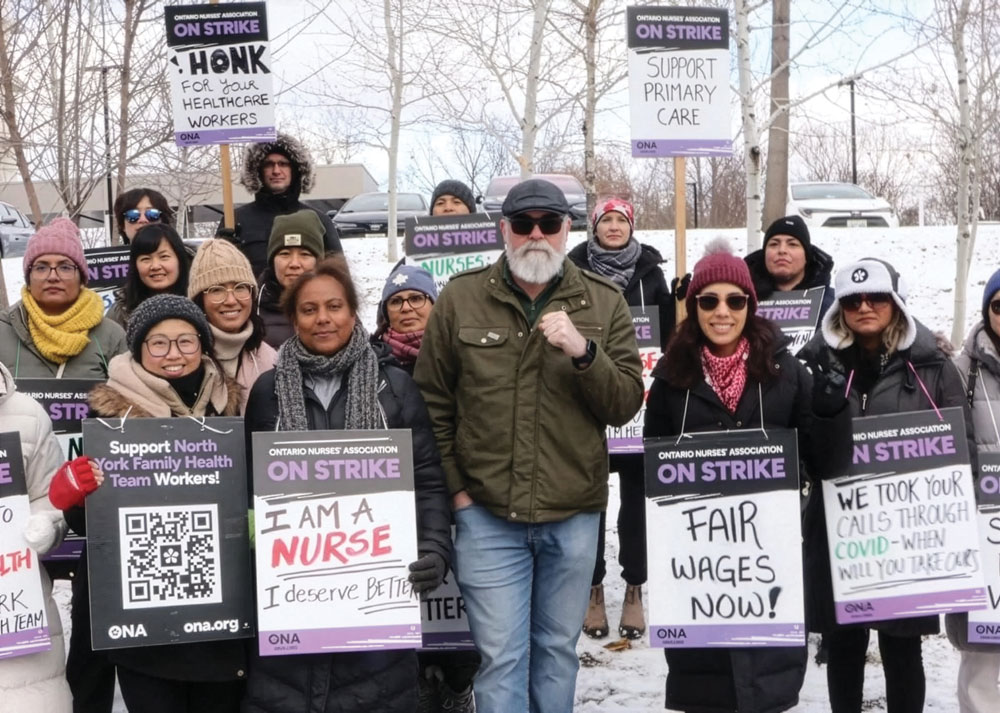
Rob Ashton on the picket line with striking Ontario nurses in late 2025. Ashton, as a longshoreman, is something of a rarity in federal politics—a party leadership candidate who comes directly from the shop floor, the rank and file of workers.
No leadership aspirant has put workers front and centre more than Rob Ashton, a dock worker who has served as president of the International Longshore and Warehouse Union for more than a decade. He speaks explicitly of “class war” and the need for the NDP to be “unapologetically loud” in fighting it. “All we see happening is our lives getting worse, the working class,” he told The Tyee. “We’re all getting screwed, and we’re all getting lied to, election after election after election. I’ve had enough of it. This is a time where workers—Canadians—need a true voice in Ottawa.”
Ashton’s “Worker Power Plan” pledges to require that workers have seats on corporate boards (although he doesn’t specify how many), to repeal section 107 of the Canada Labour Code, which the federal Liberals have repeatedly used to order striking workers back to work, and to replace the temporary foreign workers program “with a fair program, built from the ground up to protect all workers, their status and their labour.”
His advocacy for dockworkers’ interests has, however, placed him in the awkward position of being open to a repeal of the federal tanker ban on BC’s northern coast, which position earned him praise from Alberta’s UCP government.
Tanille Johnston, the federal NDP’s first Indigenous woman leadership aspirant, touted her working-class upbringing at her October 9 campaign launch, noting that her father was a miner and her mother was a small-business owner. “They taught me what perseverance looked like—that if you work hard and care for your family, act with integrity, you could lead a good life,” she said. “But today so many Canadians are finding that that promise is a lie.”
Johnston, a social worker in addition to being a city councillor, has proposed implementing minimum nurse-to-patient ratios, which BC’s NDP government introduced in 2024 in collaboration with the BC Nurses’ Union, on a national scale. She also speaks of adopting national rent control, and fully incorporating pharmacare, dental care, vision care and mental health care into the public healthcare system. “We’re finished with half measures,” Johnston proclaimed at an October NDP leadership forum in Nanaimo.
Tony McQuail, an organic farmer from Huron County, Ontario, wants to collaborate with the Greens to ensure there’s only one candidate from either party running in each riding, and advocates “degrowth” economic policies in which the corporate pursuit of endless economic growth would be abandoned in favour of democratic decision-making about resource allocation.
McPherson says the NDP needs to be “unapologetically interested in winning”—not aiming to be “the conscience of Parliament.”
The NDP convention in Winnipeg falls roughly on the 10th anniversary of the 2016 federal party convention in Edmonton, where members voted to turf leader Tom Mulcair, who sharply departed from the NDP’s social democratic roots with an ill-fated pledge of balanced budgets. But it was also where Lewis set off a firestorm by proposing a policy resolution on the Leap Manifesto, a controversy with reverberations in today’s leadership race.
The 1,300-word blueprint for a green economy, including expansion of the low-carbon care economy, was written by Lewis, best-selling author Naomi Klein (his wife) and journalist Martin Lukacs, who now serves as a policy adviser to the Lewis leadership campaign, alongside a group of environmentalist, labour and Indigenous leaders.
The most contentious detail in the manifesto was its call for an end to “new infrastructure projects that lock us into increased extraction decades into the future,” a thinly veiled reference to pipelines, which Alberta’s NDP government was pursuing vigorously at the time the manifesto reached the floor of the federal NDP convention.
Then-premier Rachel Notley called the document “naive,” “ill-considered” and “very tone-deaf.” Environment minister Shannon Phillips, whom Lewis had endorsed during the 2012 provincial election, gave a closed-door speech to the federal caucus, disparaging those who suggest “we should shut down, in the short or even medium term, the industry that powers this province and this country.” This sentiment was echoed by Wildrose leader Brian Jean, who called the Leap Manifesto a “radical anti-Alberta resolution,” and Alberta PC leader Ric McIver, who suggested it reflected “radical socialist ideology.”
For McPherson, who wasn’t yet an MP at the time but was an active party member, the Leap was a “ridiculous political policy” and “vanity project.” “My opposition to it certainly wasn’t opposition to the messages within it,” she said in our interview. “It was opposition to how it was brought forward and how it undermined the work of our membership.”
But elements of the party membership were on board for the manifesto. In the months between the Leap’s release during the 2015 federal election campaign and the NDP’s 2016 convention, the Canadian Press reported that more than 20 NDP riding associations had endorsed it.
Lewis worked on the Leap resolution with former MPs Meghan Leslie, Craig Scott and Libby Davies, as well his aunt, former Ontario NDP president Janet Solberg. The former MPs kept Mulcair in the loop about the resolution every step of the way, who relayed it to the Alberta NDP leadership, said Lewis.
Because the resolution was so low on the list of resolutions for the Edmonton convention, Lewis had to make his case before a prioritization panel about why it should be debated at all. “The Alberta NDP didn’t send anyone to speak against that,” he recalled, “because they already knew that the resolution was coming, and they’d already agreed that it should have a chance to be voted on by the delegates.”
The motion ultimately adopted by the party membership by a wide margin called for elements of the manifesto to “be debated and modified on their own merits and according to the needs of various communities and all parts of Canada.”
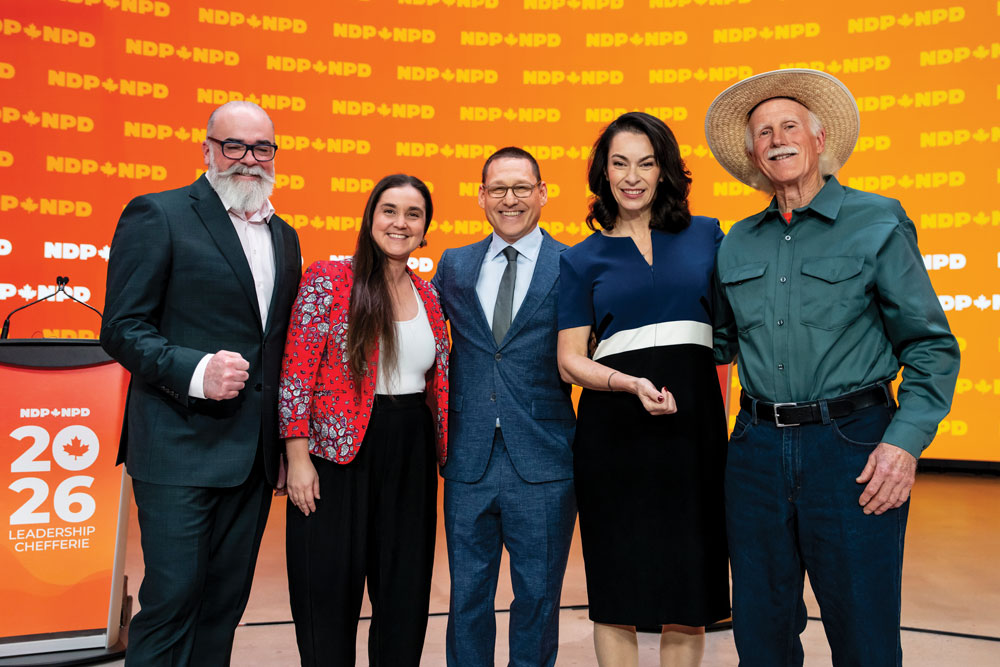
NDP leadership contenders (left to right) Rob Ashton, Tanille Johnston, Avi Lewis, Heather McPherson and Tony McQuail
Jen Hassum, the executive director of the Broadbent Institute, a think tank named after late federal NDP leader Ed Broadbent and which advocates for social democracy, argues there’s been a “class detanglement” in recent decades, in which parties that have historically appealed to blue-collar voters, such as the NDP in Canada, the Democrats in the US and Labour in the UK, increasingly draw their support from a higher-income, university-educated professional class.
Hassum attributes this phenomenon to the rise of neoliberalism, with its promise to workers that “deregulating and selling off government assets is going to lead to greater competition, cheaper costs and therefore perhaps a better standard of living.”
But “that didn’t materialize at all,” she told me. “In fact, what happened is the rise of private equity squeezed people for their time, their energy and their money, to the point where working-class people have very limited time and resources, and even very little trust, to be able to participate in politics.”
In New York City, Mamdani was able to partially reverse this trend, with exit polls showing him winning among voters who made between $30,000 and $200,000 a year, tied with former governor Andrew Cuomo among those who make between $200,000 and $300,000, and losing among both those who make less than $30,000 and those who make over $300,000.
The reason he did so wasn’t only due to his affordability-oriented policies or effective communication. “Good policy in a vacuum is just good policy,” said Hassum. What made the difference was his ground game. Mamdani’s network of thousands of canvassers, many of whom cut their teeth with the local Democratic Socialists of America chapter, literally met people where they were at to pitch their candidate to the masses while traditional media dismissed him as a far-left extremist.
The relationship between policy, communication and organizing is “symbiotic,” said Hassum. “The secret to organizing is that that’s actually how a campaign ought to learn about the policies that move people, and even the words to use to tell the story and to tell the bigger narrative.”
There’s a lesson here for the NDP as it rebuilds. “Something that I really hope to see from the NDP is a resurgence in having volunteers—regular, typical, ordinary people—do the work of reaching out within their communities and do that base organizing,” Hassum said. The NDP has the priorities and interests of most Canadians at heart, she argued. “Any seat in this country can be flipped, because our interests are aligned.”
Speaking on stage at the IBEW union hall last November with Local 424 assistant business manager Scott Crichton, McPherson said the NDP’s failure to resonate with working-class voters was especially tragic because “we’d somehow lost touch with people that we were supposed to be representing,” leading to a two-party duopoly outside of Quebec led by people who are entirely uninterested in labour issues. “Mark Carney does not give a damn about working-class Canadians, and Pierre Poilievre—he doesn’t even know what they are,” said McPherson. “This guy has literally never done anything except work in the House of Commons, basically just getting into fights.”
Crichton told me that the “key” to winning back the working class is to provide “solid and concrete” policies that support labour priorities, and to clearly state these in the party platform, as opposed to offering “rhetoric and jargon.”
For McPherson, the NDP needs to be a party that is “unapologetically interested in winning.” “I have no time for folks who think we should be the conscience of Parliament,” she added. “That’s not what I want to do. I want to elect more New Democrats, and I want us to be able to win.” She looks to the provincial NDP governments of Wab Kinew in Manitoba and David Eby in BC as models to emulate. “We’ve seen how when provincial parties across the country are able to win, they can fix things for Canadians and make life better for Canadians,” said McPherson, who’s been endorsed by former Alberta premier Notley and environment minister Phillips.
But before the federal NDP can win, McPherson said, there’s a need to “rebuild our party in a way that respects the membership.” In recent years, she said, the party “has treated our members, frankly, like some problem to be solved, not like the base of our movement.” This means working with local riding associations—and not only in ridings deemed winnable, but across the country, because those are the people who can provide insight into how to win on the ground.
McPherson credits the Edmonton Strathcona NDP riding association with flipping the long-time conservative seat to the NDP for the first time in 2008. In 2025, McPherson’s 47 per cent support was the highest share of the vote that any NDP candidate won. “We did the work, we knocked on the doors, and we talked to folks about the things that mattered to them,” she said. “And now it’s the strongest seat for the NDP in this country.”
Jeremy Appel is an Edmonton-based journalist interested in politics, the media and corporate power. He’s the author of Kenneyism: Jason Kenney’s Pursuit of Power (Dundurn, 2024).
____________________________________________