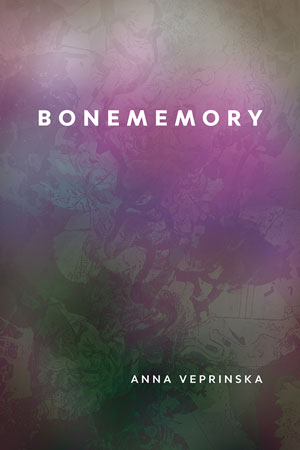
by Anna Veprinska
UNIVERSITY OF CALGARY PRESS
2025/$18.99/96 pp.
Bonememory, the second collection by Ukrainian-born Calgary-based poet Anna Veprinska, navigates a lattice of Slavic, Jewish and anglophone identity with nuance and wordplay. Articulating a stable if not fixed identity is no easy task, as language itself is “all cheekbones/ and blind spots.”
The collection has two parts: “Bone” and “Memory,” buffered by a brief “Metaphysical Interlude.” Poems such as “Not memory, but retelling” acknowledge the complexity of remembrance: “After/ Chernobyl, there was me… a small, coiled poppy.” Recounting its own origin story, the poem goes on to ask “Who am I if I believe this?/ Who am I if I don’t?”
Russian is both invader and mother tongue. One poem describes a palm reading by Belarusian poet Valzhyna Mort, who speaks “About the future, in Russian-/ a language shared between us.” The poem’s imperative to survive evokes the fraught connections language makes for us, despite ourselves. “Mama gestures at the television, where day and night news from Ukraine/ whirls without pause—our family is absent from all that.” Leveraging words to make sense of cultural multiplicity, Veprinska notes overlapping sounds in the Ukrainian word for name and Hebrew word for mother: “name and mother come tangled/ in my cultures’ languages: monikers trail bodies/ like second umbilical cords.”
Moving amid languages heightens attention to word meanings, parts and compounds, and a many-eared attention suffuses this collection. Significant strangenesses like common (and thereby unobserved) eponyms are made explicit in translation. We meet Wound, a Jewish-Ukrainian immigrant singing at synagogue in her Saturday best. She “smears religion/ on her skin/ like sunblock” and changes her name “to Wanda,/ a Slavic word/ meaning wanderer.” Veprinska’s deft tuning alerts readers to the semantics our worlds are built upon—a lingering influence indicative of powerful work.
Lore, bones, memories, meaning. These gatherings are as chronic as the speaker’s pain, heightening awareness of goings-on “beneath skinsong.” Corporeal metaphors become literal—what we stomach, gut through, gut check. Life and afterlives intertwine. One poem teaches Elie Wiesel’s Night virtually during the pandemic. Another responds to the homogenization of Emily Dickinson’s dashes for publication, highlighting how we punctuate ourselves and others, dead and alive.
Identity wanes and waxes. Away from words and people, in a field with “small suns (misnamed/ dandelions)”, temporary peace is found: “for hours/ I do not wonder/ who I am.”
K.B. Thors is the author of Vulgar Mechanics (Coach House).
_______________________________________