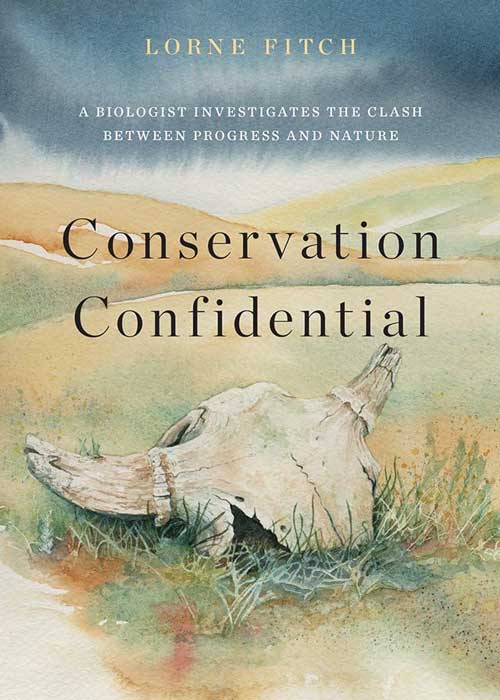
by Lorne Fitch
ROCKY MOUNTAIN BOOKS
2025/$25.00/352 pp.
Barry Lopez makes the case, in The Rediscovery of North America, that in the wake of the rampage of greed and violence unleashed by Christopher Columbus and his men in their search for wealth, subsequent waves of European settlers of “the New World” followed his tone rather than learn about the land and its peoples. Lopez argues that because settlers still know little about Turtle Island, we could embark upon a grand project of learning who has been here all along and thereby give new dimensions of clarity and meaning to our lives.
Biologist Lorne Fitch’s new book, Conservation Confidential, both calls for this kind of Ecological Literacy 101 and provides a “manual” for such an imaginary course on how to live a good life in Alberta. Writing in the tradition of Aldo Leopold’s A Sand County Almanac and Stan Rowe’s Home Place and Earth Alive, Fitch wrestles with the problem of how to awaken people with “buttons for eyes” (as naturalist John Burroughs wrote) to the power of the natural world. He laments the effects of “shifting baseline syndrome”—whereby only elders remember and old photos record natural abundance (e.g., deafening levels of birdsong, epic fishing)—while later generations assume that extirpation, scarcity and their own lack of experience with wild animals and plants is the way it has always been.
Particularly in the first half of the book, Conservation Confidential is a fishing tackle box spilling over with tantalizing knowledge about cutthroat trout, bison, magpies and more. Did you know, for instance, that along creeks in Alberta, “A five-centimetre-deep mat of plant roots provides 20,000 times more erosion protection than unvegetated stream banks”?
Some of the later essays trace mitigation and restoration projects, including the lengthy processes of negotiation with multiple levels and departments of government. While at first I longed for the natural history of the first half, I soon became re-engaged by stories about the dedication and teamwork of biologists, hydrologists and a gifted backhoe operator in the restoration of the Cascade River, not only to prevent future inundations of human infrastructure but also to support the fish. Full of aphorisms and colourful extended metaphors, the essays are engaging and inspiring, especially in terms of what can be accomplished through collaboration, not by individuals alone. As Fitch shows, knowledge of place includes conservation awareness, scientific, historical and geographical information, aesthetic appreciation and a culturally shared, collective project of attending not just to who we are but where we are in the land.
Pamela Banting teaches nature writing at the U of C.
_______________________________________