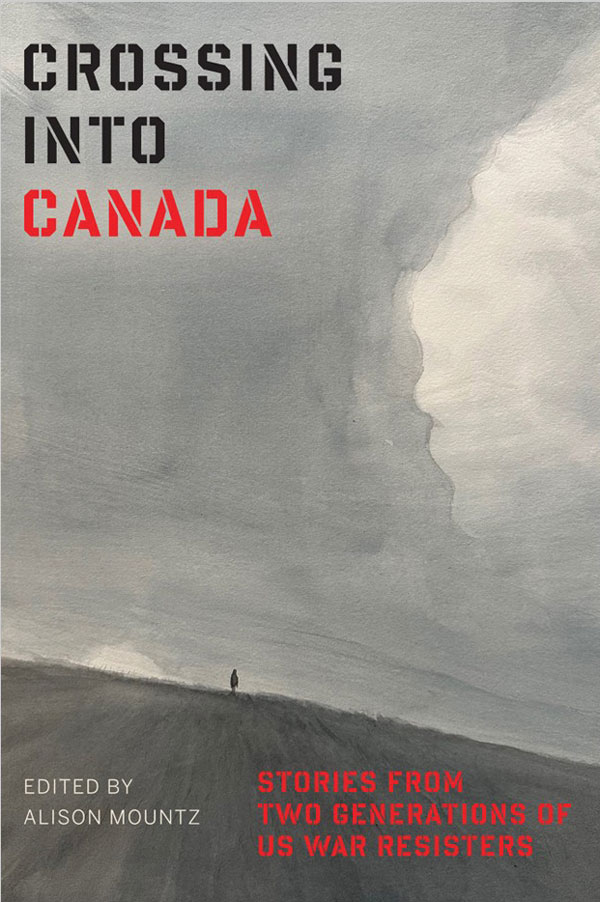
Edited by Alison Mountz
UNIVERSITY OF ALBERTA PRESS
2025/$29.99/232 pp.
A number of months ago Myrna Kostash, the celebrated Alberta author an activist, gave me her personal copy of Mark Satin’s Manual for Draft-age Immigrants to Canada. I had read a reprint of the pamphlet previously but had never seen an early edition. This particular copy, published by House of Anansi in 1970, possessed soft flaps in buttery yellow, featured a stark outline of Canada in black ink, sold for two dollars, and probably had a few stories of its own to tell. As the title suggests, Satin’s book was a how-to guide for Vietnam War resisters looking to start a new life. For many Americans this manual was an essential part of their journey to Canada, but it is now a time-stamped document. Observations regarding the character of Canadians and specific Canadian cities, for example, seem quaint and humorous. For those born after the Vietnam War, the social, personal and political realities of the age feel very far away. We forget the cost of crossing a border. We forget the cost of war.
Five decades later Crossing into Canada: Stories from Two Generations of US War Resisters is a useful companion to the seminal pamphlet. If the manual provides a how-to guide, then Alison Mountz, a professor of geography at the University of Toronto and herself an immigrant to Canada, extends the field by leaning in to personal narratives and oral histories—what fleeing actually looked like and what happened after—that is, “how people resist war, cross borders clandestinely and forge refuge.” The book contains a dozen vignettes from participants whose diverse experiences reflect a cross-section of the 100,000 Americans who fled to Canada in the ’60s and ’70s, but Mountz also includes post-9/11 resisters who fled the US during the War on Terror. As such, the book is not just an essential historical document of one war but a conversation about changing Canadian conceptions of war, borders, safe havens and political action. For Mountz, the wars of the past are embedded within the concerns of the present.
Her framing of the wide-ranging narratives is one of the collection’s strengths. Mountz orders the chapters into an overarching metanarrative that is at once individual, collective and highly readable. Her job, as she states in the introduction, is primarily to listen, and she invites the reader into a similar posture. The payoff is profound. You end each chapter feeling as if you’ve had a difficult, deep and generous conversation with a stranger who might very well be your neighbour. These are human stories with human costs: divorce, estrangement, confusion, embarrassment, shame and joy. The former soldier who found solace in drag. The wife whose husband returned to the US while she remained in Canada.
In a time when the border between Canada and the US is increasingly guarded and deeply political, this collection of personal narratives reminds us of the power of sanctuary and of the pain and beauty in seeking new life in opposition to war. As Mountz argues, the current wars in Ukraine and Gaza, much like the wars in Vietnam, Afghanistan and Iraq—indeed any and all conflicts—are opportunities to reflect upon national values in times of international crises and chaos. Americans who fled to Canada in times of war have changed, and continue to change, the social fabric of our shared continent. These are their stories, which are also now our own.
Benjamin Hertwig is the author of the novel Juiceboxers (Freehand Books) and the poetry collection Slow War (MQUP).
_______________________________________