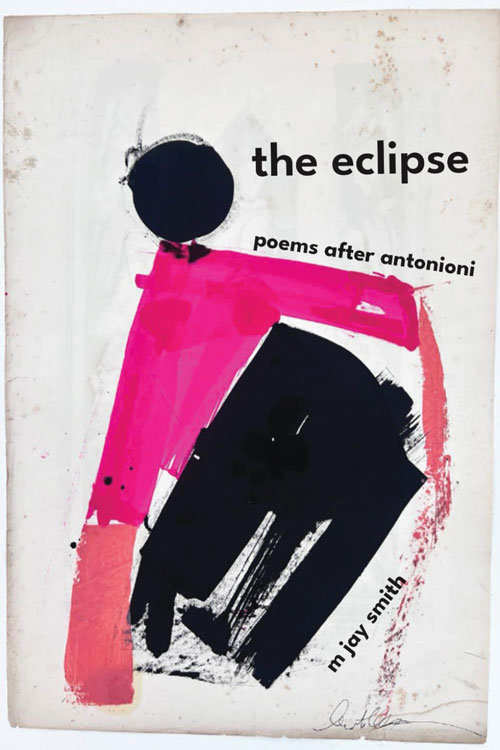
by M. Jay Smith
IGUANA BOOKS
2024/$18.00/74 pp.
You can find almost any film now and watch it at will. What’s harder than it used to be is drawing a bead on what others have seen. With audiences dispersed in their homes instead of gathered together in art houses, we’ve lost a common point of view. Everyone’s range of reference is a series of unshared memories and in-jokes. So it’s brave of Edmonton poet M. Jay Smith to make her first collection, The Eclipse, one whose starting point is the cinematic language of the late, great Italian filmmaker Michelangelo Antonioni (director, not coincidentally, of the 1962 film L’Eclisse).
A starting point isn’t the same as a POV, of course. What Smith hasn’t done is write a book about Antonioni films. She’s done something a lot more interesting—create an Antonioni film using language rather than visuals.
Take this, from “the red desert”: “today’s dream you dream of/ scarves,/ utopian shapes// perched on/ dirty grass, dimensions/ challenging belief: // cathedrals of pipes & valves/ a glimmering city”
The words here refer back to the breathtaking industrial landscapes of Antonioni’s Il deserto rosso, but the architecture of the lines is all Smith—butting concrete imagery (“perched on/ dirty grass”) up against interpretive language (“dimensions/ challenging belief”). The poem’s form—with its short stanzas of short lines—gives us the combined physical and mental experience we might have in the cinema. An image. Our thought—a footnote to it. Another image—a footnote to the thought. An embarrassment of riches.
An embarrassment of riches is a defining characteristic of the contemporary West as it scoops up everything possible into its frenzy of productivity. Antonioni saw the beauty in the artifacts of industrial production—turning the camera’s focus away from the monuments of power and onto the kinetics of nature, and of capital put to transformative use. Smith does the same, as in “the spume of leisure”. Always, she writes:
“something
resembles something else
polarized sentiment is
this, spume”
Smith sees the froth on the waves and makes of it what both nature and capitalism are always making—“something else.” The language here is a demonstration of the poem’s meaning—the repetition of sibilants and plosives, the short vowels leading to a single long vowel. We see resemblance shifting into difference and back into resemblance: a world without end and made of a world that’s always ending.
Alex Rettie is a long-time reviewer for Alberta Views.
_______________________________________
Read More from Iguana Books