 You could clearly see Calgary’s downtown from my office at what back then was called Alberta College of Art and Design (ACAD), when premier Alison Redford came to the college to learn more about this unique Alberta institution dedicated to art, craft and design. As president, I always enjoyed showing our facilities to visiting dignitaries. It was an opportunity to proudly (and easily) showcase the amazing work happening within our walls. Redford’s visit was also an opportunity to share details of our vision for turning the college into a university.
Sadly, her visit in 2012 was also, in retrospect, an all too rare occurrence in relations between our institution, now called Alberta University of the Arts (AUArts), and the leadership of the provincial government. During my 15 years (2010–2025) as president, the government changed from the Progressive Conservatives (PCs) to the New Democrats (NDP) to the United Conservative Party (UCP). There were interesting differences between those three regimes, but also some constants. Redford’s visit, for instance, was the last and only time a premier paid us a visit in my 15 years.
That does not mean I and other representatives of higher education in Alberta were not in contact with provincial leadership. Far from it. My tenure as president overlapped with seven premiers—from Ed Stelmach to Danielle Smith—along with 10 advanced education ministers and countless deputy ministers and interims. We went to meet with most of them. As president, I believed my role was to bridge the gap between politicians whose impact might expire with the next election (at most a four-year stretch) and the need for AUArts to look far beyond that timeline. We needed that bridge, I felt, because moving a college or university forward is quite a slow process. Furthermore, I believe, a key role of post-secondary institutions (PSIs)—universities, colleges and technical institutes—is to equip students to become citizens capable of responding well to the changing contexts and environments of the future. Doing that takes time.
One could speculate—and I do—that most governments do not know what to do with an art/craft/design institution such as AUArts (one of only four in Canada). Nor are they genuinely interested in understanding how they could leverage such a unique educational environment dedicated “to the art of making and the making of art.” Despite this, the existence of AUArts, which this year is celebrating 100 years, is a unique and powerful opportunity to expand what is meant by “made in Alberta” beyond the energy sector. This opportunity is hampered by the government’s increasingly top-down approach to higher education and a post-secondary funding system that—at least to date—makes effective long-term financial planning very challenging. But it is an opportunity nonetheless: arts and culture, when properly empowered, can play a prominent role as a wonderful, positive ambassador for our province.
The government’s increasingly top-down approach to post-secondary institutions makes long-term planning very challenging.
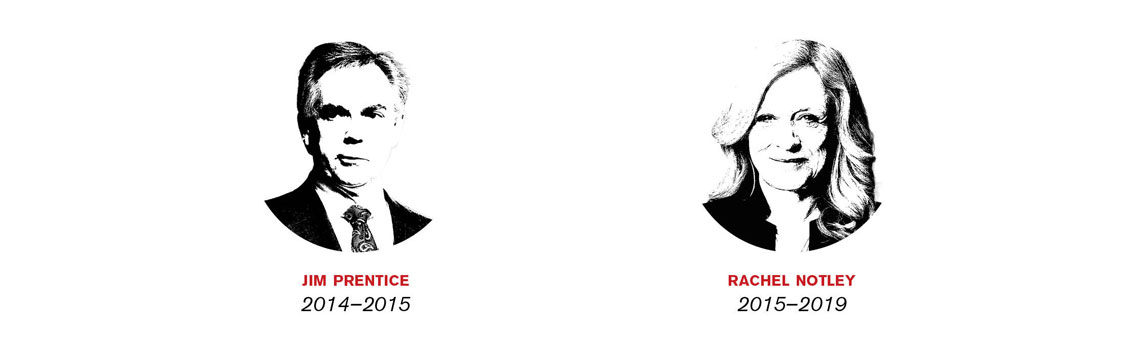
When I started as president at ACAD, I arrived at the tail end of premier Stelmach’s tenure. Although I never met him, I still remember and have kept a very kind letter he sent me, welcoming me to my new role. Interestingly, Jim Prentice, who at the time was the federal environment minister and who later would become premier (2014–15), also sent me a similar letter. I mention this as indicative of a time, sadly gone, where there was a certain savoir faire, a tact and grace among leading politicians.
Prior to my arrival, the post-secondary system had seen substantial investments under Stelmach. It was not evenly distributed among Alberta universities, colleges and institutes, but you could sense there was a genuine belief in the value the higher-education ecosystem brings to a growing and healthy society. During premier Redford’s visit, for instance, we discussed what it means to think beyond the next election timeline, to focus on the long term for the good of the province. In this light, we discussed former premier Peter Lougheed, to whom Alberta owes the first ministry of culture, the Alberta Heritage Savings Trust Fund and the Royal Tyrrell Museum, to name but a few of the gems in Lougheed’s legacy. Similarly, though premier Dave Hancock (2014) was only in office for a brief six months, I also found him receptive, perhaps more than any other premier, to the idea that higher education and the arts are essential for social well-being.
I am a firm believer that a strong society enacts and supports close relationships between cultural prosperity, social prosperity and economic prosperity. Economic prosperity is about financial development and growth, about being able to provide an environment where everyone is given a fair chance and can flourish. Social prosperity is about providing guardrails as well as equitable access to community services (such as education and healthcare), which is especially relevant for those who might not be able to easily access those services. And cultural prosperity is about our identity, about defining and expressing who we are, and maybe more importantly, who we want to be. A strong society understands that one cannot exist without the other two—as a tripod needs all three legs to be equal.
Governments often and conveniently forget that PSIs play critical roles in supporting all three legs of that tripod. Particularly in rural and smaller communities, PSIs often provide the surrounding community with key sport facilities such as the Gary W. Harris Canada Games Centre at Red Deer Polytechnic. They can also greatly contribute to a region through arts and cultural offerings, be it a theatre such as the Keyano in Fort McMurray, an art gallery such as the Illingworth Kerr Gallery at AUArts, or a venue such as the Douglas J. Cardinal Performing Arts Centre at Northwestern Polytechnic in Grande Prairie. PSIs will offer workshops, lectures and conferences to their own stakeholders and very often to the larger community as well. Some might offer daycare, summer camps, an Indigenous centre or a health clinic, to name only a few. The role of a university or a college is not just to be a fulcrum for education—a place to push the boundaries of knowledge, where ideas are explored and challenged—but also to build and nurture the local community.
A willingness to hear these ideas did not translate into financial support under the Progressive Conservatives. Under Redford our budget was cut by 7.2 per cent. For a small institution such as ours, with little room to manoeuvre and limited ancillary revenues to compensate for the loss, these cuts caused major challenges. For PSIs, revenues come from three main sources: government grants, student tuition and ancillary sources (such as parking, student residence fees, facility rentals and returns on investments). Too often, inflationary costs outpace revenues. When you have a government that controls the grant amount received and how much tuition can go up (or not) from year to year, big cuts can lead to chronic budget reductions. In this context, it is not surprising, then, that instead of focusing on implementing a long-term vision and enhancing the tripartite strength of society, administration at PSIs expends a lot of energy and time developing new revenue sources just to keep their institutions afloat.
After the NDP won election in 2015, my first encounter with premier Rachel Notley was interesting. As is customary during the Calgary Stampede, the premier holds a pancake breakfast at McDougall Centre in Calgary—generally the first Monday of Stampede. A meeting of all PSI presidents was convened so we could all meet her in person. That day, with two other presidents, as we were waiting for the elevator to take us to the meeting space, the doors opened and premier Notley was in the elevator. My colleagues introduced themselves and the institutions each represented. When it came to my turn, I introduced myself as president of ACAD. To which Notley responded by asking “What’s ACAD?” My strong disappointment showed as I had to remind her that we were the only post-secondary art school in Alberta—though I did get some laughs from my two colleagues.
Things improved from there. At a subsequent meeting several months later, Notley did gracefully acknowledge my institution.
The NDP government, perhaps not surprisingly, created strong connections between the ministry and the various student associations, sometimes even more so than with respective administrations. It was clear this was a government very much focused on students. I believe this focus is how ACAD was able to finally get the university status it needed, so our students would be perceived at parity with others in Canada. I recall that before we became AUArts it was easier for one of our students to pursue a graduate degree at an American institution instead of at a Canadian university—because the Canadian university wasn’t sure it could accept our students, for the sole reason that we weren’t called a “university” (even though our degrees were full professional ones).
The NDP’s advanced education minister, Marlin Schmidt, was very keen on treating students fairly and protecting them, and he worked hard to help ACAD become AUArts, including ensuring we had additional funding to support this critical transition. Among many benefits, this enabled AUArts to create a permanent Indigenous staff position to support our then new Indigenous centre, the Lodgepole.
At the same time, the NDP government also decided to freeze tuition. This was of course helpful for students. But it had consequences. The freezing of tuition and of non-unionized staff salaries became problematic for revenue generation as well as staff retention. While the NDP gave our institution more government support than the PCs or the UCP did, the underlying structural problem—of receiving our budget one year at a time and not being able to do effective long-term financial planning—went unaddressed. This led to a crisis when the UCP came to power.
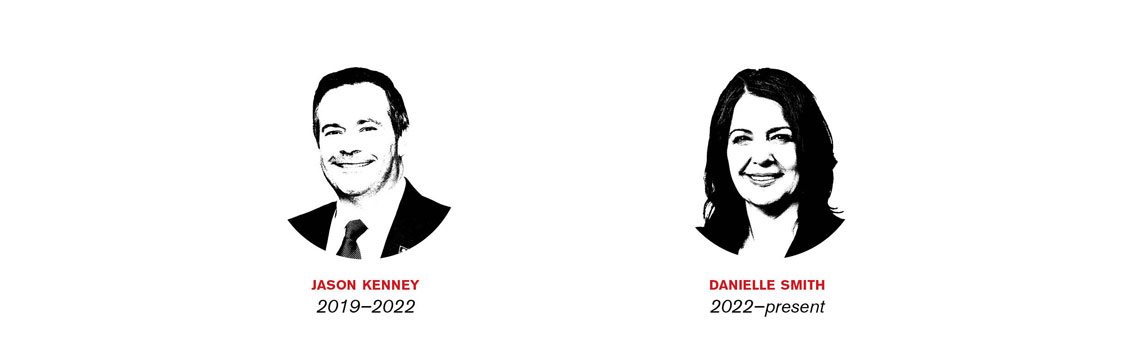
Premier Jason Kenney’s UCP government brought in the largest cuts to the post-secondary system (about 20 per cent) that I saw in my 15 years as president. Unfairly (but not surprisingly), this major funding reduction was not applied evenly across the 26 institutions in Alberta. At AUArts we saw a 20.4 per cent cut to our operating grant over four years, which, calculating for inflation, amounted to a massive cutback of 35 per cent!
For the only time during my tenure, a few staff at AUArts had to be let go or not replaced. Very sadly, this happened a lot in higher education across the province. Students suffered, not least because when Kenney’s government cut our budgets, they also ended the tuition freeze. Most PSIs raised tuition to the maximum 7 per cent allowed for three years in a row to fill the hole in their budgets. But raising tuition beyond inflation created a huge burden for many students—and was a risk for us because, depending on the type of institution and programs offered, you might price yourself out of the market. At AUArts—and I can only speak about our institution here—we noticed an increasing number of students had to find work outside their regular schooling so they could afford to remain students. For some, it meant extending the length of their studies because they could not afford to take on a regular full course load.
Interestingly, the Kenney government also kept a salary freeze in place. With inflation rising, especially during the COVID-19 pandemic, this took a toll on many staff. We saw mid-level staff move to other institutions, as this was the only way for anyone to get a pay raise during the six long years this salary freeze lasted. These were most challenging times indeed, as the government remained adamant in going ahead with the budget reductions.
When Danielle Smith became premier in 2022, to her credit all the presidents were able to meet quickly with the new premier in Edmonton. From the Queen Elizabeth II building you could see the nearby government structures and the downtown cityscape. During that one-hour meeting, she focused on the relationship of the post-secondary sector to the job market and expressed at some length her frustration with it for not supporting enough conservative voices to be heard.
On the former point, it is indeed true that one of the functions of post-secondary institutions is to prepare students for the job market. In Alberta, for all the governments I dealt with, that has been a main emphasis of their dealings with PSIs. However, I would strongly argue it is also equally true that our role is not just to prepare students for particular jobs, but also to equip them to become fully active and productive citizens. We do that by providing them with problem-solving and analytical skills to enable them—and us collectively as a society—to better respond to a rapidly evolving world.
I recall what Canadian higher education futurist Ken Steele told a group of Alberta post-secondary presidents in a meeting in Calgary in the early 2010s. Since many new professions that were created in 2005 didn’t even exist in 2000, he asked, how do you design programs for occupations that you don’t yet know the nature of?
The question is critical and should be front and centre for any government and every PSI administration. How do you best prepare for a future that will be in constant and rapid flux? Witness the disruption AI is bringing to many aspects of our society. This shift requires us to identify the potential skills, and facilitate the creativity, that will be needed in the future. It is why, most tangibly, we cannot focus solely on current job market demands. Addressing our future needs is as critical. But so far I have seen little evidence that governments are interested in this long-term conversation.
Jason Kenney’s UCP government brought in the largest cuts to the system in my 15 years as president.
The uniqueness and strength of the post-secondary ecosystem in Alberta, I believe, is in the relationship to the land on which we are located. Early in my time as president I was privileged to talk with the wonderful Indigenous artist Alex Janvier, an alumnus of our school. He explained where some of the gestures he created in many of his paintings came from. He was simply trying to represent the land an eagle flying in the sky would see, he said. This resulted in gorgeous paintings where lines and colours magically moved throughout the canvas. His work emerged from the open-minded framework he created for it. When I think about what “made in Alberta” might mean, particularly in the context of the relationship between the provincial government and post-secondary education, I recall Janvier’s approach.
An effective government provides a framework in which all organizations, businesses, institutions and individuals are given the opportunity to flourish. That is not quite what I experienced in my 15 years as president of AUArts. Rather than a partnership with the government, I experienced more of an increasingly top-down approach where universities and colleges became mere instruments for policy actions—sometimes even for ideological purposes. During my tenure I saw an erosion of our autonomy with stricter controls such as bargaining mandates and budget expenditures. This “short leash” is apparent in the fact that during my tenure we only received our budget one year at a time. Not being able to do effective long-term financial planning because things might change the following year (or even in mid-year, as we saw during the Kenney government) can be arduous to navigate.
The fact that there is no across-the-board funding mechanism for universities and colleges in Alberta is a unique situation in Canada. In most jurisdictions a specific dollar amount would be associated with a student, and the institution’s funding would be connected to enrolment—with of course some variations according to the type of studies undertaken (some programs cost more to deliver, e.g., cardiology versus French literature) and where the institution is located (i.e., rural versus urban), and this would be applied fairly throughout the system. But in Alberta it is all over the map. For the most part the overall funding here is not specifically attached to the student, resulting in a system that is not treating students equitably as between institutions. The recently released Mintz report does allude to that situation. We shall see if any changes come.
The reality is that, to date, it has been more effective for institutions to work on their own rather than as a system, because backroom deals were in the end more beneficial for individual schools. Once, in conversation with a government official, I questioned why a particular institution had received quite a substantial matching grant through a program that had been terminated a while ago, and—as they had received those funds—why couldn’t my institution also benefit from the “terminated” program? I was told I was not allowed to ask such a question.
I would think we could do better than that in Alberta.
Daniel Doz was president and CEO of Alberta University of the Arts from 2010 to 2025.
_______________________________________