It was a cloudless afternoon near the end of September, and I was wandering among the kiosks of Edmonton’s downtown farmers market. It was unseasonably warm. The sun was trying to pretend it wasn’t heading south for the winter. But the clock was ticking, and the market would soon close until next year.
I was here on the lookout not for the last vestiges of a summer harvest, but for a guy wrapped in the Canada flag—literally, according to vendors. He was here just minutes ago, they told me. He was one of an army of volunteers across Alberta carrying clipboards and inviting people to sign a petition asking the question “Do you agree that Alberta should remain in Canada?”
A simple enough question, you’d think. But in Alberta these days nothing is simple.
My flag-wearing volunteer was here, no doubt about it. He left behind evidence in the form of vendors who not only supported his petition but were happy to explain why. “I signed it,” said Julie Morrison, who runs the “Weird Neighbour” kiosk, selling pins, fridge magnets and custom mugs. She told me she believes in having a strong federal government. And she’d welcome the petition question becoming a referendum question in Alberta. “I like how it blocks them [the separatists] from ever doing this again,” she said. “We don’t need any more strife in our province. We don’t want to see every year there’s a new group, a new radical group that wants to separate, right?”
The petition was at the heart of the “Forever Canadian” initiative. The campaign was created by Thomas Lukaszuk, a former Progressive Conservative MLA and cabinet minister who rose to become deputy premier. Now Lukaszuk is architect of this anti-separatist initiative, which aims to counter a pro-separatist movement being egged on by premier Danielle Smith.
____________________________________________
Want more articles like this?
Subscribe with code FOREVER and receive 10 issues for $30.
____________________________________________
In a September Globe and Mail op-ed, Lukaszuk spelled out his motivation. Most Albertans, he wrote, love being Canadian. When anger at the federation does flare up, “the stronger will of Albertans and their pride in Canada douses the flames of separation, and we’re able to get back to the business of building a strong future for Alberta within Canada.” But recent more strident talk of separation is doing harm, he added. “[It] damages Alberta’s reputation, creates uncertainty, drives away talent and investment and divides communities.”
In an interview during the height of his campaign, Lukaszuk bristled at the suggestion the Forever Canadian initiative is partisan or the beginning of a political movement. “No one could ever say this is an NDP thing or a Liberal thing or a Conservative thing, because they’re all, in virtually equal numbers, engaged in this campaign and supporting it,” he said. “The overarching motivation is just pure love of this country.”
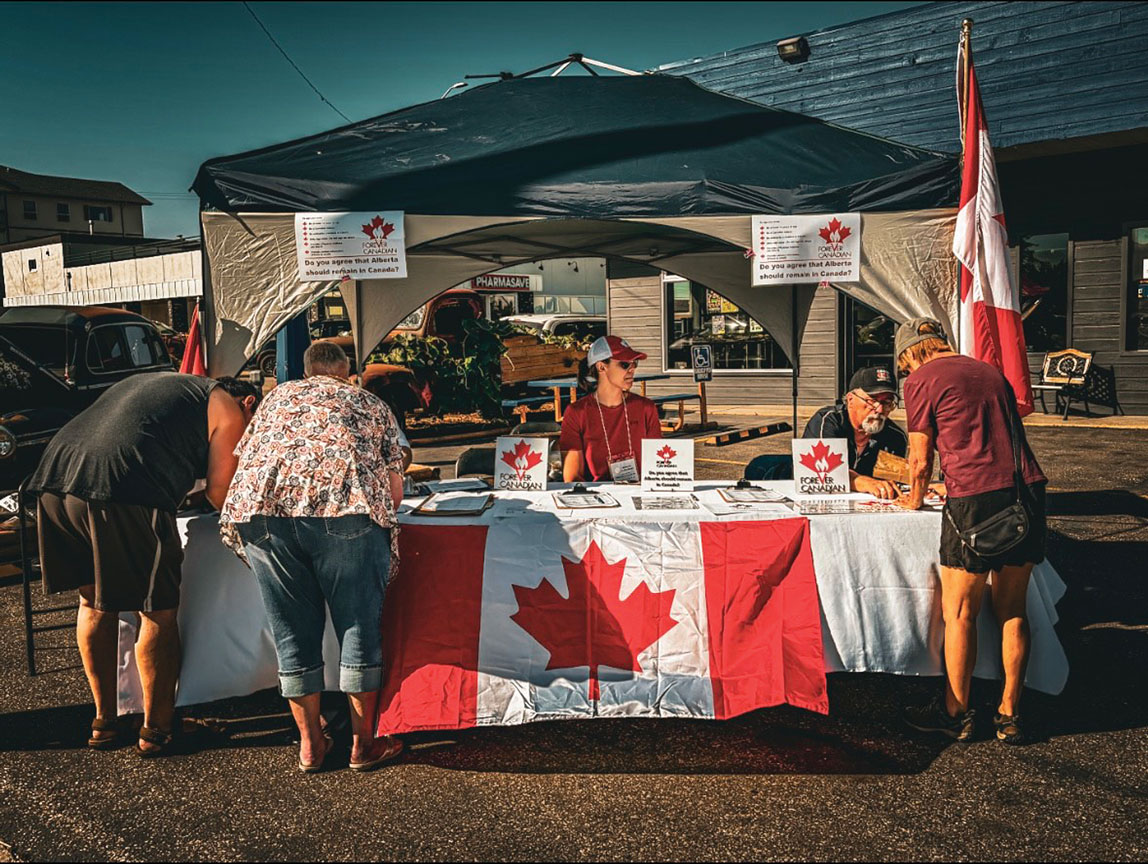
Lukaszuk said the campaign was keeping him “extremely, extremely busy” and that he was pleasantly overwhelmed by the response. He pointed to 5,000 volunteers who organized hundreds of petition-signing venues across the province, whether permanent ones inside local businesses or pop-up tables outside sports events, concerts, book fairs or anywhere else Albertans congregate for a few hours, such as the Smoky Lake Pumpkin Fair and the Andrew Garlic Festival. Lukaszuk also took a multi-week turn driving the group’s maple-leaf-adorned “Unity Bus” across Alberta to collect signatures. He said his daughter spotted a car sporting a “Forever Canadian” bumper sticker. Other volunteers noticed lawn signs. Amazing, he said—because his group didn’t produce any merchandise.
When it came to signing the petition, you had to be at least 18 years old, a Canadian citizen and a resident of Alberta with a physical address. And you had to sign in person.
Lukaszuk told his volunteers they weren’t conducting a sales pitch. They weren’t to entice people to sign, or engage in arguments, or even make the case for Albertans to reject separation. They were simply to invite people to sign. If someone said no, leave it at that.
Lukaszuk told me people had been signing up in droves. Forever Canadian’s official goal was to get at least 300,000 names, verified by the rules set by Elections Alberta, to move the question “Do you agree that Alberta should remain in Canada?” to the legislature for approval as an official referendum question in 2026. Privately, however, Lukaszuk told me he wanted to get many, many more signatures than that, because clearing the official bar so easily would itself send a message to the Smith government and all Albertans.
When I ask people why they’re signing, pretty much everyone gives me a quizzical look. The answer is so obvious. “Because I’m a Canadian citizen.”
When I asked people at various pop-up events why they were signing, pretty much everyone gave me a quizzical look, as if I’d asked a stupid question. The answer was so obvious. “Because I’m a Canadian citizen,” said Janet Johnstone, as she stopped by the booth at a dog park in south Edmonton. “I was born in Edmonton. I’ve lived here all my life. I love Alberta. But I’m Canadian.”
For Albert Kwong, who immigrated from China in 1978 and has lived in Alberta ever since (save five years in Ontario and 18 months in Vancouver), a united Canada makes sense economically and practically. “In a big Canada we support each other,” he said. “I think that’s the best way to do it, right?” And we can visit each other, too. “I just came back from the east coast,” he told me. “I can go to Toronto, go to the west, to Quebec. I don’t worry about applying for a visa. When I go to China, I need a visa.”
Lukaszuk said he heard hundreds of emotional stories, including from a woman in her 90s from Vegreville who asked a campaign volunteer to come to her home so she could sign the petition to honour her late husband who fought for Canada in the Second World War. Or the family that drove from Fort McMurray to Edmonton to sign the petition rather than wait for a pop-up event in town. (The campaign eventually got to Fort McMurray anyway, in late summer, with a petition signing in front of Mitchell’s Café.)
Lukaszuk said some Albertans signed with a mixture of love and a bit of anger: “A lot of them, refugees and immigrants as well, are mad. They’re angry. They say, ‘You know, people here just don’t realize how good they have it. What a great country this is.’ They just think it’s pathetic that we got ourselves into a situation where we actually have to declare our love for Canada, because it should be so obvious.”
Putting aside the monumental legal, economic and cultural barriers to separation, including outspoken opposition from First Nations, most Albertans are for staying in Canada. A Leger survey in May 2025 showed that 67 per cent of Albertans oppose separation. A CBC-commissioned poll, also in May, indicated that even though support for separation had grown from 12 per cent in 2020 to 17 per cent in 2025, 67 per cent of respondents disagree that Alberta would be better off if we separate from Canada.
But it wasn’t just everyday Albertans signing the petition. Lukaszuk’s initiative resurrected a number of other “old” Progressive Conservatives, once powerful and well-known local politicians who had disappeared into the annals of time, along with their party, but were now popping up like prairie dogs at sunrise.
Former premier Ed Stelmach, now retired and living on a homestead founded by his grandparents in northeastern Alberta in 1898, jumped back into the public arena with a social media post urging Albertans to sign Lukaszuk’s petition. “I support a strong Alberta within a strong Canada,” he wrote. In August Stelmach went on Ryan Jespersen’s Real Talk podcast. “I’m worried that if we rush into something like separation, do we end up with Brexit?” he asked, referring to the disastrous British vote to leave the European Union.
Two former conservative Alberta MPs, Ian McClelland and Brent Rathgeber, also endorsed Lukaszuk’s initiative, with Rathgeber going one step further to help manage the campaign.
They were joined by Richard Starke, a former PC MLA from Lloydminster, who, following the UCP–Wildrose merger in 2017, sat as the lone Progressive Conservative in the assembly. “I’m no separatist, I can tell you that right now,” Starke told me. “Separation from Canada would be an absolute unmitigated disaster for Lloydminster. We’d have a national border going down the middle of our city. It would be a train wreck.” He argued that by giving a sympathetic ear to a separatist sentiment, premier Smith is simply trying to score points with her base. “If an Alberta politician wants to gain some traction, we bad-mouth Ottawa, right? That’s especially true when there’s a Liberal government in power.”
Danielle Smith’s critics from NDP and liberal points on the political spectrum also expressed support for Forever Canadian. Lukaszuk insists his initiative has nothing to do with partisan politics. But it’s impossible to entirely disentangle the issue of separation from politics. Premier Smith has introduced a series of policy changes to achieve her goal of creating a “sovereign Alberta” within a united Canada, a statement her critics call oxymoronic. Her tactic is a significant and, for many Albertans, troubling break from Alberta’s political past, where for decades premiers chronically railed against Liberal federal governments but stopped well short of encouraging separatists.
As premier 20 years ago, Ralph Klein suggested that on any given day 15 per cent of Albertans supported separation, a number he said he could manage. But in 2003 Klein had to deal with loud separatists at a PC annual general meeting. He ended up promising to push Ottawa for more provincial powers. But Klein clearly rejected splitting from Canada. “I cannot honestly see myself saying, ‘Here is a separation question, and dammit, unless you listen to us and unless we get our own way, unless you do this, unless you do that, we’re going to separate,’” Klein told reporters. “I don’t first of all see myself doing that, and I don’t know how the feds would buy it.”
A lot of petition signers are mad. They say, “You know, people here just don’t realize how good they have it. What a great country this is.”
Twenty-some years later, premier Smith is hoping the federal government will buy it, or at least take separatist sentiment seriously enough to give in to her government’s demands for more pipelines to help Alberta companies get more oil and gas to markets. To do that she’s trying to create a base beyond diehard separatists.
A September 25, 2025, Substack by U of A Ph.D. student and researcher Sam Goertz—“Is Separatism Mainstream in Alberta?”—looked at the complexity of Albertans’ feelings about Confederation. His work was based on extensive interviews done by the Common Ground initiative, which aims to find ways for progressives and conservatives to talk to each other, because “[c]itizens appear to have lost the shared sense of purpose and values necessary to debate matters of the public good respectfully, without alienating or disparaging their neighbours.” The project constructed an imaginary “typical” Albertan called Joe, who is not a separatist but is separatism-curious. “He wants Alberta to remain in Canada and make it work, but life has been getting harder lately, and maybe things would be better if Alberta went it alone,” Goertz wrote. “Or at least, Alberta needs to do something more drastic to get a better deal with Ottawa. [Joe] feels that Alberta has little power and that Albertans are neither well respected nor understood by the rest of the country.”
In late September I met a version of Joe at a pop-up event at an Edmonton dog park. He was biking home from work and stopped to chat with a couple of the Forever Canadian volunteers he recognized as neighbours. But he wasn’t prepared to sign the petition.
“I’m in the oil and gas sector,” he told me. “And I want to be a part of Canada. But I do see why people have frustrations, right?” He said he thinks his wife signed the petition a few weeks before. “I’m not against signing,” he added. “But I have some concerns, and I don’t know if people’s voices are being heard.”
When I asked for his name, he hesitated and said to simply call him “Brad,” because politics has become too divisive and he didn’t want to be a target. “People are very confrontational right now, and if there’s a reason to be frustrated with you for not being 100 per cent one way or the other, because you have some unanswered questions, I think people, unfortunately, want to spit venom.”
Some pro-Canada anti-separatists—even as they were eager to sign the petition—told me they were wary of Lukaszuk’s motivation. His criticisms of the premier go way back, to when he was a PC minister and she was leader of the Wildrose.
Lukaszuk has heard these and similar concerns: “Some politicians are reticent to get involved, because there’s a fear I may turn this into a political party and maybe unseat them or take over their leadership,” he said. “But that’s irrational for two reasons. One, because that’s not what I’m doing. That’s not what my plan is, period.”
The other reason, he said, is that the politicians, past and present, supporting his stay-in-Canada effort represent a wide range of views that would have trouble coming together. Political strategist Stephen Carter, who worked on Naheed Nenshi’s campaign for mayor of Calgary, agreed. “People can mark their ballot against separation in a referendum and then still choose Danielle Smith [in a general election],” he told me.
Lukaszuk said his ultimate goal is to not have a referendum at all. “I’m the last one who wants a referendum on Alberta separating or staying in Canada,” he said. “We don’t need to have a referendum.” Rather, he wants the legislature to adopt a formal policy rejecting separation. But he said it can’t end there. “Those who are either hesitant to sign or who are actually outright pro-separation… I may disagree with them, but they definitely feel that way, and we need to address that.”
One benefit of the Forever Canadian campaign, he said, is that it has helped to bring Albertans’ grievances into clearer focus. “Certain demographics are starting to reveal the epicentre of this anger,” said Lukaszuk. “There’s work to be done. When this campaign is all completed, we’re not going to say, ‘Oh, don’t worry, separatism isn’t real, it’s not a threat.’ Because if we don’t start addressing some of these issues, fixing them and educating people on how things really work in Canada, this separatist movement will grow.”
The petition was the largest in Canada’s history, he said, adding the Forever Canadian movement has only just begun.
On October 28, 2025, Lukaszuk announced the campaign had “smashed” its goal. Standing in front of stacks of 61 boxes of petitions containing 456,388 signatures, he told reporters Albertans had sent a clear message: “Alberta is and always will be Forever Canadian.” The petition was the largest in our country’s history, he said. But he added that the Forever Canadian movement has only just begun.
Elections Alberta said it would verify the signatures and announce its results no later than January 6, 2026.
At farmers markets and dog parks and garlic festivals and beyond, across the entire province, the Albertans who signed Lukaszuk’s pro-Canada petition did so for reasons both unique to their own lives but also common to the group. One university student in downtown Edmonton told me he wants to keep together a country that so many of his forebears built: “Canada is a group of people made up of many other groups of people,” he said. “It’s not what we stand for as Canadians to be separating out into smaller chunks. We’re a country of immigrants and we’re a country of people who came together. Why would we want to disassemble something that we worked so hard to put together?”
Graham Thomson has covered Alberta politics for decades and writes a bi-monthly column for Alberta Views.