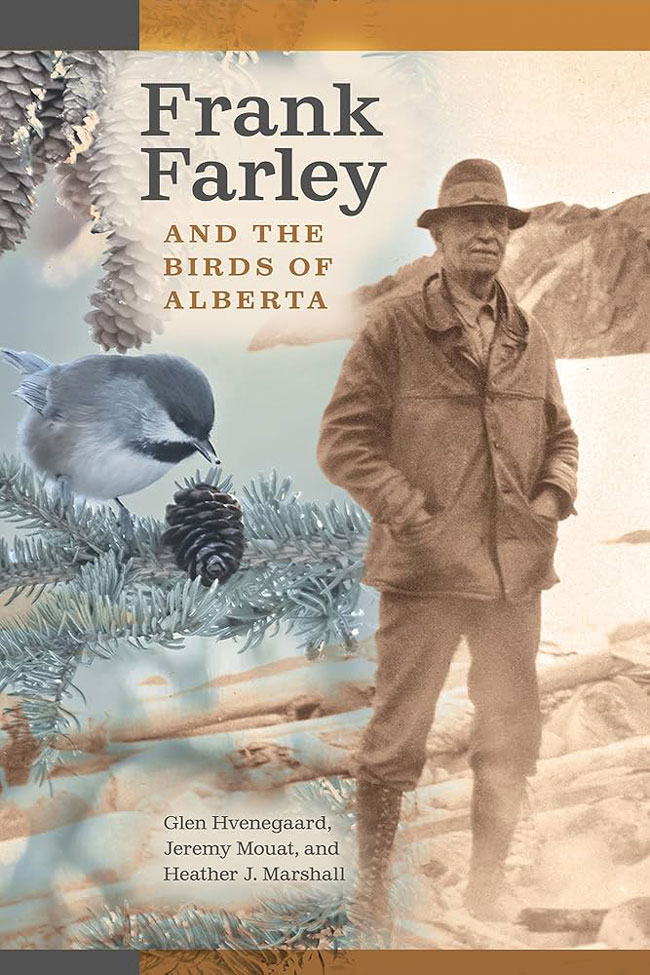
by Glen Hvenegaard, Jeremy Mouat and Heather J. Marshall
University of Alberta Press
2025/$32.99/280 PP.
The first book I ever bought with my own money was The Birds of Alberta, by Ray Salt and Albert Wilk. In 1959 it cost $5. What few bird books were then available focused more on eastern North America—and here was a comprehensive, hardcover illustrated guide to the birds of my home place. It was a game changer for an aspiring birder.
I never knew this newfound treasure was largely the product of a humble Alberta naturalist from the Camrose area: Frank Farley. Farley died in 1949, at the age of 79, but his data and observations served as the primary basis for the book, and his name should have been on the cover too. That’s okay, though: Farley’s contributions to our knowledge of Alberta’s nature and to conservation history have finally earned due credit with the publication of Frank Farley and the Birds of Alberta.
Written by Glen Hvenegaard, a professor of environmental science at the University of Alberta, Jeremy Mouat, a professor emeritus at the U of A, and freelance writer and graphic designer Heather J. Marshall, Farley’s biography stands out both for the depth and quality of the archival research that went into it and for the authors’ approach to building historical context. The latter makes it more than just a biography. It’s Frank Farley in the context of his times. After reading the book I felt like I still hadn’t quite connected with Farley as an actual person, but my understanding of the early years of ornithology and nature conservation in western Canada was now much deeper than before.
Farley grew up in an era when young naturalists collected eggs and shot birds they couldn’t identify. After moving from Ontario to central Alberta as a young man, his interests expanded to promoting ethical hunting practices and conserving bird habitat. The early 20th century was a time of unabashed boosterism and development; there seemed to be plenty of nature and no limits on enterprise. As a prominent businessman, Farley contributed to the fragmentation of Alberta nature even while being a strong voice for conservation and restraint. The authors do an exceptional job of exploring the degree to which Farley personified the cognitive dissonance of that era.
Miquelon Lake Provincial Park, between Edmonton and Camrose, is part of Farley’s legacy to Albertans. Noting its exceptional productivity for waterfowl, he decried the degree to which trigger-happy game hogs were exploiting it: “…it was a disgrace to civilized man, to see the piles of ducks that were shot and in a good many cases allowed to rot and spoil before they were taken away.” After Miquelon was finally designated a federal wildlife sanctuary in 1920, Farley was appointed as its guardian.
The town of Camrose hosts an annual purple martin festival to celebrate the abundant local population of these unique large swallows. As the birds dart overhead, they trace the signature of another conservation legacy across the sky. It was Farley who initiated the public awareness program and birdhouse projects that led to today’s abundance.
Conservation doesn’t happen by accident. If luck is involved, it’s the kind of luck that puts the right people in the right place at the right time. Frank Farley was one of those. This biography is a long overdue recognition of a man, and a time, that Alberta would do well to remember.
Kevin Van Tighem is the author of Understory: An Ecologist’s Memoir of Loss and Hope (RMB, 2025).
_______________________________________