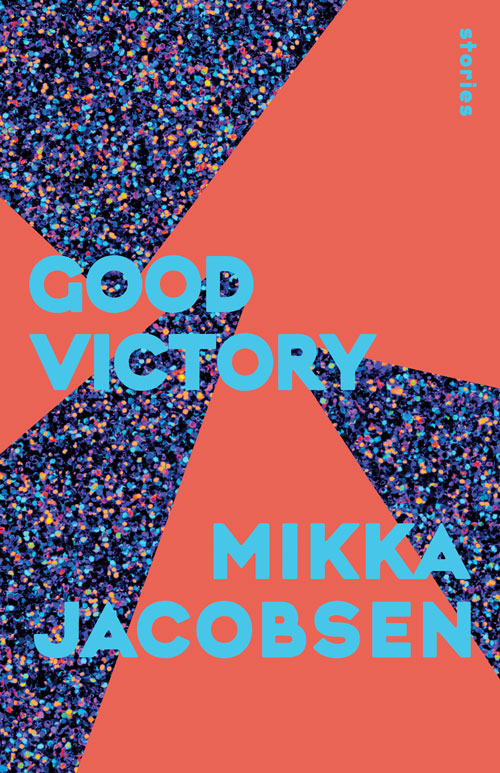
by Mikka Jacobsen
FREEHAND BOOKS
2025/$22.95/240 pp.
A satisfying short story resolves itself neatly in the end; the most resonant ones, though, drop you off a cliff. The 11 stories comprising Good Victory, the first fiction collection and second book from Calgary essayist Mikka Jacobsen, belong to the latter category.
Jacobsen illustrates quotidian urban prairie life at a slant: a teenager’s addiction to the supernatural encounters she has while asphyxiating herself; one woman’s homoerotic encounter with an ex-frenemy at a West Edmonton Mall psychic fair; another maimed by a ride at the Calgary Stampede. Jacobsen is at her best when interrogating the raw edges of femininity; she presses on the bruises of girl-on-girl cruelty and abject desire, the basest want to be wanted. Take, for example, this child’s attempt to lure the attention of her absent father: “It dawns on Lizzie that Ferris is trying to flirt with their father. The sun attacks her eyes. An ache hammers behind her earlobes. There is an uncomfortable hum in the pit of her stomach. It feels like watching people kiss naked in a movie.”
Each story contains a novel’s-worth of world-building, down to the backstories of protagonists’ mothers and names of secondary characters’ dogs. Jacobsen’s richly realized inciting incidents and conflicts, however, are rarely resolved; the stories’ endings feel spare in comparison to their beginnings. As if taking a rough ride on a seesaw, the reader is sent flying from one story into the world of the next, left to wonder what, exactly, just happened. While this could be a kind way of describing the stories as imbalanced, Jacobsen’s technique seems to serve a higher purpose. In the collection’s final story, “The Spider Olympics,” the protagonist—herself haunted by a family history of ghost-sightings, an eerie life coach, and a dead-end job as a writing teacher at a trades school—takes to reading, then writing, stories inspired by Alice Munro. Where people want clarity, the protagonist reflects, Munro frustratingly doles out “opacity and moral ambiguity.” But she also offers truth—frustratingly important truths.
Following Munro’s tradition, Good Victory trains the reader’s eye to the oblique terror of real life but doesn’t try to make sense of it. Instead, the work of processing lies with the reader. One possible thesis of the book is this: people don’t necessarily act poorly because of trauma or logic. Rather, Jacobsen reveals that desire defies logic in the first place; maybe this is why it feels so shameful to say what we want out loud. Good Victory, then, is not a collection for a reader who needs a narrative tied in a bow. But those who do take it for a spin will be rewarded with something much more thrilling.
Kate Black is the author of Big Mall (Coach House, 2024).
_______________________________________
Read More from Freehand Books