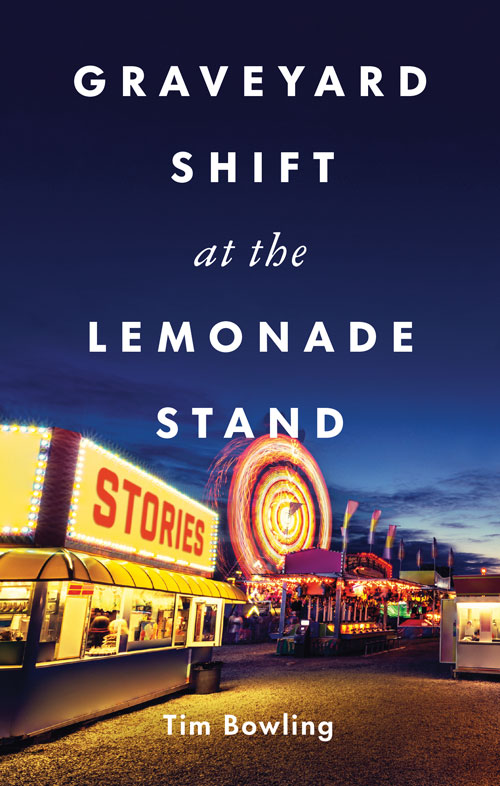
Graveyard Shift at the Lemonade Stand
by Tim Bowling
FREEHAND BOOKS
2025/$22.95/275 pp.
Where would you find a lemonade stand after midnight? A haunted sideshow? An abandoned carnival? Tim Bowling knows. The prolific Edmonton-based author uncovers these places, both bitter and sweet, in Graveyard Shift at the Lemonade Stand. It’s his first collection of short fiction, which I was surprised to learn, as the book is assured and compact and was a pleasure to read.
The collection’s first story, “The Living,” sets the tone. A teenager on a fishing trip with his parents encounters a sinister tramp, skulking along the river, whose vernacular-laced tales of adventure (plagiarized, the boy knows, from books he’s read) easily draw his father into his orbit. One of the collection’s strongest stories, it’s gothic and creepy, full of Bowling’s exacting detail (“Aunty Muriel wears her grey hair in a severe bun and is always sucking air through her teeth.”). Many other stories here feature adolescent boys presented with ethical dilemmas in which they’re either found wanting or, in an achingly sad moment, realize their parents are all too human.
“Bartleby, the Sessional” (taken after Herman Melville’s story “Bartleby, the Scrivener,” and originally published in Alberta Views, May 2021) follows a misanthropic, failed academic’s stumbling to success via the lows of the post-academic hustle. It’s scathing and poisonously funny, ventriloquizing Melville’s interiority and his common themes of deceit and free will (and giving some additional nods—the professor meets a student at Starbucks; poetic signifiers like “salt spray” are dotted throughout). In other hands, stories such as “Bartleby” could fall on the side of the cringe-inducing, overly satirical and sneering. It’s clear, however, that Bowling cares deeply for these characters, here and in other tales that riff on literary themes and writers—such as the John Cheever-inspired “This is a Test of the Emergency Book Buying System,” and a fable-like story, “Tidal Change,” where a blue heron transforms into a man and discovers the blessings and curses this brings, turning the pathetic fallacy inside out.
Taken as a whole, the collection reads like the work of a reader’s writer—you can feel how many authors and books Bowling has absorbed over his lifetime. Canadiana (and Americana) thread through the stories; fans of work from David Adams Richards to The Body-era Stephen King will love it. As much a truly delightful read as an exemplar of craft—and it is—the collection may be best experienced by dipping in and out, one tale at a time, though you may find that difficult to do. As the title hints at, these are stories to be gulped down and read into the late hours.
Bryn Evans is a writer and clinical social worker.
_______________________________________