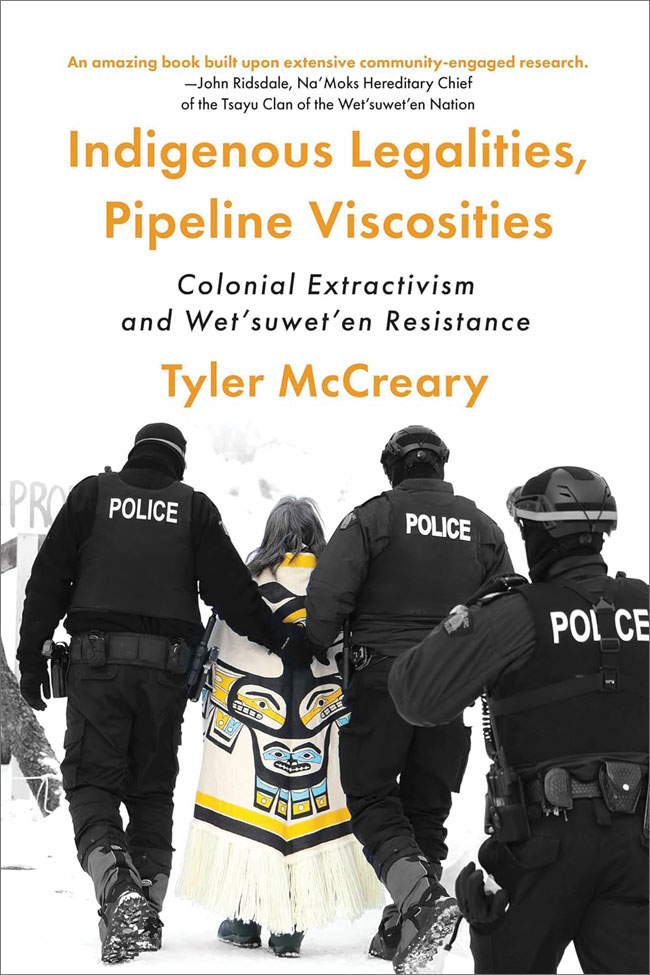
by Tyler McCreary University of Alberta Press, 2024
In 2006 prime minister Stephen Harper claimed that Canada’s tradition of inclusive development was a key part of our country’s “emergence as a global energy powerhouse.” We were, of course, not there yet. The landlocked oil sands require pipelines to link production to global markets. In Harper’s time, the first new pipeline proposed was the Northern Gateway—from Alberta to the northwest BC coast. The attempt to build it, writes Tyler McCreary, revealed that “the ideal of inclusive development that Harper evoked was illusive if not illusory in practice.” The pipeline would have run through the traditional territory of the Wet’suwet’en First Nation, who have taken their land claim to the Supreme Court, and who largely opposed the pipeline. “This book unpacks how the fate of this pipeline became entangled with Indigenous mobilizations,” writes McCreary. “Specifically, it examines how state and corporate actors tried to incorporate Wet’suwet’en concerns into formal governance processes and how Wet’suwet’en resistance exceeded those frames, ultimately becoming part of the constellation of forces that blocked the proposed project.” For those wanting insight into the complex realities of Indigenous law and proposed resource development in Canada, this is an essential book.
_______________________________________