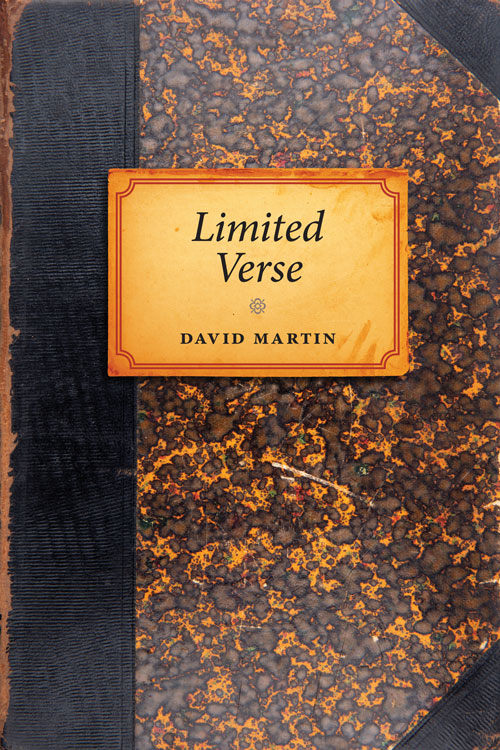
by David Martin
UNIVERSITY OF CALGARY PRESS
2024/$18.99/136 pp.
Calgary poet David Martin’s third book, Limited Verse, is a brilliant feat of imagination, mashing together poetry, dystopian sci-fi and literary theory. But most of all it is a profound and moving investigation of language: about how language hems in or liberates our thoughts, about its power to preserve memory and forge human connection despite its limits, and about its inherent instability through time.
The book takes the form of an annotated manuscript recovered after the liberation of New Earth, a fictional penal colony of labourers whose memories were wiped and whose language was “Harmonized”—that is, replaced with New English, a rudimentary lexicon of 850 words. (New English is modelled on Basic English, invented in 1925 by the real linguist C.K. Ogden as a means of cross-cultural communication.) On the brink of being shipped out to New Earth and desperate to build a bridge between past and future selves, the manuscript’s anonymous author has translated beloved poems into New English in a notebook to be smuggled into the colony, interspersing the poems with journal entries that ruminate on the looming transformation.
The opening pages of the journal express a searching curiosity rather than pure dread: “Yes, I have fear, but maybe when I am awake with only 850 words I will experience a strangeness that will make the land feel new. I will have less to grip onto with my mind and more to see with feeling.” What ensues is an invitation to the reader to consider the effects of such a radical simplification of language—what is lost, what is gained, what eludes the grip of the mind and what is preserved in the way of feeling.
Working my way through the book, I found myself fantasizing about being an English instructor and designing a course around Limited Verse—I can’t imagine a better teaching tool for conveying poetry as the act of fumbling toward vivid precision within the limits of language and the constraints imposed by poetic form. The original poems upon which the translations are based are all in the public domain and can easily be found on the internet, occasionally with some creative searching. I read each New English poem side by side with its original—first the translation for a first impression, then the original, then back to the translation for a close comparison.
Many of the poems deal with themes of loss, transformation and renewal, as does “Fire-Flowers” by E. Pauline Johnson/Tekahionwake. The ending stanza of the original is:
And only to the heart that knows of grief
Of desolating fire, of human pain
There comes some purifying sweet belief
Some fellow-feeling beautiful, if brief
And life revives, and blossoms once again.
In Martin’s hands—without the pivotal word “grief”— the stanza becomes:
And only to the heart that knows death’s song
Of wasting fire, and of the human pain,
There comes something so clear, so sweet and strong,
Some equal-feeling beautiful, not long.
And time restarts, and opens now again.
The translated poems at times sing and at times strain, but both their beauty and their awkwardness are illuminating and spark reflection: How does a limited verbal palette foreclose opportunities for playing with sound as well as meaning? Does a reduced vocabulary for the natural world constitute a tragic form of collective memory loss, as explored by Robert Macfarlane in his book of poems The Lost Words, devoted to items (e.g., “fern”, “heron”, “willow”) dropped from the 2007 edition of the Oxford Junior Dictionary? Or does the need to express familiar referents with new raw materials allow us to see a thing afresh, as when Martin translates “falcon” as “knifebird”? When does the austerity of New English sever our link to the past and when does it lift an already deadened and inaccessible form of language into the present, pulsing with new vitality?
Endnotes, provided by fictional scholars from far in the post-New Earth future, offer analysis and commentary on the recovered notebook. Leveraging an ample lexicon that permits nuance and abstraction, these notes delve into theories of literary translation, George Orwell’s views on language, the Sapir–Whorf hypothesis about the relationship between language and thought, the fetishization of simplicity by high modernist writers such as Eliot, Joyce and Pound (who were advocates for the spread of Ogden’s Basic English), and the creative power of constraints on language (“the smaller the room in prison, the greater the mind’s purpose and power of expansion,” writes Martin’s protagonist). An integral part of the text, the notes guide the reader into a deeper experience of the New English poems and journal entries.
The mind-wipe and Harmonization process awaited by the protagonist serves to anchor one of the book’s central preoccupations: that language is never fixed in time, that it is always subject to the forces of change, loss and reinvention. It is easy to foreground the losses—in our own historical moment, declining reading habits and the levelling effects of ChatGPT may well be simplifying English, and within our lifetimes many of us will feel the mind-wiping effects that come with dementia or aphasia. But a deeply humane and hopeful vision permeates Limited Verse, reminding us that a creative spirit can withstand what may seem a devastating shrinkage of language. A lexicon of 850 words is enough to grapple with the most profound aspects of human experience: love, religion, trouble, death. Clever and erudite as he is, Martin’s true genius lies in showing, through his rejuvenated—if at times lurching—poems and through the soulful journal entries of the protagonist, that “art is ever the sign of the attempt to connect” and that “the Old English will be gone, but thought is able to stretch beyond the limit of language and touch the deepest part of us.”
Julie Sedivy is the author of Linguaphile (Farrar, Straus and Giroux) and Memory Speaks (Harvard University Press).
_______________________________________
Read More from University of Calgary Press