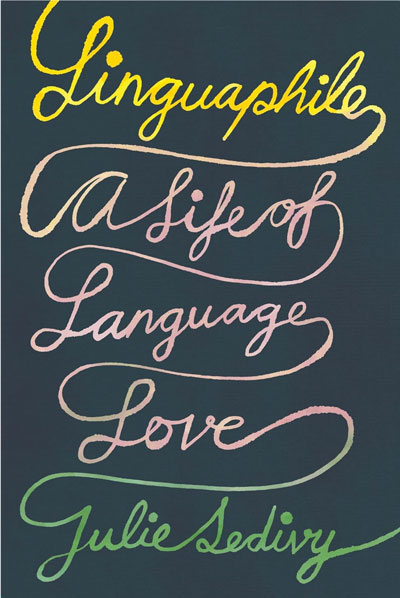
by Julie Sedivy
FARRAR, STRAUS & GIROUX
2024/$39.00/336 pp.
Julie Sedivy’s Linguaphile is a fascinating account of the Calgary author’s long-standing love affair with language as well as a scientific deep dive into the world of human communication. Divided into three sections—Childhood, Maturity and Loss—Linguaphile blends elements of memoir, research and cultural commentary to take the reader on a surprisingly moving and intimate journey. Having grown up in multiple cities in Europe and North America, where she was exposed to a variety of languages from a young age, Sedivy is quick to acknowledge that each language “comes with its social habits and its judgments about what to forgive, what to condemn and what to revere.” Perhaps that’s why, until the end of the 20th century, teachers “warned about the dangers of bilingualism, believing children would be linguistically confused.” Thankfully, that belief has changed, because inherent in our species is a “capacity to merge attention with each other” through sound, signs and tactile movements. There is no curriculum, Sedivy reminds us, “designed to teach children how to converse in their mother tongue.” By contrast, her memories of learning Spanish in high school, with its focus on grammar instruction, was the “opposite of reckless, ignorant, infantile language love.” It made students afraid to make mistakes. And fear, as Sedivy alludes throughout, is the enemy of both language acquisition and application.
Despite the loss Sedivy writes about in the final section—her brother’s death, the return of her husband’s cancer, and her fear of becoming “language broken” as she ages, through stroke or dementia—Linguaphile leans into the miraculous. That we communicate at all is a great feat, and, in the author’s impassioned words, “love is an accelerant for learning.”
Some conversations, she cautions, are like glaciers—not to be traversed alone. “If you are going to travel over language filled with cracks,” Sedivy concludes, “you’d better be roped to your companions.” More than anything, however, the book celebrates the love of word play, the joyful mouth feel of certain words (like “Malayalam”), and the under-recognized assets of growing old. Not being able to immediately recall words as we age, for instance, might simply be due to having an abundant inventory. To paraphrase the author, if a 60-year-old can recall only 90 per cent of the thousand names she knows, while a 17-year-old can recall 98 per cent of the 100 names she knows, then it’s clear whose memory is the more powerful.
The well-written and researched work of a professional scholar, Linguaphile is also a love letter to human sound and an entertaining read about the aesthetic delights of language.
Theresa Shea’s third novel is forthcoming from ECW Press.