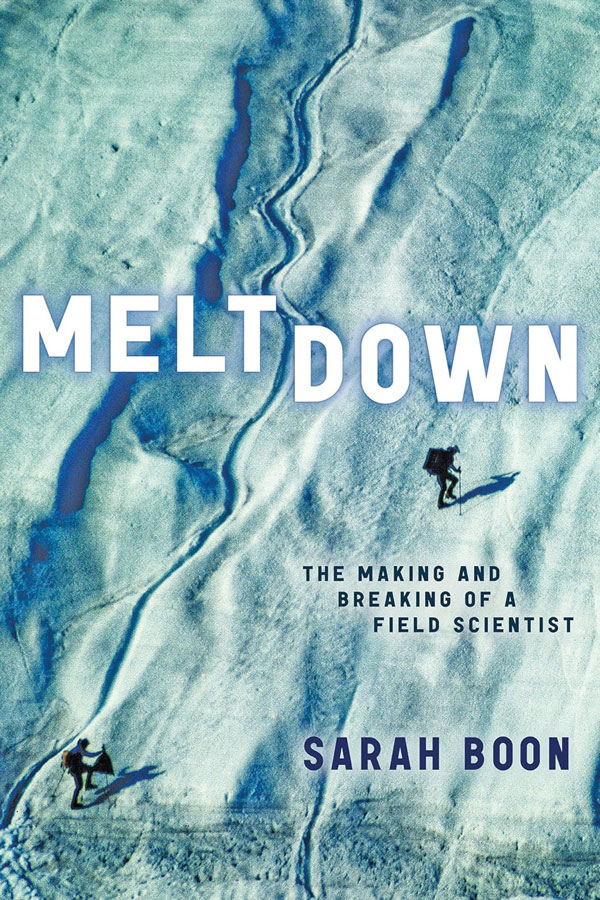
by Sarah Boon
UNIVERSITY OF ALBERTA PRESS
2025//$27.99/312 pp.
Meltdown opens with a harrowing scene. Alone with a student on an Arctic glacier, hours from help, the student repeating “I don’t want to die, I don’t want to die.” In such remote places a small misstep can rapidly become life threatening. Author Sarah Boon rises to these moments. A hydrologist by training, she has ventured across northern and western Canada, from the forests of northern British Columbia to Ellesmere Island in the high Arctic to the Rocky Mountains in southern Alberta. Her fieldwork offers a window into landscapes few ever see. Among the most dramatic is the collapse of meltwater lakes that form on Arctic glaciers each summer: “We sensed movement—like a freight train running beneath our feet—and heard loud cracking and creaking with the ice. It was a bit unnerving to imagine the glacier as a living organism on whose back we were standing as it shook off the remnants of winter.”
Against the backdrop of glaciers and remote forests, Boon captures the less glamorous side of science: setting up instruments, sorting data and warding off black flies. But what she sees as most central to her approach is ground truthing, the conviction that being in the field, watching ecosystems shift, offers insights no remote dataset can match. She writes of “the joy of leaping from rock to rock to cross a stream, and the satisfaction of finding my footing on a rubbly mountain trail.”
While her passion for this kind of science is clear, she also recounts how difficult she found the culture and politics of academia. Much of this, she argues, stems from the experiences of women in science; indeed, she cites a jaw-dropping study showing 64 per cent of women in fieldwork experienced sexual harassment and 22 per cent report assault. These figures underscore the risks shaping women’s participation in field science. At the same time, Boon’s difficulties in academic settings seem to arise not only from external barriers but also from her own preference for solitude and self-reliance.
Boon lays herself bare with commendable candour. The book reads like a diary, a cathartic record of her search for a place in the world, oscillating between research and writing. Writing is the path she ultimately embraces, foreshadowed early but only revealed in the book’s closing pages.
Meltdown is not a book for everyone: its immersion in academic life and the minutiae of fieldwork will appeal most to those drawn to the inner workings of science. Yet for those who enter, it offers a compelling portrait of a determined, self-reliant and brilliant woman, and a vivid sense of what it takes to carry out research in some of the most remote corners of Canada.
Annie Prud’homme-Généreux is a science writer at UBC.
_______________________________________