
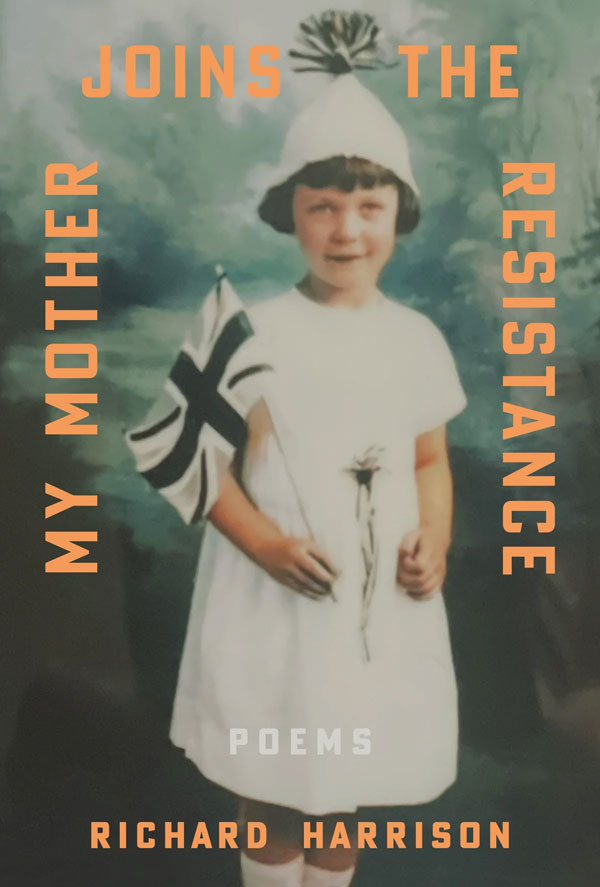
by Richard Harrison
WOLSAK & WYNN PUBLISHERS
2026/$20.00/68 pp.
Richard Harrison achieved Canadian literary fame with his collection of hockey poetry entitled Hero of the Play. The first book ever launched at the Hockey Hall of Fame, the collection has been in print for over 30 years. In 2017 he followed that success by winning the Governor General’s Award for Poetry for his collection On Not Losing My Father’s Ashes in the Flood. Further attesting to Harrison’s success, his poetry has been translated into six languages. In 2025 the Writers’ Guild of Alberta gave him the Golden Pen Award for lifetime achievement.
Harrison, then, publishes his new book carrying the heavy weight of high expectations.
Up to the task, My Mother Joins the Resistance works as both history lesson and social commentary. It teaches readers about the British government moving thousands of kids to rural areas to spare them the horrors of war—and about the horrors some children, including Harrison’s mother, suffered in those alleged sanctuaries. Harrison also explores the ethics of MAID, detailing his mother’s chosen death. For its depth and honesty, this collection is one to be revisited, offering new insights with each rereading.
My Mother Joins the Resistance works as a companion to On Not Losing My Father’s Ashes in the Flood. Where the 2017 collection reflects on Harrison’s father’s death—and the meaning of fatherhood, grief and life itself—in the context of the 2013 Calgary flood, this 2026 collection considers Harrison’s mother’s life in the context of her suffering as a child during the Second World War and her decision to choose MAID in response to her terminal cancer diagnosis.
Harrison excels at exploring the personal in order to reach depth and profundity relevant far beyond his own life or the life of his family. Where Harrison’s father suffers from forgetting (vascular dementia), his mother suffers from remembering (sexual abuse as a child during the war).
The following stanza from the poem “A Photograph of Doreen Elizabeth Howard, Six Years Old, in 1934,” demonstrates the ease with which Harrison moves between his childhood, his mother’s, and the broader global political reality. Reflecting on the cover photo of his mother as a child, Harrison writes:
I cannot count the stories I’ve been told since I found
out when I was ten –
And some of them were lies –
Just to find that face that was yours before
the man used you as if you had no being of your own.
Zooming out from that specific experience to wider truth, the poem reads:
What children understand from birth is love. /
It takes a lifetime to understand sin – if they ever do.
As with much great poetry, the beauty and clear-sightedness of Harrison’s lines balance the pain of reality. There is power, too, in facing historical ugliness and personal sorrow head-on. In a timely fashion, Harrison demonstrates with unflinching gaze how to see evil as it is, sin as it is, and resist.
The final lines of the book show Harrison cleaning out his office and leaving this note for his successor to discover:
Welcome.
I did my best.
Your turn.
The conclusion gently nudges all readers to do just that, their best. In the face of high expectations, My Mother Joins the Resistance proves yet again that Richard Harrison is a treasure. This stirring, profound and far-reaching collection deserves a spot alongside his widely celebrated and deservedly award-winning poems.
Angie Abdou is a professor of creative writing at Athabasca University. Her most recent book is This One Wild Life (ECW).
_______________________________________


