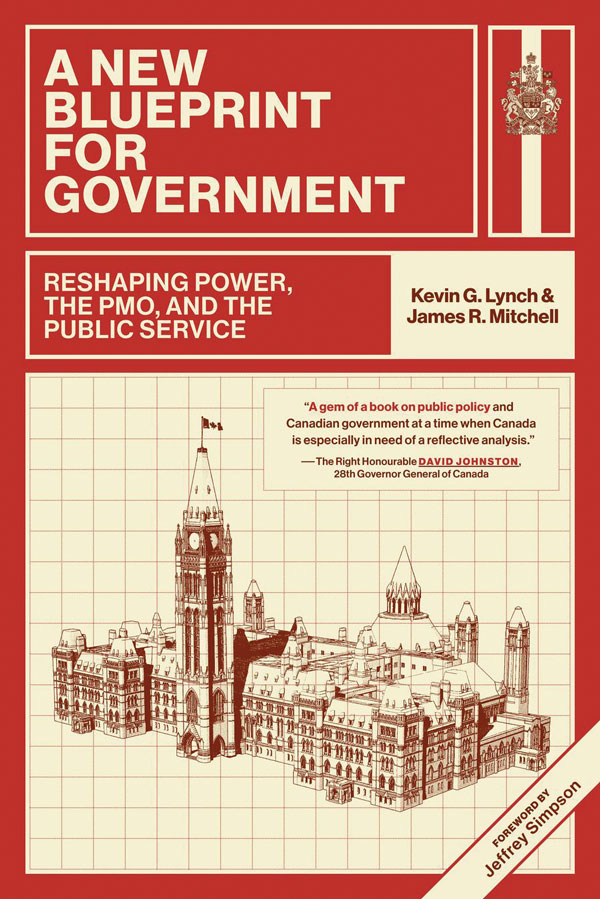
by Kevin G. Lynch
and James R. Mitchell
UNIVERSITY OF REGINA PRESS
2025/$29.95/218 pp.
This is a must-read book for those who take seriously the Canadian constitution’s promise of peace, order and good government. Because, according to the authors, we are not getting good government. Both authors have extensive experience inside government bureaucracy: Lynch was federal deputy minister of finance and industry and Mitchell a diplomat and senior official in Privy Council and Treasury Board.
Why do these insiders say Canada needs a new blueprint for government? Primarily because the prime minister (PM) has too much power, and too much control is concentrated in the prime minister’s office (PMO) of over 100 partisan staff. The public service, which provides non-partisan support and serves not a political party but the people of Canada, has less of a role in government than political staff—those hired by the party in power and therefore inclined to serve that party. Even cabinet ministers have less power than the PMO.
The authors argue Canada is in serious decline. Markers of underperformance are low productivity, weak per capita income growth, high inflation, declining standard of living, falling business investment, low public trust, and polarization. Government is ineffective in delivering core public services yet has amassed huge debt. Leaders lack a national vision. Social problems include lack of affordable housing, an overloaded healthcare system and climate disasters. In 2015 Canada was fifth in the World Competitiveness ranking. Now it is 19th.
They recommend several changes: Restore cabinet as the collective decision-making body of Government. (Here, Government [upper case] refers to the elected Government of the day whereas government [lower case] refers to the organization as a whole.) Modernize the public service and cut layers of hierarchy and red tape. Restore the points-based immigration system. Increase productivity by encouraging business investment, controlling immigration, eliminating the tax system’s small-firm bias, cutting interprovincial trade barriers, measuring public sector productivity, simplifying regulations and streamlining approval processes (Canada ranks 188th out of 208 countries for the time it takes to get a construction permit). They argue every policy should be judged on whether it will increase Canada’s competitiveness, that we should find other trading partners and actually trade with them, that we must meet our NATO defence spending commitments, and that we must have better partnerships between the federal government and the provinces.
At the core of the book is the section describing how our Westminster system of governance should work and why it now does not. The system we inherited from the British “combines an effective political executive supported by a non-partisan public service, with strong, democratic accountability to an elected legislature… and with an independent judiciary.” Today, they say, we have an overly strong executive, a weak legislature, a bloated bureaucracy and courts that interfere inappropriately. Formerly, strong cabinet ministers played prominent public roles. Now the PM has all authority, and his staff are more powerful than ministers. The current cabinet is too big to function as a decision-making body. There are too many departments and too many ministers with grand titles and no authority or accountability. Mandates assigned by the PM to ministers are now public relations exercises with impossible goals that have nothing to do with good governance. Elected MPs have no meaningful role. What goes on in Parliament is mere theatre. Opposition members engage in “incessant partisan attack, ridicule and outright lying.” The public service, formerly “helping ministers serve the common good” and intended to offer evidence-based policy advice to the Government, has been supplanted by partisan staffers.
Central to government reform is putting cabinet back at the centre of collective decision-making, with strong ministers accountable for results, able to appoint their own chiefs of staff and make their own announcements. “Effective management of large and complex systems requires providing the overall strategy and then empowering leaders throughout the organization to deliver.” To right-size government, cuts to programming and personnel are necessary. From 2015 to 2024 the public service grew by over 40 per cent while the population only grew 16 per cent. The authors recommend reducing the number of government employees by 60,000. With 436,000 employees, the government should be able to do its work itself instead of contracting it out to consultants—who cost $17.8-billion in 2023–24. When the government hires people, it should look in-house for the skills it needs, particularly technology skills, and cease outsourcing.
A fundamental responsibility of government is public safety. The authors argue we need a national police force to deal with national and international organized crime, cybercrime, terrorism etc.—and to protect our border. The RCMP should focus on this instead of contract policing in rural areas. Currently 20,000 of 31,000 officers are engaged in contract policing. Officers need to be trained for the nation’s security needs of the 21st century, not the wild west of the 1800s.
Currently, our intelligence gathering has “a Keystone Cops air to it,” while foreign interference in our elections continues. Threats to our sovereignty require us to strengthen our defence, diplomacy and intelligence. But having diplomatic missions in 180 countries is not a sign of strength. The authors recommend concentrating our foreign policy efforts and diplomatic resources where they will make the biggest difference, such as in Japan, South Korea, Germany, Indonesia and Singapore.
The insight into government provided by this book could be alarming, but it needs to be read. Only when large numbers of citizens realize the urgent need for change will public pressure make change possible.
Jackie Flanagan is the founder of Alberta Views.
_______________________________________