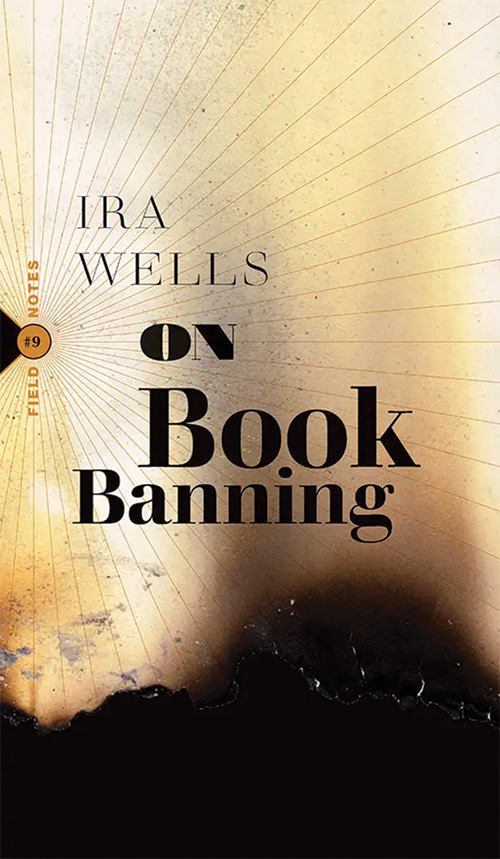
by Ira Wells
BIBLIOASIS
2025/$21.95/184 pp.
The publication of Ira Wells’s new book, On Book Banning, could not have been more timely: as I sat down to write this review, Alberta’s UCP government had issued and then paused a ministerial order removing books containing sexual content from school libraries. Photos of empty bookshelves in classrooms proliferated in the news and on social media.
Wells is an acclaimed magazine writer, professor of literature at the University of Toronto, and president of PEN Canada. In this book he addresses the fraught history of banning books under charges of obscenity, which have historically been weaponized to target queer writers and publishers, as well as in attempts to suppress books now considered to be literary landmarks, James Joyce’s Ulysses among them. But he is equally critical of Ontario’s Peel District school board’s decision in 2023 to throw out thousands of volumes as part of an “equity based weeding process.” Many so-called classics were among the books deemed no longer suitable for children, flagged as Euro-centric texts that reinforced harmful ideologies and failed to reflect students’ own experiences. “Nothing is neutral,” emphasized the guidelines for educators tasked with judging which books should be removed, leaving library shelves empty.
Both of these incidents are blatant acts of censorship, in Wells’s eyes. In both cases, the instigators view art and literature as serving a moral purpose, and little else. “Once we had agreed that art was politics,” he writes, “we could get down to the business of sorting.” But the real value of a work of literature, he argues, is precisely that it can’t be reduced to a single message or aligned with a simple identity or worldview; the best books are “internally conflicted, containing multiple voices and viewpoints, arguments and counter-arguments.”
The true damage of censorship is that it closes down the reader’s own conversation with a book, fails to acknowledge, in fact, that reading is a conversation with a book, rather than an unthinking slurping up of content. The reader is confronted with the thoughts and feelings of another mind. What happens next is up to the reader. They may feel empathy or revulsion. They may inch toward the worldview of the author or a character, or hone their arguments against it. “Those who would purify our libraries do not understand this,” writes Wells. “They presume to know not only what your child should read, but also how they will read it.” His book is an impassioned plea not just for the freedom to read whatever books one likes, but for the protection and cultivation of reading as an act of intellectual autonomy.
This slender volume makes for excellent conversational kindling. More than a definitive treatise or clear prescription for protecting the right to read, it serves as a starting point for serious thinking about the question. The book is an embodiment of its core values, engaging with multiple viewpoints and arguments, containing its own internal conflicts—as when Wells acknowledges the collision between the values of intellectual freedom versus inclusion in dealing with the opposition of some Muslim groups to books that promote “gender ideology.”
Wells makes the point that expressive freedom has been the historical exception rather than the rule, emphasizing both how precious and how fragile it is. He takes us on a tour of two thousand years of institutionalized erasure in the West, and notes the contrast between the soaring language of freedom in the First Amendment of the US Constitution and the energetic practice of state-sponsored censorship throughout the history of that country. He summarizes John Milton’s nuanced defence of free speech, including the value inherent in reading “bad books,” while observing that Milton, a staunch Protestant, would not extend his own principles to Roman Catholic authors. Throughout the book, Wells considers the benefits of expressive freedom while hitting up against its inevitable limits.
It is not lost on Wells that book banning is on the rise at the very moment in history when the cultural value of books is plummeting. Half of Americans surveyed in 2023 hadn’t read a single book that year. University students admit they rely on AI-generated summaries to bypass the time and effort of struggling with longer texts. One study reported that teens in the US spent an average of eight minutes per day reading for pleasure, a time allotment utterly swamped by the 4.5 hours daily they spent on their smartphones. In an attentional ecosystem such as this, why are so many people and governments scrutinizing and removing the books on library shelves?
Wells suggests that culling books largely serves a symbolic function—it is a way for people and political parties to signal their allegiance to an ideology. Which is not to say that concrete attempts to restrict freedom to read should not be vigorously countered. But it does challenge those of us who buy into Wells’s arguments: in fighting book bans, we need to make sure we don’t fall into the trap of resisting in ways that are purely symbolic rather than substantive. Or that simply aim to replace one set of favoured books with another.
Books do lend themselves to autonomous engagement, more than other media, especially when they are read in private, with attention and in the absence of time pressures or ideological agendas. That is when the conversation between reader and book can take place freely. To truly defend the right to read books, in ways that exercise our own agency, will require protecting and nurturing the very habits of reading that permit this freedom, against all the counter-pressures of the current attention economy. And that will be a longer and harder struggle than the overturning of ministerial orders banning books from school libraries.
Julie Sedivy is the founder of How Can You Think That?!, a public book club in Calgary devoted to political discussions
_______________________________________