If you have ever eaten chicken in Alberta over the last three decades, you’ve probably had one of my birds. I started chicken farming back in 1997, when I decided my life needed a new direction. I have never regretted my decision. I may have complained about it occasionally, as farmers are wont to do, but I never wished I had chosen a different career.
Why chicken farming? I was raised on a farm, but I disliked it when I was younger and couldn’t wait to leave. Then, as a university student in the mid- to late-1980s, I worked at a poultry processing plant during the summers. It wasn’t glamorous, but I found it interesting—not so much what I was assigned to do (basically standing at a trough and deciding whether a chicken was “grade A” or “utility”), but rather watching all the huge trucks loaded with thousands of live chickens as they rolled into the plant in the wee hours of the morning. By afternoon those chickens were processed and making their way into restaurants and stores throughout Alberta.
After university I spent several years working at jobs I didn’t like—and probably wasn’t very good at. The morning commute and spending eight hours behind a desk did not appeal to me. So, possessing a limited knowledge of how chickens are grown, and a fairly decent credit score, I became a poultry farmer. Throughout my farming career I’ve striven to be the best producer I possibly could, and the birds I’ve supplied to my processor have been regarded as a superior product, raised with an unwavering commitment to humane treatment and respect for the environment.
Unfortunately, however, my tenure as a farmer is drawing to a close.
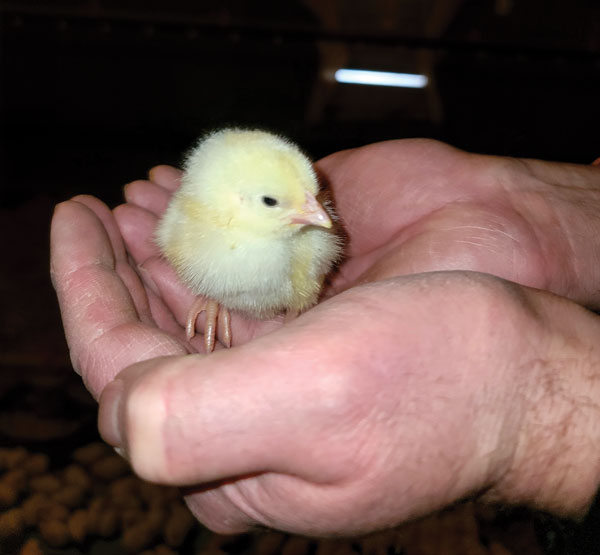
A chick in 2025
When I started farming, I promised myself I would not deviate from my values regarding animal welfare. For 27 years I cared for and respected my birds to the best of my ability. It’s something I’m very proud of. As with any intensive livestock production, the potential for abuse is always present. Due to the sheer concentration of livestock housed together, a minority of farmers may consider individual animals as nothing more than payable weight, and the most efficient method of operating a farm is to concentrate on the total kilograms out the door. I’ve always considered this method of production both harmful and unethical. Fortunately, many of my fellow livestock producers, whether in poultry or other meat animals, do not raise their animals in this manner. But it would be foolish to claim abuses don’t occur.
I promised myself I would not deviate from my values regarding animal welfare.
I received my first cycle of chickens in the fall of 1997, when approximately 30,000 four-hour-old baby chicks were delivered to my farm early one morning. And I had to learn quickly how to care for them. Yes, I was aware they needed to be fed and watered and kept at a temperature of 35°C, but I soon discovered there was much more involved than subsistence and temperature. Lighting programs needed to be followed. There were protocols to minimize disease and bacterial infections. Environmental conditions such as humidity and air quality had to be constantly monitored. Different feed rations needed to be introduced at different times throughout the growing cycle. And most importantly, constant supervision was required to maintain the health and comfort of the birds. For me, this meant being in the barns several times a day, walking through the flock and tending to the birds’ specific needs. Nearly 40 days later, I was introduced to how the birds were shipped to the processor. A specialized crew loaded the grown chickens onto trucks, and they were then transported to the plant. After the birds were gone, I learned how to clean and disinfect the barns to prepare for a new cycle. All told, it was an intensive eight weeks. Then it started all over again.
After nearly 30 years, I’m still learning. Poultry farming has never remained static. Over the years I’ve seen many changes, most of them beneficial. Chick quality has improved due to better selective breeding. Chickens can now gain weight more quickly with fewer inputs than before, causing less stress on the bird itself and leaving more time for the farmer to clean and maintain the facilities. Resistance to diseases and infections has improved and has afforded consumers a choice to purchase chicken products grown without the use of antibiotics.
Growing facilities have also changed throughout the years. My four barns are 6,000 square feet each, for a total of 24,000 square feet. Producers are now building individual barns that are well over 50,000 square feet with high ceilings and massive exhaust fans for improved cooling and environmental conditions, making them much more efficient. Even loading practices have changed when it’s time to send the chickens away for processing. Not too long ago chickens were caught by their legs, taken outside and loaded by the handful into specialized trucks. Today, sections of crates are brought into the barns and the chickens are loaded much more humanely.
Most importantly, at least to me, several federally and provincially mandated rules have been introduced that target bird welfare. When I started farming, growers could put as many chicks in a barn as they wanted. This often led to overcrowded conditions as the birds matured. Now the number of chicks is restricted, allowing the birds a mandated amount of room as they grow. All poultry farmers are now also required to have a yearly audit performed, ensuring facilities provide a safe and humane environment for the chickens to mature. Detailed record-keeping is a component of these audits, the grower having to provide documentation of such items as feeds used and medication administered. Even processors have had to adapt to these ongoing changes, such as providing adequate care while the chickens are shipped to their facilities and minimizing the amount of stress the chickens might experience during processing. Fortunately, many growers have welcomed these changes.
Poultry farming in Canada is based on a supply-managed quota system. Quota needs to be purchased before a farmer can become a commercial producer. Currently, chicken quota must be obtained from another producer. In the past, production quota has also been released by marketing boards if the demand for poultry products has increased.
A quota unit is basically a predetermined measurement of weight, in this instance kilograms. The more quota units owned, the more kilograms a producer can grow. Each province is allocated a number of kilograms per cycle, and in Alberta approximately 250 farmers produce the province’s allowable kilograms based on the number of quota units they own. Farmers who overproduce are subject to both a monetary fine and a reduction of producible kilograms the following year. Discouraging overproduction ensures there isn’t a glut of product in the marketplace, which would lead to a softening of wholesale prices.
This quota system is sometimes maligned, usually because of misinformation presented by Canadian-based but foreign-owned (mostly US) media outlets that claim US production is far more beneficial to Canadian consumers than domestic production. However, it has ensured Canadian producers receive a fair price for their efforts and capital costs while offering a safe, affordable and accessible product without overproduction. And unlike the production of poultry in the United States, which is controlled by five major processors, the market isn’t subsidized with billions of taxpayer dollars. In any Canadian supply-managed industry, the consumer isn’t paying for foodstuffs twice, once through tax dollars and again at the till. American poultry farmers are also not independent producers, instead operating under contract to large conglomerates. The processor owns the chickens, feed mills, hatcheries, transportation lines and veterinary supplies. A chicken farmer in the US is merely a caretaker. Several legal challenges over the years have attempted to give US farmers more input into their farm production to ensure bird welfare and profitability.
In Canada, contrary to some media outlets—such as US hedge-fund-owned Postmedia, which regularly runs opinion pieces critical of supply management—poultry farmers do not dictate the price of chicken at the retail level. Farm gate prices, however, are negotiated among industry partners, and adjusted each period. As of late 2024, the farm gate price paid by the processor to the farmer was $2.16 per kilogram. If a farmer produces a spec weight, usually 2.35 kilograms per chicken, the farmer is paid $5.08. From this the farmer deducts chick and feed costs. After deducting these costs, the average return is currently about 80 cents per kilogram, or approximately $1.88 per 2.35-kilogram chicken. But chick and feed costs don’t represent the true cost of production. The farmer also needs to pay for such inputs as electricity, natural gas, water, insurance, maintenance, labour and catching and loading services, as well as equipment and mortgage costs. Factoring all that in, the only way to remain profitable is to raise chickens on a large scale, hopefully without any bird illnesses or mechanical failures.
In short, poultry farming isn’t much different from other types of farming: large capital expenses combined with long days, and returns often influenced by circumstances not of your own making. When it’s time to leave, you sell your assets, pay your recapture on those assets, and your taxes, and hopefully have enough left to retire.
The only way to remain profitable is to raise chickens on a large scale.
Poultry farming has been good to me. My commute is a short walk of about 150 metres to the closest barn. I love being my own boss, knowing that success or failure often depends on my own actions. I feel proud knowing my commitment to animal welfare is recognized by many within the industry. The part of farming I enjoyed the most, however, was having a loyal dog named Princeton at my side while we did chores together. For 17 years we were inseparable, and over time the farm became his as much as it was mine. Eventually I renamed the place Black Dog Farms Inc. to recognize Princeton’s contribution. He passed away a few years ago, and although I still enjoy farming very much, I feel a profound emptiness while I work around the farm. I do really miss him.
When Princeton passed, I promised him I would carry on. I believe he would be proud of how the farm continues to operate. I also believe he would understand I probably won’t be able to continue too much longer.
As much as I love my profession, it is a tremendous amount of work and responsibility. Except for when Princeton was alive, I’ve farmed alone. My days are at least 12 hours long—usually longer. When the birds are in the barns, I usually walk among them at least six times a day. When I’m not in the barns, I’m hauling chicken feed, maintaining and repairing the barns or performing general upkeep on the property. I never sleep more than four hours at a time, knowing I need to go out to the barns for another welfare check. The worst times are during extreme cold, when I’m very much aware that mechanical failures can have huge consequences. Exhaust fans, boilers, furnaces, water pumps, circulating fans, air intakes and supportive equipment all need to be monitored and maintained. Going up to the barns at 3:00 a.m. in –35°C weather to scrape condensation off exhaust fan flaps isn’t the most enjoyable task. Even when things are running smoothly, it’s often not possible to leave the farm, knowing that any mechanical mishap could lead to the death of tens of thousands of chickens.
I guess with all of this work I’ve worn myself out. I’m told I need new hips and knees, surgeries I’ve delayed because of my commitment to the farm. A couple other health issues need to be resolved immediately. And admittedly, at now nearly 60 years of age, I’m tired. Tasks I performed with such enthusiasm and vigour when I was younger have become more difficult. I used to be able to stay up all night loading chickens onto trucks, grab a coffee and then start washing barns. Working 48 hours straight to clean the barns wasn’t a problem, especially if I wanted to take a few days for myself to camp with Princeton or go on a short motorcycle trip. Now I’m often wondering how much longer the day will last.
I’ll watch the catching crew as they leave, knowing I’ll never see any of them again.
But it’s not just my own body that has led to my upcoming departure. I’m concerned about what I perceive to be attitude shifts that are detrimental to how I grow chickens. Animal welfare is very important to me, and I have never deviated from my chosen growing practices. There are three major poultry processors in Alberta, but I’ve supplied chickens to only one of them for my entire farming career, and I purchase my baby chicks from them as well. For most of that time I’ve worked closely with a gentleman named John, who represents my processor. John has always accommodated my approach to animal welfare. He may not have always agreed with me, but we have usually found a compromise between farmer and processor. If I’ve wanted to ship my birds at a particular time to avoid stresses on them, he has tried to accommodate me. In extreme heat during the summer, we have worked together to find a solution to make sure my birds arrive at the plant safely. John sends particular truck drivers and catching personnel to my farm to alleviate any concerns I have during the ship-out process. I’ve had a number of surgeries over the last couple of years, and John has worked with me to change my placement or ship-out dates to allow me to overcome my health concerns.
Each of us has looked after our respective interests, but we have always been able to find common ground. That’s rare in this day and age, when people are making decisions with little accountability, and experience seems to have been replaced with unpractised knowledge. I now deal with industry people who have never seen the inside of a chicken barn. Or if they have, the next chicken they grow will be their first. Proposed changes at the processing level, such as no longer having control over the catching crews that load my chickens onto the trucks, also concerns me. Many of these changes have made me uncomfortable, knowing that my concerns about animal welfare may be the responsibilities of people who have little experience in animal husbandry.
John retires at the end of next year. I will not continue to grow chickens knowing that my concerns might not be addressed. None of this is to say the industry I have been proud to be a part of for so many years isn’t sympathetic to my concerns. It is, for the most part, but I now accept that my voice isn’t as heard as it once was. I’m a relatively small farm, and some of my concerns may no longer be addressed in an industry that has to rely on scale and big production numbers to be profitable.
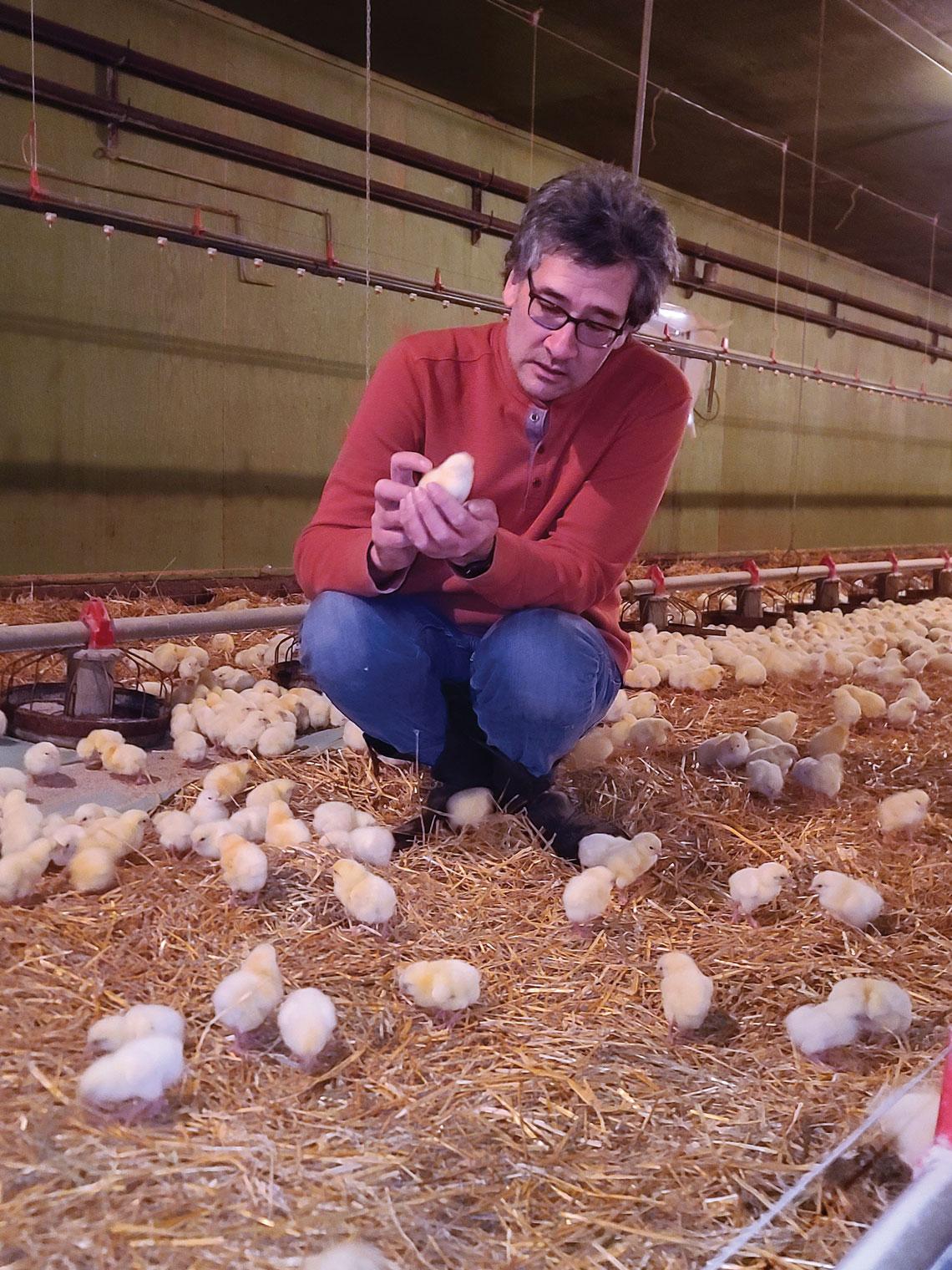
Terry Fong with newly placed chicks in one of the four barns at Black Dog Farms in February 2025.
One evening towards the end of 2025, large trucks will roll into my yard to pick up my mature chickens. A specialized catching crew will be waiting in the shop. We’ll probably start loading birds in the very early morning while it’s still dark. As I’ve always done, and somewhat of a rarity in the chicken industry, I’ll watch nearly every bird being loaded into the crates to ensure no hardships are inflicted on them. The crates will be loaded onto the waiting trucks, which will soon leave in the order they arrived.
After about four hours the last truck will drive away and the catching crew will return to the shop to change into their street clothes and then leave for another farm. I’ll watch the last truck and the crew as they leave, knowing I’ll never see any of them again. I’ll walk into each of my barns and stand in the emptiness left behind. Eighteen exhaust fans will be turned off and fall silent, never to be heard again. I’ll look at the rows of water and feed lines, 550 metres and 275 metres respectively, that will never provide water and feed again. The boilers and blast furnaces will never again need to maintain temperatures of up to 36°C, as they diligently have for nearly three decades. My barns can rest.
In the days that follow, the manure will be moved out and hauled away. As I do at the end of every cycle, I’ll put on my wetsuit and spend a few days washing the interior of each barn until it gleams. The water and feed lines will be immaculate, and the walls and ceilings will be spotless. I’ll then repair anything that may have broken during the growing period and the ship-out. Why do all this work when the barns will now remain silent for the rest of their lives? Because it’s the right thing to do. My barns provided me with the means to safely care for and raise my chickens. They will be left in the same condition they were in when I started farming so many years ago. I owe that to them.
As for me, I guess I’ll move on to another chapter in my life. But whatever happens in the future, I’ll always consider myself a farmer. It has been an honour to raise these birds. What you’ve consumed from my farm was grown in a safe manner where animal welfare was paramount. Remember to always question and explore where your food comes from, whatever type of food that may be. Food production is consumer driven, as it should be, and knowing where our food comes from and how it’s been grown, whether plant- or protein-based, is everyone’s responsibility. Doing this will ensure that whatever ends up on the dinner table is not only high quality but has been properly and humanely grown.
Terry Fong is the owner of Black Dog Farms and the author of Princeton: A Love Story (2020) and Princeton: My Remarkable Journey (2024), both from Corner Tree Press.
____________________________________________
Read more from the archive “Can Organic Food Feed the World?” July/August 2023.