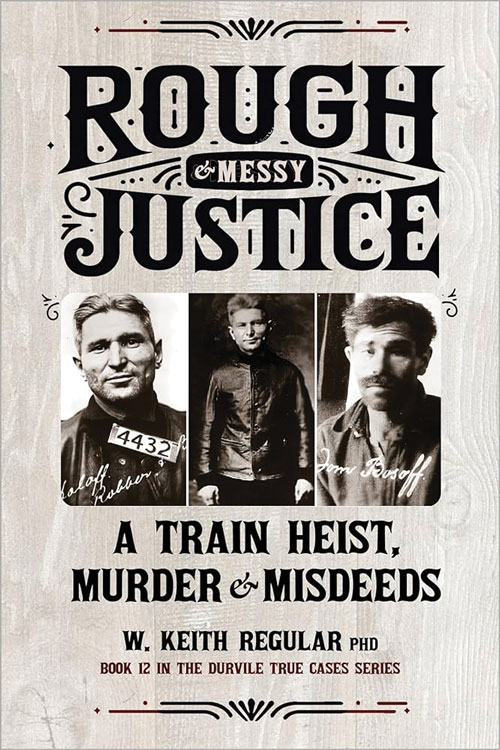
by W. Keith Regular
DURVILE & UPROUTE BOOKS
2025/$35.00/288 pp.
In August 1920 a trio of men robbed a train travelling from Lethbridge to the Crowsnest Pass. A few days later, three police officers cornered two of the bandits, leading to a shootout in which one of the outlaws and two officers were killed. For historian W. Keith Regular, the author of Rough and Messy Justice, the resulting manhunt, trial and execution of the surviving robber was a miscarriage of justice in which the accused, Thomas Bassoff, did not get a fair trial.
Citing an abundance of primary sources, Regular draws a clear and credible account of the events. He reveals the deep-seated mistrust of “foreigners” such as Bassoff and how this prejudice biased the court against him. The narrative is a bit repetitive—Regular restates the details of the heist, the shootout and other events multiple times—but remains nonetheless readable and engaging throughout. And in Chapter 13 he cogently lays out his case that Bassoff was unjustly hanged.
Perhaps the most damning confirmation of this comes from a key witness, who immediately after the shootout claimed that the mortally wounded bandit, George Akroff, shot and killed the two police officers. But at the trial the witness changed his story, insisting it was Bassoff who killed the constables. Bassoff’s lawyer failed to catch this discrepancy, almost certainly due to being assigned the case only one day before the trial, leaving him virtually no time to prepare an adequate defence.
Readers are left with little doubt the legal system grievously failed Bassoff. Regular concludes: “He was, indeed, an unlucky and unfortunate man; unfortunate to be an Eastern European immigrant in Canada at a time when race very much mattered, unfortunate to be poor, and more unfortunate still to be charged with the most heinous of crimes and captive to a judicial process rife with systemic prejudice.”
However, despite the book’s strengths, Regular leaves us wanting. He offers almost no background on Bassoff or his accomplices. What inspired them to emigrate from their country of origin? What was their life as immigrants like in Canada? What motivated them to rob the train? Without this context, Bassoff’s plight is deprived of additional meaning.
Plenty of other questions could have been raised to reflect on larger issues or implications, such as the role of the media in our perceptions of crime. Lacking this, the book is limited in depth. Top-tier true crime—such as Erik Larson’s The Devil in the White City—can weave in broader reflections on society and justice without compromising pace or readability. Still, Regular’s focus on meticulous reconstruction of events and narrative engagement fits squarely within the genre’s sweet spot.
Andrew Torry is a curriculum designer and playwright.
_______________________________________
Read More from Durvile & Uproute Books