
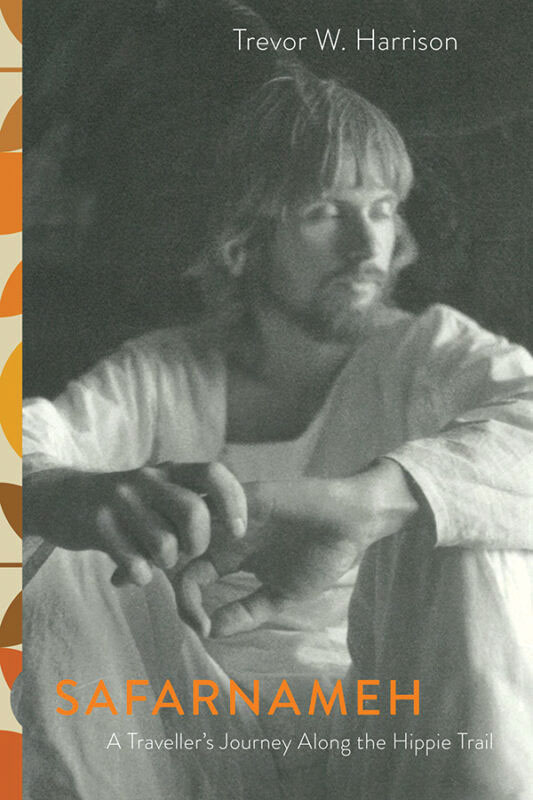
by Trevor W. Harrison
ATHABASCA UNIVERSITY PRESS
2026/$29.99/232 pp.
Some journeys end when we arrive home; others stay with us forever. Trevor W. Harrison’s was one of the latter. In 1976, at the age of 23, he left Alberta to follow the “hippie trail” from Turkey to India. Bumpy bus rides across desert landscapes, nights in tiny, cockroach-infested rooms, and evenings spent beneath the stars, among the pillars of ancient temples, began to reshape the way he understood the world—and himself. When he returned in early 1977, even his Alberta home felt new and unfamiliar.
Over the years, as Harrison raised a family and built a career as a professor of sociology at the University of Lethbridge, memories of the journey recurred. Sometimes they were triggered by a passing smell of diesel fuel. Then the relentless images of 9/11 and its long aftermath often drew his thoughts back to the region. And his dreams—at night, he says, he would wander again through labyrinthine streets or sit in cafés watching old men sip chai. That’s when Harrison decided to more fully examine his travels. The result is Safarnameh, a thoughtful memoir that revisits the people and places he encountered and the memories that remain.
Harrison looks back tenderly yet unflinchingly at the young man whose adventures shaped the political sociologist he would become. More than a coming-of-age story, it’s also an examination of the hippie trail, asking what compelled hundreds of thousands—perhaps over a million—young westerners to head east in the 1960s and 1970s. Was it rebellion, the search for drugs, sex or spiritual enlightenment—often all at once—or simply the desire to explore the world?
Those questions would take decades to answer. The long gestation is evident in the depth and scope of this book’s research. Harrison weaves his own memories with interviews with 48 other travellers, placing his personal journey within the era’s political, economic and cultural aspirations. It’s a portrait that is at once poignant and analytical, personal yet panoramic, capturing the hippie trail phenomenon with an authority few accounts can match.
Yet for all its meticulous research Safarnameh never loses its emotional core. The title, rooted in the Persian tradition of travel writing, means “travelogue,” but it also hints at something deeper: the transformative power of immersive travel. Harrison’s journey did not end when he returned to Alberta. It continued to shape the direction of his scholarship and ultimately the life he built in this province. Travelling with him, we come to understand why the most important journeys are the ones we never truly leave behind.
Agnieszka Matejko is an artist and writer in Edmonton.
_______________________________________


