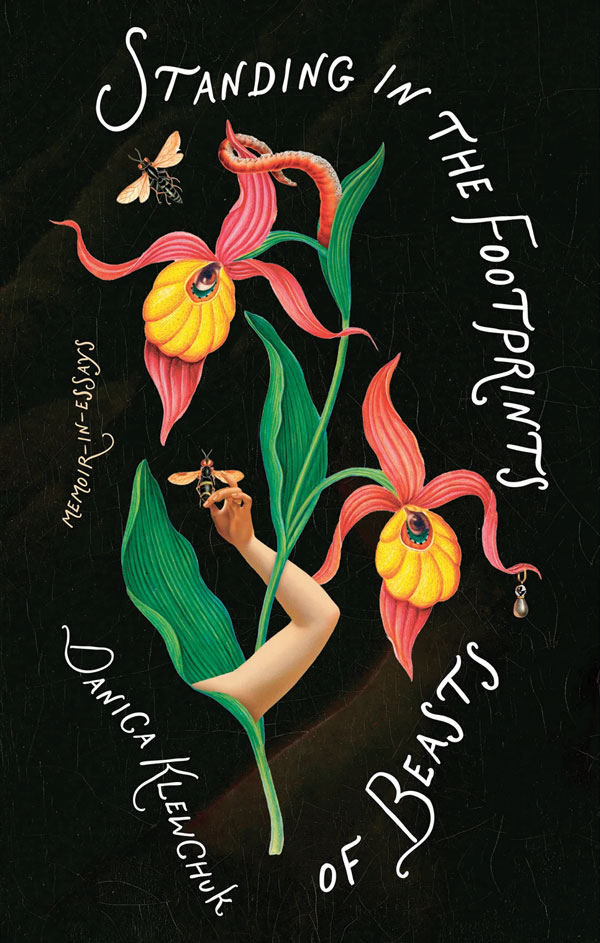
by Danica Klewchuk
NEWEST PRESS
2025/$23.95/264 pp.
A kaleidoscopic quality permeates Danica Klewchuk’s debut memoir, Standing in the Footprints of Beasts. Each of its 15 essays is an artful arrangement of images and fragmented memories, a colourful depiction of the author’s early life. We meet young Danica when she’s not yet 10, living in rural northern Alberta—a landscape punctuated by oilfield towns, graveyards and highways. By the book’s end, we see the mature, self-possessed woman Klewchuk is on the verge of embodying. Overall, this memoir-in-essays could be read as a non-idyllic coming of age story, tracking its protagonist across continents as she grows into herself. The chronology takes us from the enforced innocence of Klewchuk’s childhood in an orthodox religious community, to the enforced worldliness of discovering one can be accosted just as easily when praying in a temple in Laos as when serving drinks in an Edmonton bar.
Several themes emerge through the individual essays: sexual awakening comingles with abuse, trauma recovery with repression, adventure travel with risky behaviour, working-poverty with everyday grace. In instance after instance, we see how the line between what will kill us and what will cure us is rarely a line at all. In the nebulous space between the beautiful and the grotesque, tender moments arise. For example, in “Ghost Shirt,” Danica and her boyfriend encounter a specimen of a testicle grown huge from elephantiasis. After realizing the parasite spreads through the very foods they’ve been sharing with Thai farmers, they dine at a restaurant on the shores of the Chao Phraya River. Klewchuk writes, “We toasted each other with bottles of Tiger beer, intertwining our arms as we fed each other identical de-worming pills, the huge white tablets sticking in our throats.”
Time and space feel malleable in the world of this collection. In general, the ethereal jumble of weeks and years and people and places contributes to the book’s atmosphere, but “That Business With Eve,” which recounts a trip to Ukraine, might have benefited from a time stamp against which the reader could gauge Danica’s mother’s anxiety that the Ukraine/Russia conflict would envelop her daughter. Mostly, the narrative succeeds in creating the feeling of being on-the-cusp, elucidating the push–pull drivers that inspire travel to unexpected places such as Bratislava or a crocodile pond in the Daintree Rainforest—curious explorations but never carefree, imbued with a youthful assumption that the devil you haven’t met yet could be better than the one you’ve left behind.
Fragments from earlier essays reappear in later ones, contributing to the collection’s kaleidoscopic feel. As snippets reverberate in new contexts—sometimes discordantly—the reader is provoked to look deeper. In one passage, Klewchuk confesses to lying in an earlier version because she was too ashamed to admit she’d frozen in fear instead of fighting an assailant. This made me wonder whether one function of post-traumatic memory might be to rehearse courage, revising a story until we’re ready to brave the truth.
The essays combine as if components of a modular sculpture. Pieced together one way, we see how a sheltered early existence prepared a young girl for the wider world. Pieced together another way, it’s a story about bodies discovered, abandoned and discovered again. Another framing shows how we artfully coexist with creepy crawlies (even the human kind) in every moment of every day. Tarantulas perch atop bare breasts, Huntsman spiders claw at car windows, turquoise-bellied spiders dangle over indifferent boyfriends. Life scuttles along.
A line from “Let’s Draw Straws” stood out as summative of Standing in the Footprints of Beasts: “The best perfumes always have a little bit of shit in them.” Arguably, this could be the thesis of Klewchuk’s edgy and wondrous debut.
Jessica Waite is the author of A Widow’s Guide to Dead Bastards: A Memoir (Atria Books, 2024)