Joyce Wright is barely scraping by. The 71-year-old retiree owns a half-duplex in Calgary, and her annual after-tax income is just $17,000. Every penny counts. And these days the cost of electricity and other utilities is hitting her hard. “They keep going up,” she says. “Before November, I never had a utility bill over $300. January 2025 was $307. I’m not going to be able to afford to live in my house.”
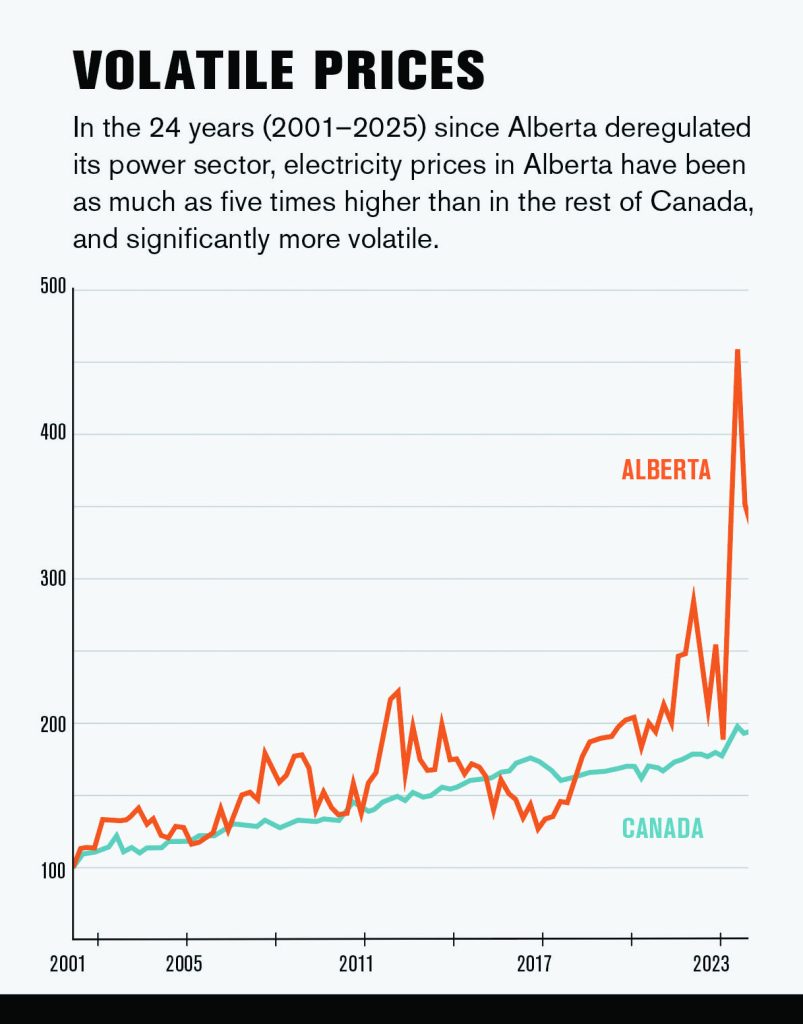
Wright is far from alone in feeling the impact of a high price of electricity. Over the past three years Albertans have suffered a wild ride. Just eight years ago the price reached an historic low of 2.88 cents per kilowatt hour (kWh). Since then, the transient retail price of electricity—the price you pay if you don’t have a contract with an electricity retailer—has skyrocketed. By December 2022 it peaked at 12 times the 2017 rate: 37.46 cents/kWh.
No other province in Canada has seen such dizzying swings. And Albertans can pay high rates even when others don’t. Jim Wachowich, an Edmonton lawyer specializing in public utility regulation and a spokesman for the independent Consumers’ Coalition of Alberta (CCA), notes that while Alberta’s wholesale electricity price surged to 24.3 cents/kWh at its peak in late 2022, for example, its neighbour Saskatchewan’s sat at 12.2 cents. Other provinces were even lower.
A typical Alberta home consumes about 900 kWh of electricity each month. That means the average monthly cost of electricity in this province was as low as $29.92 in 2017 (all prices are before administration and delivery charges). It reached a high of $337.17 in late 2022.
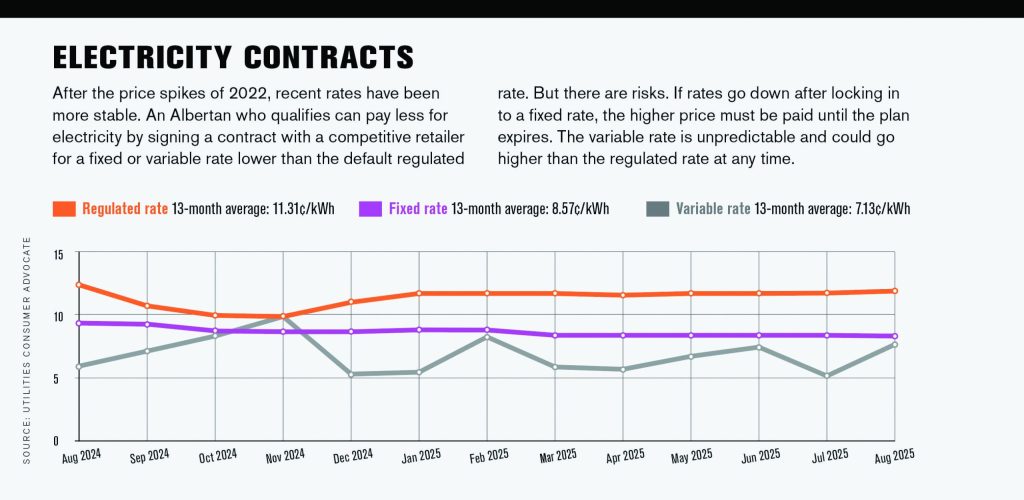
This year the transient rate has averaged 12.01 cents/kWh. The provincial government calls this price the “Rate of Last Resort.” About one-quarter of Albertan power users pay this rate, because they don’t have (and often don’t qualify for) a contract with an electricity retailer. Contract prices have lately been 6–9 cents/kWh, depending on the retailer and length of term.
Alberta’s price turmoil has triggered a debate on the wisdom of the provincial government’s decision 24 years ago to invite private companies to compete in an unregulated market, the only one of its kind in Canada. Critics say the price shocks and supply insecurity that have occurred here since then prove deregulation and privatization were failures. Advocates of deregulation, however, say there’s no going back; that restoring a large public power-generating authority, like Alberta had in the past and like most other provinces continue to have, has too many downsides.
The price of electricity in Alberta has skyrocketed. No other province has seen such dizzying swings.
There’s no question Albertans have been paying more for power than people in other provinces. In a November 2024 study for the Alberta Federation of Labour (AFL), Edgardo Sepulveda, a telecommunications and electricity economist, calculated that since 2001 Albertans have paid about $24-billion more for their electricity than if they had paid the same prices as other Canadians.
We’ve also experienced critical supply gaps. The system has at times been dangerously unreliable. On two days in January 2024, the Alberta Emergency Management Agency issued an alert that our grid was at “high risk” of rotating power outages as a result of extreme cold, high demand and less access to power from other provinces. It urged consumers to immediately limit their electricity use to essential needs only. Supply also fell short. The privately owned H.R. Milner power plant near Grande Cache was producing around one-tenth to one-quarter of its 300-megawatt capacity, and Alberta experienced a near-total lack of wind and solar generation.
Such supply crises were apparently unforeseen when then-premier Ralph Klein set the stage for deregulation way back in 1996. His government created a competitive market for power generation, then fully deregulated pricing in 2001. Klein believed deregulation would attract more power-generating companies to the province. That, in turn, would increase competition, driving down prices for consumers and making Alberta more attractive to business.
“It was an ideological leap of faith,” Sepulveda tells me in an interview. “They (the Klein government) believed the state could do no good. And the grifters latched on to that.”
The grifters, he says, included Enron, the now bankrupt US-based utility that found a way to manipulate and profit from Alberta’s power purchase agreements, a mechanism that was put in place ostensibly to protect electricity consumers.
Klein’s government divided the electricity sector into four parts: generation, transmission, distribution and retail. Generation is now basically completely deregulated, transmission and distribution almost fully regulated and retail is a mix of the two. (That’s why today your utility bill reflects charges for each.) But the massive influx of investment promised by deregulation never came, leaving the market concentrated in the hands of a few large players. “They said there would be lower prices and increased reliability,” says Sepulveda. “That promise did not deliver.”
Deregulation has fallen short of its promise. Could reregulation get us out of this mess? Sepulveda believes so, and he lays out a path in his AFL report.
His plan has two key components: reregulation of the market and a gradual increase in public ownership of generating capacity. A new public power company would compete on price and service with private generators. Reregulation could be done fairly quickly—in a year or two, in Sepulveda’s view, since the Alberta Utilities Commission (AUC, a regulator overseen by but independent of the provincial government) already exists. But increasing the public share of power generation could take years if not decades. That’s because Sepulveda recommends buying power plants and “wires”—the distribution network—only when they come up for sale, not forcing private companies to sell assets to the province.
From time to time generating facilities do come up for sale. For example, Edmonton-based Epcor, Canada’s first public electrical utility when it was formed in 1902, spun off its generating arm, Capital Power, in 2009. It was bought by private investors. A public power utility could have bought it instead, had such an entity existed, Sepulveda says. The same is true for Heartland Generation Ltd., Alberta’s third-largest power-generating company. In December 2024 it was sold to TransAlta Corp., the province’s largest generator, which further reduced competition. The sale left just 9 per cent of Alberta’s generating capacity in public hands—Calgary-based Enmax serves about 700,000 customers, mostly in the province’s south.
A new Alberta power authority could also be the exclusive holder of new capacity, gradually growing its share of power generation over decades. This, says Sepulveda, is exactly what BC Hydro is doing.
Albertans have been paying more for our electricity—since 2001, about $24-billion more than other Canadians.
The price spiral is not entirely the Alberta government’s fault. One of the biggest hits came from Alberta’s phase-out of cheap coal generation, a change mandated in 2012 by the federal government of Stephen Harper. While phasing out coal was an important environmental move, most of the remaining power generators were vulnerable to fluctuations in the price of natural gas. In 2001 coal-fired generators had accounted for as much as 80 per cent of the electricity on the province’s grid, but the last coal-fired plant closed in June 2024. The conversion also cost the provincial government an estimated $2-billion, according to Nathan Neudorf, the UCP government’s affordability and utilities minister.
But natural gas price fluctuations became a handy excuse for private electricity generators to jack up power prices, Sepulveda charges. Although Saskatchewan and Nova Scotia also rely heavily on natural gas for power generation, rates there increased about 20 per cent. Alberta’s private operators, Sepulveda says, have never been made to explain why their price increases are so much higher than those other provinces’. “Commercial operators don’t have to make excuses,” he says.
And private-sector opportunism isn’t the only cause of soaring electricity prices. Government decisions on power generation have limited Alberta’s resistance to price spikes. With vast reserves of coal, oil and natural gas, the province never took advantage of its hydroelectric power potential—a fuel-free source of electricity. Today just 3–5 per cent of Alberta’s electrical power is sourced from hydro, while 85 per cent of its power comes from fossil fuels. Almost all of the electricity generated in Manitoba, Quebec, BC and Newfoundland and Labrador, by comparison, comes from hydro. It’s an opportunity lost, because, according to a 2010 estimate prepared for the AUC, Alberta has an estimated 42,000 gigawatt-hours per year of developable hydroelectric energy potential, enough to power 5.8 million homes. But to develop those sites now would take decades, face regulatory challenges and environmental concerns, and cost billions.
The biggest impediment to price stability and reliability, however, is the way the province has taken away the incentive for private generators to build more capacity. When Alberta opened its doors to private electricity, it created an “energy market.” In simple terms, this means generators are paid only for the electricity they produce and sell into the market. They aren’t paid, Sepulveda points out, for having more capacity than is needed. This differs from many publicly owned generators in other provinces, which operate in a “capacity market.” There, publicly owned generators are given a fair rate of return not only for the power they produce but also for making sure a little extra capacity is on hand should a crisis—e.g., Alberta’s January 2024 cold snap—arise.
The risk with energy markets is obvious, says Sepulveda: “Companies aren’t paid to be reliable.” They aren’t incentivized to create surplus power. The market governs when private firms decide to build more capacity, leaving the risk of supply at times running dangerously low—and of prices shooting through the roof.
Private generators also engage in a practice called “economic withholding,” explains Nagwan Al-Guneid, the NDP opposition’s energy critic. Those companies hold back some of their supply, offering it at a higher price. She says government efforts to limit economic withholding, introduced in 2024, have been only partially successful.
Sepulveda’s ideas face plenty of skeptics who dismiss the notion that publicly owned and regulated electricity generation would make life more affordable.
“I think it would be a crazy idea,” says Nigel Bankes, professor emeritus of law at the University of Calgary, who has worked in electricity regulation. The generation of power, Bankes argues, “is not a natural monopoly.” In other words, the more producers competing with each other, the better.
With a public utility, he says, “you lose all the benefits of the market: there’s no innovation and competition. Over time they settle into a fixed way of doing business,” and that leads to a “fossilized” approach. Look at BC Hydro, Bankes says. “It took them forever to look at small hydro options. Why? All they thought of was building big stuff. It took them forever to take wind seriously. Why? Because it wasn’t in their wheelhouse. They didn’t do wind.”
Although Bankes acknowledges the wide-open generation market has faults, he says these can be resolved through better design. “You don’t throw the baby out with the bathwater,” he says. Price fluctuations aren’t even all bad, he argues, because high prices spur investment in new infrastructure. “You’re naturally going to see some of this spiking anyway,” he says. “Without the spikes, [companies] wouldn’t build.”
With dozens of companies in Alberta’s generation and distribution game, reregulation would be like trying to close the barn door after the livestock has already bolted, says CCA spokesman Wachowich. “OK, it’s possible. We can get those horses back in the barn. But isn’t it better to just optimize the existing system?”
Sepulveda says he’s disappointed the ideas in his report haven’t yet gained more traction. Even Al-Guneid admits she hasn’t read the report: “I scanned it awhile back. I don’t remember every detail.”
Was the province wise to invite private companies to compete in an unregulated market, the only one of its kind in Canada?
The skeptics claim Sepulveda’s recommendations overlook how much more complex the system has become. “You just can’t fathom the complexity of the system today,” Wachowich says. A lot has changed since deregulation, including higher costs driven by stricter safety regulations, input costs beyond government’s control, longer waits for essential equipment, and supply chain issues. “It’s not like the good old days,” he says. “You’d have to become an expert in all these costs.”
Affordability and utilities minister Neudorf wasn’t available for an interview, but he sent a statement saying Alberta’s open and competitive electricity market has attracted “roughly $40-billion in new power generation projects, including $6-billion currently in development, entirely through private investment—not taxpayer dollars.” He noted that Alberta “is the only province free from debt on power generation.” We consumers may be paying much higher power bills, in other words, but our government doesn’t need to finance the construction of new power plants.
Demand for more electricity in Alberta seems relentless. Society is moving toward what Wachowich calls “the electrification of everything.” The Alberta Electric System Operator (AESO, a non-profit responsible for operating our grid and prohibited from owning any generation or transmission itself) estimates demand will grow by 1.2 per cent annually over the next 20 years as Alberta soars past five million people, industry grows, more people use air conditioning (thanks to a warming climate) and more electric vehicles hit the road.
The province also aims to attract $100-billion worth of artificial intelligence data centres over the next five years—facilities that gobble massive amounts of electricity.
Sepulveda says such demand growth will trigger more price increases—shocks that a publicly owned generator could help ease. He says deregulation’s expensive 24-year history proves his point. “This (study) was showing whether or not that promise of innovation, lower prices, better reliability was actually achieved in practice,” he says. “And the answer is no.”
Faith in the private sector runs deep in Alberta. “People will not be persuaded, regardless of the evidence that’s put in front of them… that this an inferior system by any metric,” Sepulveda says. As far as he’s concerned, “To this day, no one has refuted [my report].”
Sure, Alberta’s electricity prices have been volatile, says Blake Shaffer, associate professor of economics at the University of Calgary, where he conducts research on electricity markets. But the fixed rates of 6–9 cents/kWh currently available through the province’s retailers are “pretty reasonable.”
That’s only now, however, and only for a portion of Albertans. Many low-income Albertans can’t get a fixed-rate contract because they don’t have a good enough credit rating, Sepulveda says. And during those all-too-frequent times when all Albertans are paying too much for electricity, “marginalized residents are paying [even] higher prices.”
Al-Guneid says the government could help protect the most vulnerable consumers from price spikes by overcoming the credit-check barrier, perhaps by underwriting the risk of default.
Shaffer agrees with Bankes that periods of high prices have stimulated rapid growth in capacity, notably in renewables, where capacity has doubled in Alberta since deregulation. The province has since throttled that growth, however, through strict new limits on where wind and solar can be located. Conventional supply has also increased by 3,500 megawatts through Suncor’s cogeneration facility in Fort McMurray and Capital Power’s expansion of its Genesee generating station.
Shaffer favours staying with Alberta’s deregulated model, with adjustments to meet the rapidly evolving market landscape. To better assure supply, for example, he suggests signing long-term contracts with built-in supply obligations.
For her part, however, Wright, the retired homeowner, is just looking for a way to stay in her half-duplex. “I can manage it because I don’t have a mortgage to pay,” she says. “But [utility bills] keep going up.… I can remember when electricity was a provincial government entity. The people and the province should own it. We should build it and not give it away to private companies.”
Doug Firby was editorial pages editor at the Calgary Herald (2001–2008) and taught journalism at the post-secondary level.
____________________________________________
Support independent local media. Please click to subscribe.