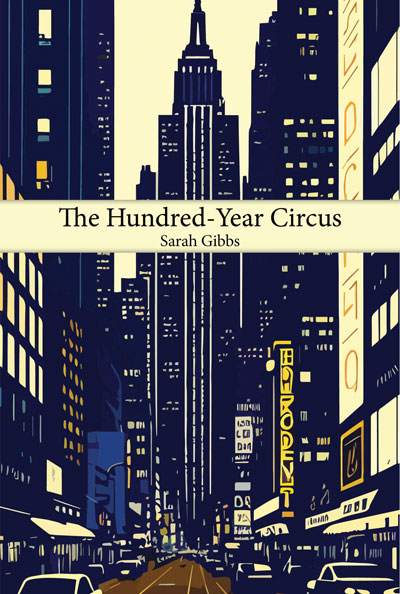
by Sarah Gibbs
FRONTENAC HOUSE
2024/$19.95/112 pp.
In a “Playwright’s Preface” to The Hundred-Year Circus, a wild poetic collage of a book, Sarah Gibbs writes: “Were I a real writer I would forge it: a play of nationhood. But I can only manage a Tall Tale, some Bob Dylan B-side, when time bends like a mountain switchback so you can race through years or spin moments into decades.”
As ringmaster of an “apocalypse cabaret”—subtitled “An American Tragi-Comedy”—Gibbs jams 100-plus years into her tent in four acts. It’s drama noir, theatre of the absurd, and satire, featuring sprung leaps, high-wire strides and many-faced clowns. It’s a play in both senses—theatre and amusement. And Gibbs admits to Dylanophilia.
The cast of 37 includes John F. Kennedy, Suze Rotolo, Gluttony and Miss Atlas (secretary to POTUS). In Greek drama style, there is a chorus. Throughout, the playwright interjects commentary—as if it’s a dramaturgical rehearsal.
We meet The Tramp. “[Lights up. The beams illuminate bodies and bars and THE CHORUS. The Tramp sits hunched on a cot.][…] stares / like time has a view, / a landscape of minutes.”
The Jokerman appears: “Crossroads Demon, Fallen Angel, Faerie King who says eat at my banquet, dance ’til you die […] Don’t look Him in the eye.”
In “The Lord’s Secretary in the Typing Pool,” a woman steps in, providing a feminist slant: “She / survivor / of Adams, Hoover, Coolidge, Jefferson, / and other men with no ability to tie their shoes / or find a pen / when there is killing to be done.”
The story’s romp, a travelling, ever-changing, multi-ring carnival, presents a challenge to the reader’s focus; it’s best just to go with the show. It takes us from New York to Hibbing (where Bob Dylan grew up) to the wild West. Recurring along the journey are Dylan nodes: “Blonde on Blonde,” Newport Folk Festival, “Bob Dylan Breaks his Neck”; and, in “Diamonds and Rust,” an apparently legendary scene is cited: “Bob plays the music / and / Joan does a little clog dance. / ‘Imagine the offspring of those two,’ / Grossman says.”
Other references abound—Roosevelt, Nixon, Troy, Thebes, the Bible, the Koran. It’s a construct, a speculation, yet for the playwright it is real and timeless: “The play—if I don’t finish it, Jokerman will get me. / […] He’ll get me before the fires, the drought, / the secret police.” As the lights dim, we’re dazzled. Like history, like our current phantasmagoric, mediatized days—everything is a show. Gibbs paces the whole tent, with Dylan, “our” soundtrack, in her ear: “He was what T.S. Eliot and Wallace Stevens and Wyatt Earp / would have been if they’d known how to play the guitar. // Orpheus, man. Orpheus.”
Steven Ross Smith is the former Banff poet laureate.
_______________________________________