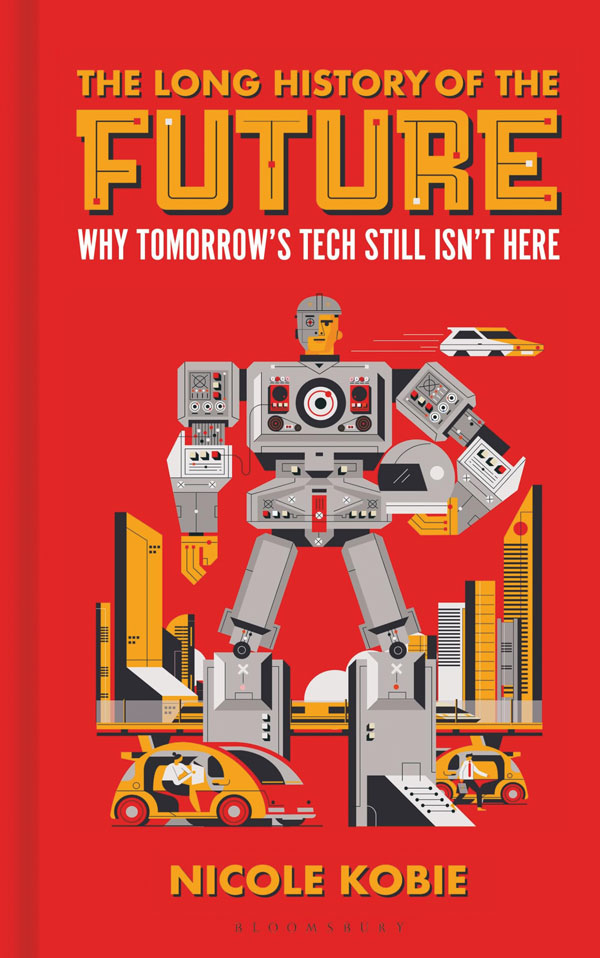
by Nicole Kobie
BLOOMSBURY PUBLISHING
2024/$37.00/368 pp.
Flying cars. Robot butlers. Artificial intelligence. For much of the 20th century, these futuristic technologies weren’t just sci-fi fantasies—they were the inevitable next steps in the march of progress, presented in lifestyle magazines and world fairs as the results of a rising tide that had lifted the world from horse-drawn carriages to lunar landers in less than a century. So why is it that a full 25 years into the new millennium, none of them have materialized?
That’s the question posed by Nicole Kobie’s The Long History of the Future: Why Tomorrow’s Technology Still Isn’t Here, an insightful and often funny look at the false starts and dead ends lying between us and our glorious high-tech future. Born in Calgary and based in the UK, Kobie has made a career of cutting through hype cycles for publications such as PC Pro, Wired and New Scientist, and she puts that clear-eyed perspective to good use exploring the great undelivered technologies of our time.
Each chapter presents a new technology with a new set of challenges and a new cast of characters working to overcome them. As the title implies, these histories of new tech go back further than you might think. With working mockups of self-driving cars in the 1930s, sales of fully licensed flying cars dating back to the 1950s, and augmented-reality headsets in the 1960s, the future is surprisingly well represented in the past.
But clearly those successes weren’t enough to launch those innovations into our day-to-day lives. As Kobie recounts, the reasons are understandably varied. Some technologies were successful in controlled conditions but too complex for wider deployment. Others never found a way to bridge the gap from neat idea to useful product. And still others were never particularly good ideas in the first place. Watching Kobie unleash her well-honed sense of skepticism on needlessly complex hyperloops and surveillance-heavy smart cities is especially gratifying. “We don’t need smart cities,” she says pointedly of the latter. “We need good ones. We need livable ones. We need sustainable ones. And we need them quickly.”
Critical as it can be of hypesters and hucksters, The Long History of the Future is rarely cynical, and Kobie has a clear fondness for most of the visionaries (and occasional kooks) whose ambitions and missteps helped build the modern world. And considering it is, in a sense, a history of failure, the book leaves you with a surprisingly optimistic view of technological progress. Whether we channel our efforts into moonshots that may never materialize or focus on less glamorous, incremental improvements that make life better for everyone, the direction the future takes is up to us.
Peter Hemminger is a writer and editor in Calgary.
_______________________________________