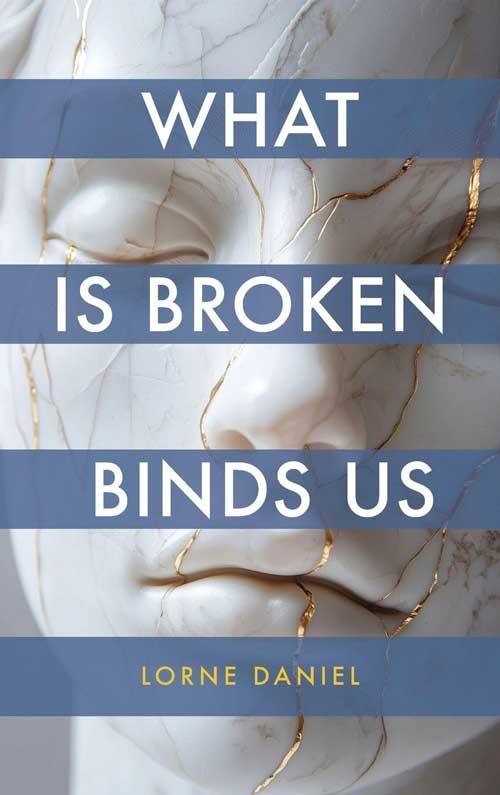
by Lorne Daniel
UNIVERSITY OF CALGARY PRESS
2025/$18.99/96 pp.
“I who once thought myself a true/ Alberta boy,” Lorne Daniel writes in the breath-filled piece “What Has Taken Place,” from his multi-faceted collection What Is Broken Binds Us. Daniel, a former Albertan living in BC, returns to family, to the land, to ancestors and to sites of injury—including estrangement from his struggling son—to craft poems that hurt with necessary truths while working towards mending.
Right from one of the early pieces, “Crushed,” the reader knows Daniel has an ear for language, with lines such as “waiting for a break,/ me and this sleek crow, its cape/ tucked and trim.” This knowledge builds trust to follow his passage from the personal injury and recuperation of a bicycle accident in Part One, to Part Two’s sharp awareness of colonial privilege and its damages: “Charlie asked no questions,/ I am sure, about how land came to be ‘free’ ” (“Tack, Harness, Lash”). Throughout the third section, Daniel returns to his ancestral plantation in Magnolia, Texas, articulating in descriptive stanzas the disjunct between historical wounds, both personal and communal, and his current comprehension, marking how the reverberations of past traumas in North America—such as slavery and conquest—continue, with the “tempo and tone/ playing out now” (“Fugue and Spiritual”).
Potent as these pieces are, the 13-part long poem “Episodic Tremor and Slip,” about Daniel’s grown and troubled son, has the deepest impact. This central elegy charts the regularly approaching tremors of the “earthquake” offspring, and how useless one can feel as a parent in the face of such pain. One is always crisis-managing but never resolving. As Daniel lists, “So little to show/ for the emergency cash, the good talk, that last/ fresh start.” And he points to how society often attends to a problem’s externals, rarely looking within: “Sure, we can talk about the drinking./ So much harder to talk about the thirst.” The crushing thirteenth section recounts how, after two years of absence, he sees his son, and despite all, finds himself “thinking/ something about hope.”
The poems following this stunning piece feel less realized at times, or perhaps some lyrics needed cutting and others combining into fewer segments that meld familial death and a bond with nature. But one line rings clear: “People don’t send cards/ mourning the anniversary/ of an estrangement” (“You Don’t Get Here Without”), as Daniel elaborates on the gaps in our capacities to honour, bear witness or truly heal. And yet poets will always make the attempt to cross that crevasse, as he writes in “To Carry an Absence”: “learn to lean/ a little… to feel a certain balance shift.”
Catherine Owen is the author of Moving to Delilah (2024).
_______________________________________