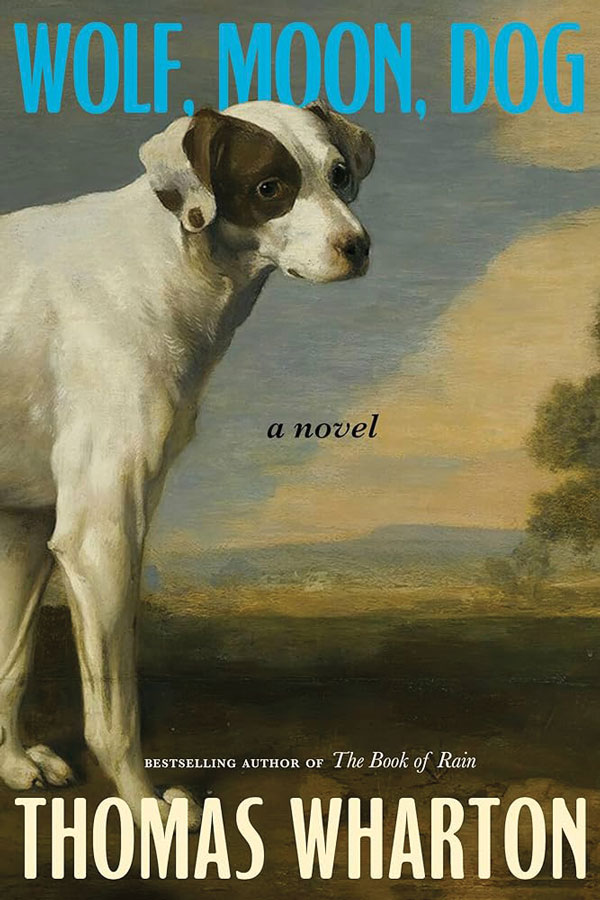
by Thomas Wharton
Random House Canada
2025/$35.00/272 pp.
Almost everyone loves a good dog. Most people love a good novel. Thomas Wharton’s new novel, Wolf, Moon, Dog is typeset in ITC New Baskerville, which, as we read in “A Note About the Type,” is “a cheeky nod to The Hound of the Baskervilles.” This book, inspired by fables, is itself a “cheeky nod” to the notion of a novel. It’s a compendium of tales that span the imaginary life (or lives) of a single character, a protagonist named Wolf, the first and archetypal ur-dog, who crosses the species threshold from wolf pack into human society, and then travels through time and space in an epic series of picaresque adventures. Wolf is three-headed Cerberus, and an overbred consort in a medieval court. He inspires a famed Zen koan, illuminating the nature of being; and is Laika, a Moscow street dog and first living creature to orbit the earth. Wolf is abandoned at an airport in Colombia and remains faithful, and heartbroken, until his solitary end. He is a protagonist in tales of ancient Egypt and in narratives akin to Homer, Austen and Joyce. He is companion to a famous Proustian novelist, and “something of an expert on narrative himself,” who “lives other, more memorable lives” not in evanescent memory but through his nose: “Each lamppost, tree and fire hydrant held the phrases, paragraphs and entire chapters of an ongoing saga that was his alone to read.” Through it all, of course, “There was nothing finer, he was certain, than a bone.”
In short, Wolf gets around. He’s seen and done many things. It’s a charming, flexible, capacious narrative gambit, like something from the Italian maestro Italo Calvino: an Oulipo-inspired structure or “machine” for creating stories, with the dog as Forrest-Gumpian figure who doesn’t need to run between scenes in order to pop up amidst familiar narrative styles and strategies, taking a star turn in sterling moments of historical dog-dom. Wolf is “Good Dog,” “Underdog” and “Moondog”—as chapter titles attest. He is a guard dog, rescue dog, hunting dog and a creature trained to go against instinct in chasing down humans held in bondage. He’s an unhoused dog, a dog dosed by hippies, a film star and a time-travelling avatar of speculative fiction, where in a distant future dogs work together and find “ways to help the planet heal itself.”
Wolf, Moon, Dog is a playful literary provocation, a bravura flight of research and performance that reaches for profound moments of imaginative insight. Wharton is one of Alberta’s finest writers. His 1994 novel Icefields was recently republished in a Landmark Edition by NeWest Press, and his 2023 novel The Book of Rain was an ambitious, multi-layered narrative exploring the complexities of resource extraction and climate change. Readers need to encourage writers to take risks in innovating within familiar forms, as Wharton does with Wolf, Moon, Dog. We need to reimagine our relations with non-human nature, creating a new ecological knowledge in which rivers, plants and animals are members of our communities, as Wharton does here. This is one reason we love dogs, after all. And gardens. And books that help us cross the threshold between nature and culture, which is an imaginary divide, after all.
Wharton’s writing is concise and clear, deeply imaginative and easily accessible. For these and other reasons, I wanted to like this book more. The wide-ranging fragments pulled the book apart with a powerful centrifugal force, however, such that the narrative centre could not quite hold. Standing alone, many of these stories shine. But for this reader at least, this cheeky series of fables just about refused to cohere.
Ian MacRae is an associate professor of English at Wilfrid Laurier University.
_______________________________________