The mood was celebratory. The smoked salmon appetizers were scrumptious, washed down with wine. Oohs and aahs filled the gallery as the buzz intensified while a lineup waited outside the Whyte Museum in the winter air. The launch event of MELTDOWN: A Drop in Time, an exhibition of large-scale photographs of glacial landscapes, was a resounding success.
The images were downright jaw-dropping. Giant prints—some wider than many living room walls—featured sculpted, polished and glimmering blue glacier ice, some resembling splendid precious gems. Others showed no ice at all. Dry rock, bare, sharp ridgelines, rubbly moraine slopes, naked cliff bands. Dark, dirty, dry and withered ice. Dying ice. On one hand, the ultimate eye candy for a glacier lover; on the other, a bitter aftertaste of reality.
MELTDOWN was conceived by Jim Elzinga. A groundbreaking Rockies-based alpinist since the 1970s, Elzinga led the 1986 team that supported Canmore’s Sharon Wood to become the first North American woman to summit Mount Everest, climbing a never-repeated route. Elzinga followed up with a 25-year international career as an organizational development consultant.
Now, with his hardest climbs behind him, the glacier-draped peaks and ice cliffs he ascended are diminishing too.
The loss of these inspired him to found Guardians of the Ice, a non-profit focused on the steadily shrinking Columbia Icefield as indicator of the worldwide climate crisis. Spanning approximately 200 km2 atop the Continental Divide where Jasper and Banff parks meet, that icefield is a significant bellwether of Earth’s warming climate.
“One of the many reasons I want still photography to be part of the Guardians project is the ability to make large high-quality prints that immerse the viewer, like an IMAX film,” Elzinga said. “I feel this is the best way to create an emotional connection with the viewer and provide an experience as if they’re actually in the mountains. Our purpose is to effectively engage the public to build support for a low-carbon future.”
Using a high-resolution Phase One medium format camera, Elzinga partnered with friend and cinematographer Roger Vernon. To create each image required three people—one to hold the camera, another to recalibrate the settings on a laptop, and a third to pilot the helicopter.
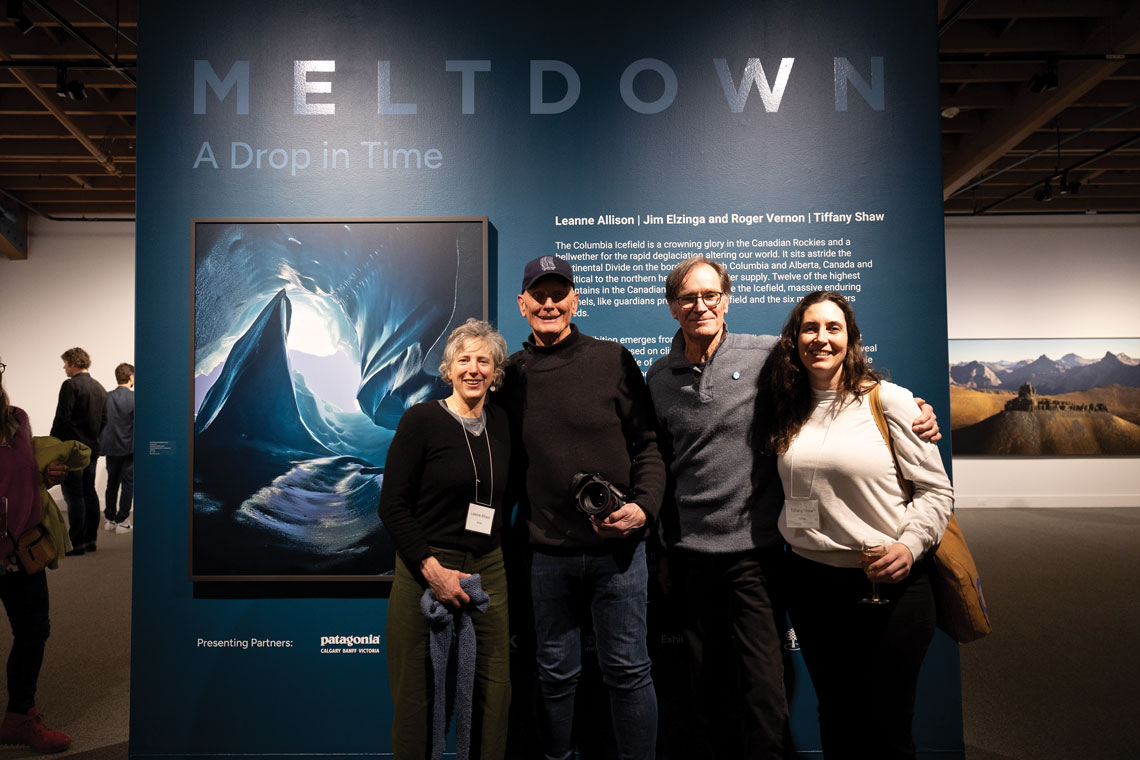
Leanne Allison, Jim Elzinga, Roger Vernon and Tiffany Shaw. Whyte Museum
That January 2025 night at the Whyte, however, was more than a photo exhibit. It was also the official launch for the Canadian branch of the 2025 United Nations International Year of Glaciers’ Preservation. The IYGP was proposed in 2022 by Tajikistan, whose 13,000 glaciers supply the mountain headwaters for Central Asia and some two billion people downstream.
The IYGP Canada co-chair is long-time Canmore resident Bob Sandford, senior government relations liaison on Global Climate Emergency Response at the UN University Institute for Water, Environment and Health. Most of the world’s glaciated countries are participating, and with Switzerland’s glaciers having lost 10 per cent of their volume in two years alone—2022 and 2023—that country and France have announced major commitments. “But even countries without glaciers, like Holland, are participating in the full realization of how much glacial ice contributes to the thermoregulation of the entire global climate system,” Sandford said.
The purpose is to raise awareness of the vital role glaciers, snow and ice play in the climate system.
Western Canada’s mountains (combined with the US northwest) comprise one of 19 regions around the world represented in the IYGP, alongside New Zealand, Greenland, Antarctica and the southern Andes. The Year’s purpose is to raise awareness of the vital role glaciers, snow and ice play in the climate system and water cycle, as well as the far-reaching impacts of rapid glacier melt.
A full quarter of Earth’s remaining ice is found in Canada, with some 18,000 glaciers in the mountain west. Alberta’s Rockies hold more than 1,100, including the best-known and most accessible glaciers in the country. This makes Alberta the natural centre for the Canadian IYGP initiative. “The latest scientific research regarding the state and fate of our glaciers originates here,” Sandford said. “As Parks Canada rolls out its 2025 UN Glacier Year program, Canadians all across the country will learn what the Dutch already know: that even if there isn’t one nearby, glaciers contribute enormously to the stability of the global climate.”
Canada’s IYGP objectives include promoting Canadian snow and ice research to improve scientific understanding of climate change impacts and recognizing snow and glacier ice as more than just water resources, with an emphasis on artistic and Indigenous perspectives.
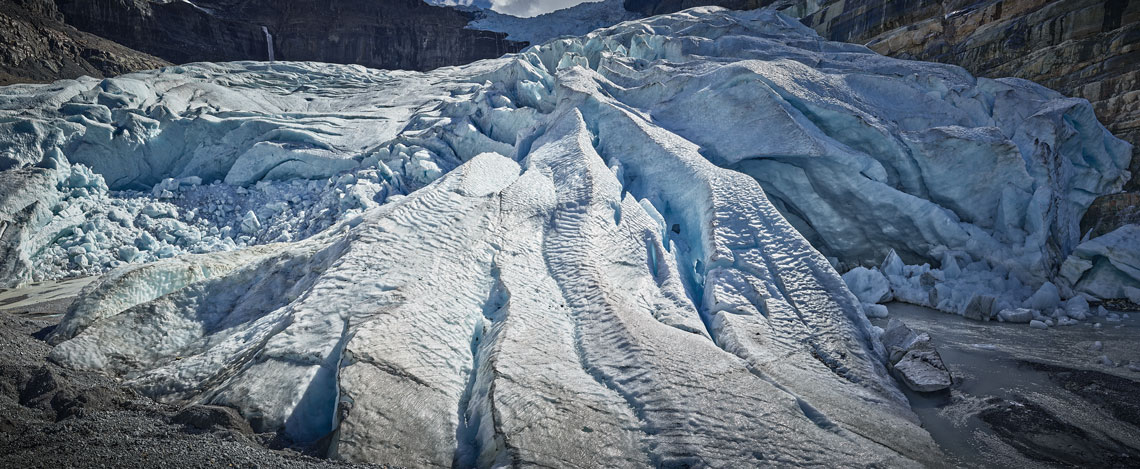
“Terminus.” Jim Elzinga and Roger Vernon
MELTDOWN’s image titles speak volumes: “Terminus,” “The Black Hole,” “Battered Hero.” The latter depicts Mount Athabasca, a peak that’s been trod by countless crampons since J. Norman Collie and Herman Woolley were most likely the first to stand on its summit in 1898. Reaching the mountain back then took 19 arduous days on horseback from Lake Louise; nowadays it’s a two-hour drive. From that summit, they viewed the massive Columbia Icefield, noting that its meltwater flows to three oceans—the Arctic via the Sunwapta, Athabasca and Mackenzie rivers; the Atlantic via the North Saskatchewan, Saskatchewan and Nelson rivers; and the Pacific via the Columbia River.
More ice melted from the glacier in 2023 than in any of the 10 previous years.
Compared to historical photos in the Whyte’s bookshop showing Athabasca’s slopes blanketed in plush white snow and ice during Collie’s time, the MELTDOWN image shows dingy ice clinging to rocky slopes like a threadbare sheet.
Climbers and tourists remain drawn to these peaks. The Columbia Icefield Centre (CIC), located where the Athabasca Glacier terminated a century ago, now hosts nearly a million visitors annually, with more than 400,000 riding specialized snowcoaches onto the glacier. Hundreds more join walking tours, whose guides safely lead them to peer into crevasses and experience coursing meltwater streams close enough to get splashed. MELTDOWN images are now on display at the CIC’s Glacier Gallery having left the Whyte.
Jasper is one of seven national parks—along with BC’s Glacier National Park—where hundreds of glaciers are carefully monitored by Parks Canada. Geological Survey of Canada and Parks Canada researchers recorded more ice melt from the Athabasca Glacier in 2023 than in any of the 10 previous years. In Glacier, as of 2018, 129 glaciers remained, down from 337 in 1978. The next survey is planned for 2026. Scientists estimate that if all the glaciers in Glacier National Park melt, the area’s creeks and streams would carry one-third less water. Many could disappear completely.
“By partnering in the IYGP, Parks Canada can encourage hundreds of thousands of Canadians to reflect on the importance of glaciers and the role of protected areas,” said Louis-René Sénéchal, a Parks Canada manager. “We want to inspire them to do something about climate change and share with them the knowledge to make a difference.”
If all the glaciers in Glacier National Park melt, local creeks and streams could carry one-third less water.
The 2023 NFB film Losing Blue was playing continuously behind a privacy screen at the Whyte. Visually exquisite, poetic and soul-stirring, the 16-minute film by Canmore’s Leanne Allison (whose previous award-winning films include Being Caribou and Finding Farley) posed the question “What does it mean to lose a colour?” The narrator references how the world’s glacier-fed lakes are losing their beguiling turquoise hues as glacial content declines. Drone imagery brings viewers seemingly close enough to touch the glaciers, soaring mere centimetres above an ice cave—which I recognized as Peyto Glacier’s toe, which has since melted and flowed onward to Hudson Bay.
“The ancient bond between glaciers and lakes is ending—the bond that gives the lakes their otherworldly blue,” states the narrator.
A smaller gallery presented an exhibition of images by Canmore’s Glen Crawford titled Etched in Ice. The photos shared perspectives captured by drone at his backcountry lodge in the Rockies north of Golden, BC. Intimate and abstract, their subtlety balanced the raw power of the MELTDOWN images. Dull-grey ice, bisected by a long, skinny strand of whitish snow dribbling into a dingy-green meltwater pool. Pebbles and dirt filling the creases of dark, scrawny ice. Ice resembling hammered metal, scratched and beaten.
“I’ve been very fortunate to live in the Bow Valley and explore the nearby mountain wilderness for 50 years. Glaciers are an integral part of this landscape,” Crawford told me. “They’re also key in helping understand how climate change has an effect worldwide. With potentially 15,000 years of climate record stored in glaciers, they’re a natural archive that is now endangered. I hope the UN IYGP promotes awareness, discussion and motivation that help enact change.”
That hope is shared by other IYGP partners, including Tim Patterson, an IYGP Canada ambassador. A member of the Lower Nicola Indian Band of the Interior Salish-speaking peoples of BC, Patterson is a hiking guide who owns and operates Zuc’min Guiding—the name means “red ochre,” with which Indigenous people painted their faces before entering the mountains.
By sharing Indigenous perspectives with his clients—including during walks on the Athabasca Glacier—Patterson aims to foster Indigenous perspectives and knowledge of Canada’s glaciers, water, ice and snow among international travellers and Canadians alike.
While many of the IYGP Canada team members are Albertans, Québécoise ambassador Caroline Côté shares perspectives as a polar expedition guide. Long before her first Arctic expedition, she was awed by remnants of an ancient glacier, the Laurentide Ice Sheet, which covered much of Canada 20,000 years ago.
“Glaciers are at the centre of my life,” she said. “But I also believe that they are, and must be recognized as, the centre of every Canadian’s life. If you head east of Baie-Comeau, you can still see traces of the last glaciation. What struck me the most was the sheer power of ice, its ability to move mountains and carve valleys, leaving its mark on the rock. Our world, as we know it, was shaped by glaciers thousands of years ago.”

“Battered Hero” Jim Elzinga and Roger Vernon
Early in her career, Côté dreamed of exploring Antarctica, a dream she felt fortunate to fulfill. But she later realized Canada was home to more than 20,000 glaciers, and she needn’t travel so far. “To protect glaciers, my goal in the coming years is to reduce my travel and make more conscious choices.”
During the formal launch of the main UN IYGP in Geneva, Switzerland, on January 21, Canmore resident John Pomeroy, director of the University of Saskatchewan’s Centre for Hydrology and its Canmore-based Coldwater Laboratory, spoke in his role as IYGP advisory board co-chair. He laid it bare. “Global concentrations of carbon dioxide have risen from 315 to 425 parts per million, and as a result winter temperatures in northern Canada have risen over 6ºC during my lifetime. Counterfactual industries and regimes around the world would deny these measurements, but they can’t deny their culpability in the destruction of glaciers that’s occurring before our eyes. Glaciers don’t care if we believe in science; they just melt in the heat for all to see. The International Year of Glaciers’ Preservation provides a mechanism to kick-start renewed efforts to reduce greenhouse gas emissions and increase the science and adaptation necessary to prepare for a warmer, less icy world. There is still time to turn this around.”
This statement brought me to a MELTDOWN image titled “After the Heat Dome.” Dark, severe, rough broken rock dominate the frame, with a thin layer of glacier ice resting on the highest ridgetop, its days obviously numbered.
A 2015 study established that western Canada could lose 60 to 80 per cent of its glacier ice by 2100, and the bulk of the melting would happen between 2020 and 2040. Since then I’ve had one question. What would the melting look like?
For decades, I’ve skied across glaciers and icefields in winter and hiked among them with my camera in summer. The 2021 heat dome that engulfed Alberta and BC was a regional gamechanger, breaking temperature records and being cited as a leading cause of some 600 deaths. It accelerated the deaths of our glaciers too.
On June 30, 2021, Jasper reached 40.8ºC, its hottest temperature ever recorded. The resulting flooding caused by rapidly melting snow and ice resulted in catastrophic damage to trails and bridges in the area; the Berg Lake trail in Mount Robson Provincial Park is still under repair. Heat-absorbing soot from wildfires—including the 2024 Jasper fire—coats glacier surfaces and accelerates melting. Globally, 2024 was the hottest year ever recorded—after 2023, which had set the previous record—all directly caused by humans burning fossil fuels.
In a handful of years, glacier loss has become visible to the naked eye.
Western Canada’s glaciers had been gracing paintings since before the Canadian Pacific Railway was completed in 1885. In decades since, photographers, filmmakers and writers have shown us this icy landscape. Adventurers have skied across glaciers for days, weeks, sleeping in tents or snow caves. Guides earn their living on glaciers. We create memories on them.
As they melt, we can honour glaciers by sharing these stories and artworks.
“In this coming year, we will celebrate Canadian researchers and institutions studying snow and ice, and honour writers, poets, artists and photographers working to help us understand what the loss of glacier ice means,” Sandford said. “The UN Glacier Year allows us to halt backsliding in terms of climate action by learning more about what we face, and provides an opportunity to shine on the world stage as an example of everything we stand for.
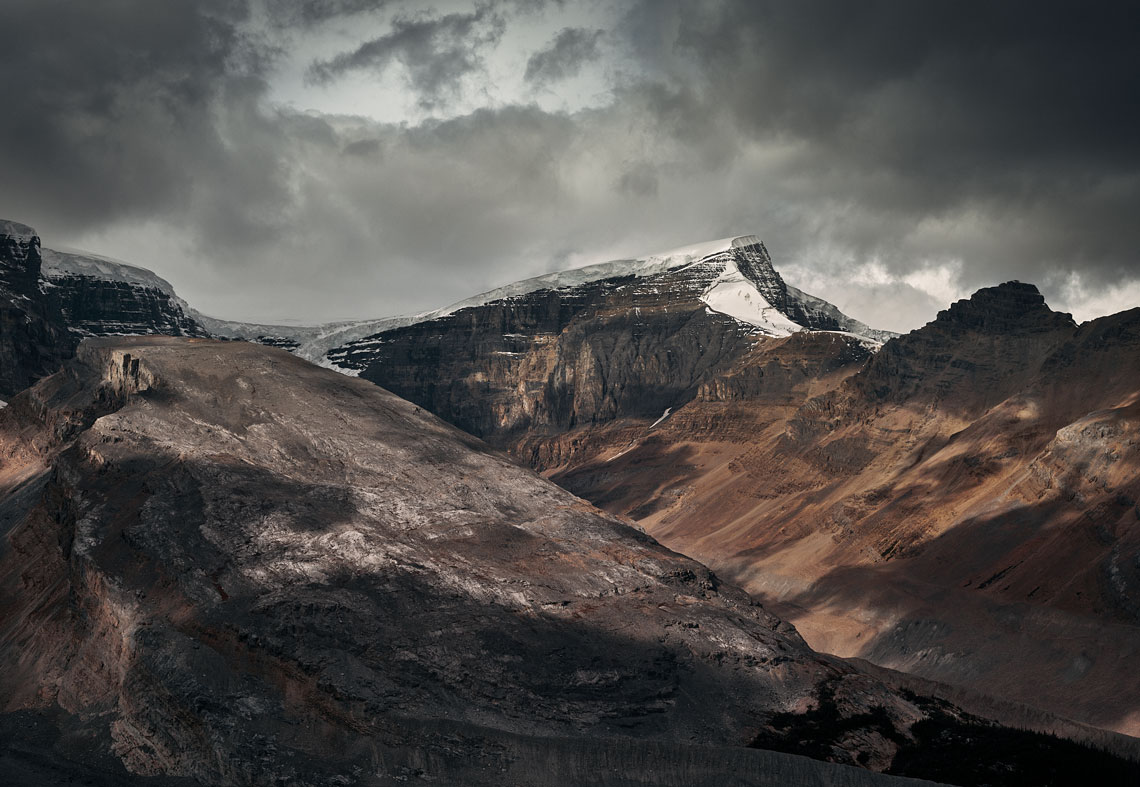
“After the Heat Dome” Jim Elzinga and Roger Vernon
“We want to be able to tell the world that we as Canadians listened for an entire year to what the disappearing ice was trying to tell us.”
At the Whyte Museum that night, I listened as Alberta-based Métis artist Tiffany Shaw explained how she created her glass sculptures from casts taken from the Athabasca Glacier. “I think these will last longer than the glacier,” she said, “which is really sad.”
Lynn Martel is writer in residence for IYGP Canada, an accredited hiking guide, and the author of three books about local mountain culture, including Stories of Ice (RMB, 2020).
____________________________________________
Read more from the archive “Goodbye to Peyto Glacier” September 2022.